
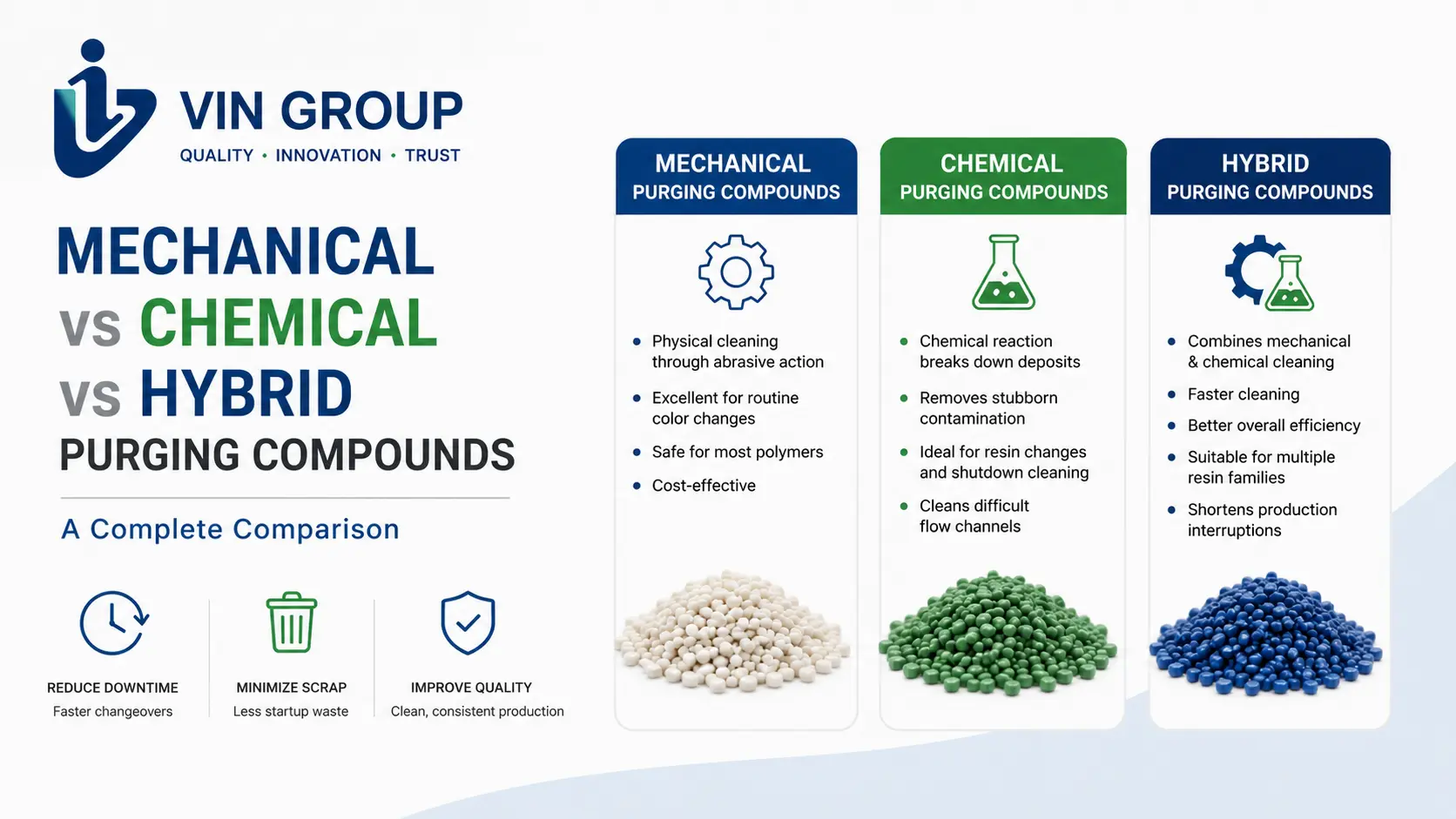
Mechanical vs Chemical vs Hybrid Purging Compounds: A Complete Comparison
Introduction
In plastic manufacturing, every production changeover affects productivity, material consumption, and operating costs. Whether switching colors, changing resins, or preparing equipment for shutdown, residue left inside screws, barrels, nozzles, and hot runners can result in contamination, startup scrap, black specks, and inconsistent product quality. This is where Purging Compounds play a vital role.
Modern manufacturers can choose from mechanical purging compounds, chemical purging compounds, and hybrid purging compounds, each designed to solve different cleaning challenges. Selecting the right solution can significantly reduce machine downtime, improve cleaning efficiency, and lower production costs.
This guide compares all three technologies, explains where each performs best, and helps processors choose the most suitable option for injection molding, extrusion, and color changeover applications.
Why Purging Compounds Matter in Plastic Processing
Purging compounds are specially formulated materials designed to clean polymer residue from processing equipment without dismantling the machine.
They help manufacturers:
- Reduce machine downtime
- Minimize startup scrap
- Improve color changeover efficiency
- Remove degraded polymers
- Eliminate contamination
- Improve production consistency
Today, they are widely used in injection molding purging, extrusion purging compounds, blow molding, and compounding operations.
Mechanical vs Chemical vs Hybrid Purging Compounds: A Complete Comparison
Choosing between different Purging Compounds depends on several production factors, including resin type, contamination level, processing temperature, and machine configuration.
Mechanical Purging Compounds
Mechanical purging compounds clean equipment using abrasive or high-viscosity action rather than chemical reactions.
They physically scrub the screw, barrel, and flow channels to remove contamination.
Advantages
- Excellent for routine color changes
- Safe for most polymer systems
- Easy to operate
- Suitable for frequent cleaning
- Lower operating cost
Limitations
- Less effective on heavily carbonized deposits
- May require longer purging cycles for stubborn contamination
Mechanical grades are commonly used as reliable color changeover solutions in both extrusion and molding processes.
Chemical Purging Compounds
Chemical purging compounds contain active ingredients that react with degraded polymer deposits.
Instead of only pushing residue out, they loosen and break down carbonized material for easier removal.
Advantages
- Removes stubborn contamination
- Excellent for resin changes
- Cleans difficult flow channels
- Effective for shutdown cleaning
Limitations
- Requires correct processing procedure
- Processing temperature must remain within the recommended range
Many manufacturers rely on chemical purging compounds when machines process engineering plastics or high-temperature polymers.
Hybrid Purging Compounds
Hybrid products combine both mechanical cleaning and chemical cleaning mechanisms.
They physically scrub while simultaneously loosening degraded material.
Advantages
- Faster cleaning
- Better overall efficiency
- Suitable for multiple resin families
- Reduces manual cleaning
- Shortens production interruptions
Hybrid technologies have become increasingly popular because they balance cleaning performance with production efficiency.
Comparison of Mechanical, Chemical, and Hybrid Purging Compounds
| Feature | Mechanical | Chemical | Hybrid |
|---|---|---|---|
| Cleaning method | Physical scrubbing | Chemical reaction | Combination of both |
| Color changeover | Excellent | Very Good | Excellent |
| Carbon removal | Moderate | Excellent | Excellent |
| Routine maintenance | Excellent | Good | Excellent |
| Heavy contamination | Moderate | Excellent | Excellent |
| Production downtime | Low | Medium | Lowest |
Which Purging Compound Cuts Changeover Time Most?
Reducing plastic machine changeover time is one of the biggest priorities for manufacturers.
In most production environments:
- Mechanical compounds work well for routine color changes.
- Chemical compounds excel at removing stubborn contamination.
- Hybrid compounds generally deliver the fastest overall changeovers because they combine both cleaning methods.
However, the ideal choice depends on machine condition, resin type, and production frequency.
Can You Use a Mechanical Purge for Deep Carbon Deposits?
Yes—but only to a certain extent.
Mechanical purging compounds effectively remove fresh polymer residue and light contamination. However, when deep carbon deposits have built up after prolonged production or thermal degradation, purely mechanical cleaning may not completely eliminate the deposits.
For severe carbon buildup, manufacturers often prefer chemical or hybrid purging compounds because they penetrate and loosen hardened residues before removing them.
Will Chemical Purges Damage My Screws?
This is one of the most frequently asked questions by processors.
When used according to the manufacturer’s processing guidelines, quality chemical purging compounds are designed to clean equipment without damaging screws, barrels, or hot runner systems.
Problems generally occur only when:
- Incorrect temperatures are used
- The purge remains inside the machine for excessive periods
- Incompatible materials are processed together
Following recommended procedures ensures safe and effective cleaning.
Which Compound Minimizes Startup Scrap?
Startup scrap directly affects production costs and material waste.
Among all Purging Compounds, hybrid formulations generally minimize startup scrap because they remove both loose residue and carbonized contamination more effectively.
Good purging practices help manufacturers:
- Produce clean parts faster
- Reduce contamination
- Improve first-pass quality
- Shorten machine stabilization time
For frequent color changeover solutions, this translates into significant cost savings.
Factors to Consider Before Selecting Purging Compounds
Before selecting a purging solution, manufacturers should evaluate:
Resin Compatibility
Different compounds are optimized for different polymer families, including PE, PP, ABS, PC, PET, and engineering plastics.
Processing Temperature
Always select a purge compound compatible with your machine’s operating temperature.
Machine Type
Some products perform better for injection molding purging, while others are optimized for extrusion purging compounds.
Contamination Severity
Routine cleaning requires different solutions than heavily carbonized equipment.
Frequency of Color Changes
Plants performing frequent color changes benefit from faster purging systems that reduce production interruptions.
Benefits of Using the Right Purging Compound
Choosing suitable Purging Compounds provides several long-term benefits.
- Faster color changes
- Lower raw material waste
- Reduced machine downtime
- Improved product quality
- Cleaner processing equipment
- Longer equipment life
- Lower maintenance costs
- Higher production efficiency
These improvements help manufacturers maximize machine utilization while reducing operational expenses.
Best Practices for Effective Purging
Manufacturers can improve cleaning performance by following these practices:
- Select the correct purge for the resin being processed.
- Follow the recommended processing temperature.
- Purge immediately after production before residue hardens.
- Avoid mixing incompatible polymers.
- Schedule preventive purging instead of waiting for severe contamination.
- Train machine operators on proper purging procedures.
- Monitor changeover performance to identify optimization opportunities.
Why Choose Vin Group?
At Vin Group, we understand that efficient production depends on clean processing equipment and minimal downtime. Our range of high-quality Purging Compounds is developed to support faster color changes, improved resin transitions, and cleaner processing across injection molding, extrusion, and compounding applications.
By combining technical expertise with consistent product quality, Vin Group helps manufacturers reduce startup scrap, improve productivity, extend equipment life, and achieve more reliable manufacturing performance. Whether your operation requires mechanical purging compounds, chemical purging compounds, or hybrid purging compounds, our team can help you select the right solution for your processing requirements.
FAQs
1. What are Purging Compounds used for?
Purging Compounds clean screws, barrels, nozzles, and hot runners by removing residual polymers, contamination, and carbon deposits during resin or color changes.
2. Which is better: mechanical, chemical, or hybrid purging compounds?
The best choice depends on your application. Mechanical compounds are ideal for routine cleaning, chemical compounds remove stubborn deposits, while hybrid purging compounds provide balanced cleaning and faster changeovers.
3. Can Purging Compounds reduce machine downtime?
Yes. Proper Purging Compounds significantly reduce plastic machine changeover time, minimize cleaning effort, and improve production efficiency.
4. Are chemical purging compounds safe for injection molding machines?
Yes, quality chemical purging compounds are safe when processed according to the manufacturer’s recommended temperatures and procedures.
5. Which Purging Compounds are suitable for extrusion?
Specialized extrusion purging compounds are formulated to clean screws, dies, barrels, and melt channels efficiently during production changes.
6. How often should I use Purging Compounds?
Manufacturers typically use them during resin changes, color changes, scheduled maintenance, and before machine shutdown to maintain consistent production quality.
7. Do hybrid purging compounds reduce startup scrap?
Yes. Hybrid purging compounds remove contamination more effectively, helping manufacturers achieve clean production with less startup waste.
8. Why are Purging Compounds important for color changeovers?
They eliminate residual pigments and degraded polymers, making color changeover solutions faster, cleaner, and more cost-effective.