
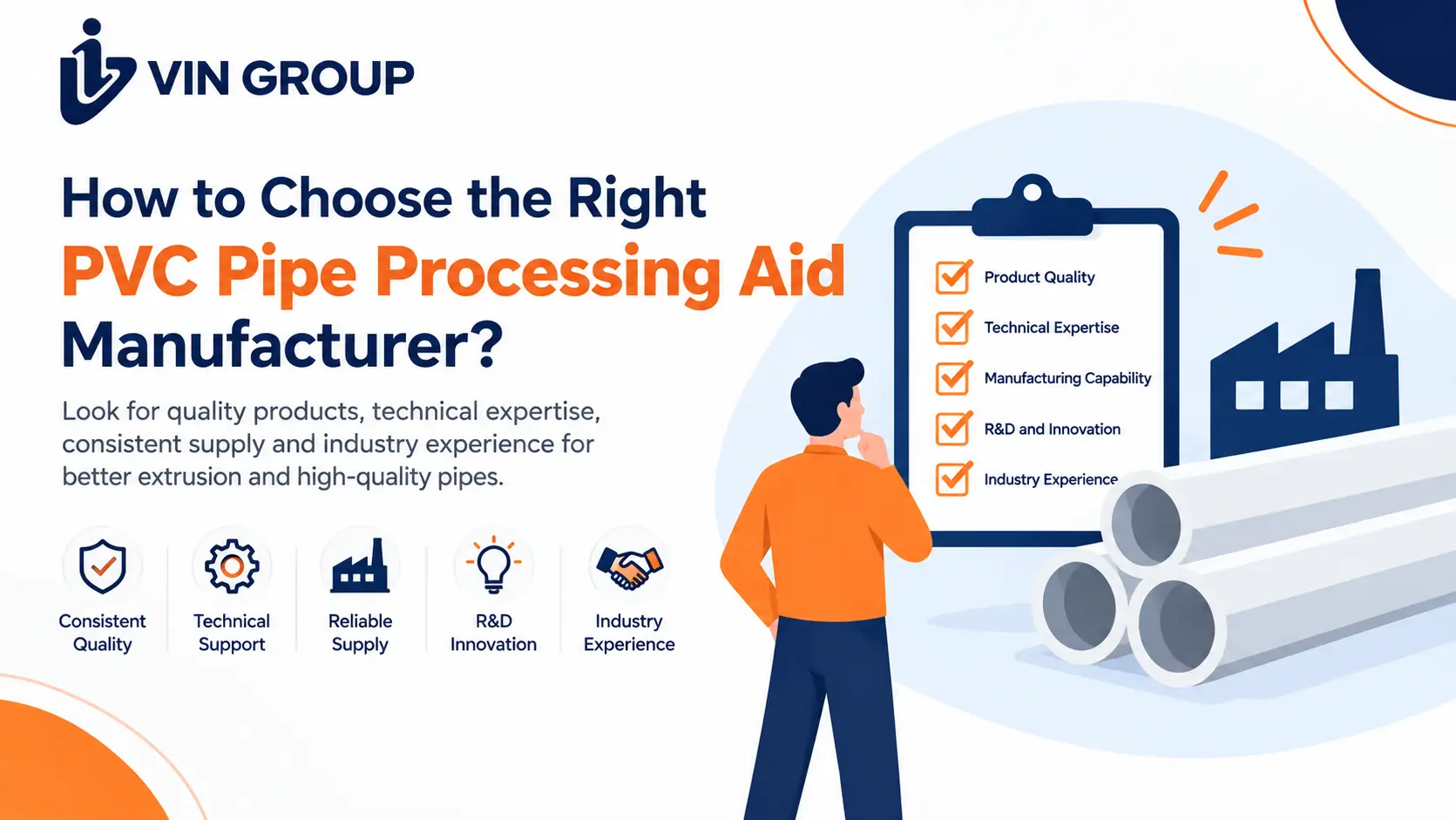
PVC Pipe Processing Aid Manufacturer: How Do You Choose the Right One?
The quality of PVC pipes depends on more than just the resin used during manufacturing. Processing aids, stabilizers, lubricants, impact modifiers, and other additives work together to ensure smooth extrusion, excellent surface finish, high impact strength, and consistent production. Among these, processing aids play a crucial role in improving melt strength, fusion behavior, and processing efficiency.
Choosing the right PVC pipe processing aid manufacturer is therefore an important decision for every PVC pipe manufacturer. A reliable supplier not only provides high-quality products but also offers technical expertise, consistent quality, formulation support, and dependable supply. Whether you are producing plumbing pipes, pressure pipes, agricultural pipes, or electrical conduits, selecting the right processing aid partner can improve productivity while reducing manufacturing costs.
This guide explains how PVC processing aids work, the factors to consider when selecting a manufacturer, and why quality additives contribute to long-term production success.
What Is a PVC Processing Aid?
A PVC processing aid is a specialty additive that improves the processing characteristics of rigid PVC compounds during extrusion or molding.
Unlike stabilizers or impact modifiers, processing aids primarily enhance the manufacturing process rather than changing the fundamental chemical structure of PVC.
A good processing aid helps manufacturers achieve:
- Faster fusion
- Better melt strength
- Improved melt flow
- Higher extrusion stability
- Better dimensional accuracy
- Smooth surface finish
- Reduced production defects
These advantages make processing aids an essential component of modern PVC pipe formulations.
PVC Processing Aid Uses
Understanding PVC processing aid uses helps manufacturers appreciate their importance in pipe production.
Common applications include:
- uPVC pressure pipes
- Agricultural pipes
- Plumbing systems
- Electrical conduits
- Drainage pipes
- PVC fittings
- Window profiles
- Door profiles
- Sheets and panels
In each application, processing aids contribute to stable manufacturing and improved product quality.
Why Processing Aids Are Important in PVC Pipe Manufacturing
Rigid PVC naturally has a narrow processing window. During extrusion, manufacturers must achieve proper fusion without degrading the material.
Processing aids assist by:
- Promoting faster fusion
- Increasing melt elasticity
- Improving melt homogeneity
- Enhancing die swell control
- Reducing surface defects
- Supporting higher production speeds
These improvements help manufacturers produce stronger and more consistent PVC pipes.
What Is Acrylic Processing Aid for PVC?
One of the most widely used processing aids is Acrylic processing aid for PVC.
These additives are specially designed polymers that improve melt strength and processing behavior without negatively affecting the final product.
Benefits include:
- Faster fusion
- Improved melt strength
- Better surface finish
- Higher dimensional stability
- Reduced die lines
- Better extrusion consistency
Because of these advantages, acrylic processing aids are commonly used in rigid PVC pipe manufacturing around the world.
How to Choose the Right PVC Pipe Processing Aid Manufacturer
Selecting a PVC pipe processing aid manufacturer involves more than comparing prices.
Manufacturers should evaluate several important factors before making a decision.
Product Quality
Consistent additive quality is essential for maintaining stable production.
A reliable manufacturer should provide products with:
- Uniform particle size
- Consistent molecular characteristics
- Stable processing behavior
- Reliable batch-to-batch quality
Consistency minimizes production variations and reduces reject rates.
Technical Expertise
An experienced supplier should understand:
- PVC formulations
- Extrusion technology
- Pipe applications
- Additive compatibility
- Processing optimization
Technical support helps manufacturers solve formulation challenges and improve production efficiency.
Manufacturing Capability
A dependable supplier should have sufficient production capacity to ensure uninterrupted supply.
Reliable manufacturers typically maintain:
- Quality control systems
- Modern production facilities
- Standardized manufacturing processes
- Consistent inventory management
These capabilities help prevent supply chain disruptions.
Research and Development
Innovation plays an important role in today’s PVC industry.
Manufacturers that invest in research and development can provide:
- Improved processing aids
- Better processing efficiency
- Enhanced product performance
- Cost optimization opportunities
Continuous product development allows customers to remain competitive in evolving markets.
Industry Experience
Experience often reflects technical knowledge and manufacturing expertise.
Established suppliers understand the processing requirements of various PVC applications and can recommend products based on practical production experience.
PVC Pipe Processing Aid Manufacturer in India
India has become one of the world’s leading producers of PVC additives and specialty chemicals.
A reputable PVC pipe processing aid manufacturer in India typically offers:
- Technical support
- Quality assurance
- Competitive pricing
- Reliable supply
- Customized solutions
- Modern manufacturing facilities
These strengths make Indian manufacturers important suppliers for both domestic and international PVC pipe producers.
PVC Pipe Processing Aid Manufacturer in Hyderabad
Hyderabad has developed into an important manufacturing hub for specialty chemicals and polymer additives.
A professional PVC pipe processing aid manufacturer in Hyderabad generally provides:
- Advanced manufacturing capabilities
- Skilled technical teams
- Efficient logistics
- Strong research support
- Customer-focused product development
Manufacturers operating in this region often serve both Indian and export markets.
Relationship Between Processing Aids and PVC Stabilizers
Processing aids work together with stabilizers during PVC manufacturing.
While processing aids improve extrusion behavior, stabilizers protect PVC against thermal degradation during processing.
For this reason, manufacturers often evaluate processing aids alongside products supplied by PVC stabilizer manufacturers.
Selecting compatible additive systems improves:
- Processing consistency
- Product quality
- Long-term durability
- Manufacturing efficiency
PVC Stabilizer Manufacturers in India
Several PVC Stabilizer manufacturers in India supply additive solutions for rigid PVC applications.
When selecting a supplier, manufacturers should evaluate:
- Product consistency
- Technical support
- Regulatory compliance
- Manufacturing capability
- Industry experience
- Product portfolio
A supplier offering both processing expertise and dependable product quality can contribute significantly to manufacturing success.
Top PVC Stabilizer Manufacturers in India
When comparing the Top PVC stabilizer manufacturers in India, manufacturers generally consider:
- Product quality
- Technical service
- Innovation
- Supply reliability
- Customer support
- Manufacturing standards
Rather than selecting suppliers based solely on price, manufacturers should evaluate overall value, technical competence, and long-term partnership potential.
PVC PROCESSING AID HS Code
Manufacturers involved in international trade frequently search for the PVC PROCESSING AID HS Code for customs documentation, import, and export purposes.
The applicable HS Code may vary depending on:
- Product composition
- Polymer classification
- Country-specific customs regulations
- Product specifications
Businesses should always verify the correct classification with the relevant customs authorities or trade documentation before importing or exporting processing aids.
What Are the Storage Requirements for These Additives?
Proper storage is essential to maintain the quality and performance of PVC processing aids. Even high-quality additives can lose their effectiveness if they are exposed to unsuitable environmental conditions.
Manufacturers should follow these recommended storage practices:
- Store in a cool and dry environment.
- Keep the material away from direct sunlight.
- Protect bags or containers from moisture.
- Keep packaging tightly sealed after opening.
- Avoid contamination with dust, oils, or other chemicals.
- Follow the manufacturer’s recommended storage temperature.
- Use products according to the first-in, first-out (FIFO) inventory system.
Maintaining proper storage conditions helps preserve product consistency, improves processing performance, and reduces the risk of production issues.
How Do These Aids Affect the Physical Properties of the Pipe?
Although processing aids are primarily designed to improve manufacturing efficiency, they also influence several physical characteristics of finished PVC pipes.
A properly selected processing aid can contribute to:
Better Fusion
Improved fusion results in a more homogeneous PVC structure, which supports better mechanical performance.
Improved Surface Finish
Uniform melt flow helps reduce die lines, roughness, and other surface imperfections, producing pipes with a smoother and more attractive appearance.
Enhanced Dimensional Stability
Better melt strength allows the pipe to retain consistent diameter and wall thickness throughout the extrusion process.
Increased Production Consistency
Stable processing conditions help manufacturers produce pipes with consistent quality from batch to batch.
It is important to note that processing aids are not intended to replace impact modifiers or stabilizers. Their primary role is to optimize processing while indirectly supporting overall product quality.
What Is the Recommended Dosage for PVC Pipe Processing Aids?
The recommended dosage depends on several factors, including:
- PVC resin grade
- Processing aid type
- Pipe application
- Extrusion equipment
- Production speed
- Overall formulation
Most manufacturers determine the ideal dosage through laboratory evaluation and production trials.
Using the correct dosage helps achieve:
- Faster fusion
- Stable extrusion
- Better melt strength
- Improved surface finish
- Consistent product dimensions
Excessive dosage should be avoided, as it may increase formulation costs without providing additional processing benefits.
What Is the Difference Between Processing Aids and Impact Modifiers?
This is one of the most frequently asked questions by PVC manufacturers.
Although both additives are used in PVC formulations, they serve completely different purposes.
| Processing Aids | Impact Modifiers |
| Improve processing efficiency | Improve impact resistance |
| Increase melt strength | Increase toughness |
| Promote faster fusion | Reduce brittleness |
| Improve extrusion stability | Improve low-temperature performance |
| Enhance surface finish | Improve crack resistance |
| Primarily influence processing | Primarily influence mechanical properties |
Processing aids help manufacturers produce PVC pipes more efficiently, while impact modifiers improve the durability and impact strength of the finished product.
For optimum performance, both additives are typically used together in rigid PVC formulations.
How to Select the Best PVC Pipe Processing Aid Manufacturer
Finding the right PVC pipe processing aid manufacturer requires evaluating several key aspects beyond product pricing.
Manufacturers should look for suppliers that provide:
Consistent Product Quality
Reliable processing aids should deliver uniform performance in every production batch, ensuring stable extrusion and consistent pipe quality.
Strong Technical Support
A knowledgeable supplier can help optimize formulations, recommend suitable additive combinations, and resolve processing challenges quickly.
Reliable Supply Chain
Consistent product availability minimizes production interruptions and helps manufacturers meet delivery schedules.
Product Innovation
Suppliers investing in research and development are better equipped to offer advanced additive solutions that improve productivity and product performance.
Customer-Focused Service
The best suppliers work closely with customers to understand production requirements and recommend solutions tailored to specific manufacturing needs.
Future Trends in PVC Processing Aids
As PVC manufacturing continues to evolve, processing aid technologies are becoming more advanced.
Some important industry trends include:
- Improved melt strength for high-speed extrusion
- Better compatibility with modern PVC formulations
- Enhanced processing efficiency
- Reduced production waste
- Greater formulation flexibility
- Improved surface quality
- More sustainable manufacturing practices
Manufacturers increasingly seek additive systems that support higher productivity while maintaining consistent product quality.
Conclusion
Choosing the right PVC pipe processing aid manufacturer is essential for achieving efficient production, stable extrusion, and high-quality PVC pipes. A reliable processing aid improves fusion, melt strength, dimensional stability, and surface finish, allowing manufacturers to increase productivity while minimizing production defects. When combined with technical expertise and dependable customer support, the right supplier becomes a valuable long-term partner in manufacturing success.
At Vin Group, we are committed to providing high-performance PVC additive solutions that help manufacturers improve processing efficiency and product quality. Our comprehensive range of processing aids is designed to support smooth extrusion, excellent surface finish, and consistent manufacturing performance across a wide range of rigid PVC applications. Backed by technical expertise, quality assurance, and customer-focused service, Vin Group helps businesses develop reliable formulations that meet today’s demanding production standards.
Frequently Asked Questions
1. What does a PVC pipe processing aid manufacturer provide?
A PVC pipe processing aid manufacturer supplies specialty additives that improve PVC fusion, melt strength, extrusion stability, surface finish, and overall processing efficiency.
2. What are the main PVC processing aid uses?
PVC processing aid uses include improving melt flow, increasing fusion speed, enhancing dimensional stability, reducing processing defects, and producing smoother PVC pipes and profiles.
3. What is acrylic processing aid for PVC?
Acrylic processing aid for PVC is a polymer-based additive that improves melt strength, promotes faster fusion, enhances extrusion stability, and delivers better surface finish during PVC processing.
4. How should PVC processing aids be stored?
Processing aids should be stored in a cool, dry place, protected from moisture, direct sunlight, contamination, and excessive heat while keeping the original packaging properly sealed.
5. Do processing aids improve the strength of PVC pipes?
Processing aids primarily improve processing performance. However, by promoting better fusion and more uniform melt flow, they indirectly contribute to improved consistency and overall product quality.
6. What is the difference between processing aids and impact modifiers?
Processing aids improve manufacturing efficiency and extrusion performance, whereas impact modifiers increase toughness, crack resistance, and impact strength in finished PVC products.
7. Why is choosing the right PVC pipe processing aid manufacturer important?
A reliable manufacturer provides consistent product quality, technical support, dependable supply, and formulation expertise that help manufacturers achieve stable production and superior PVC pipe quality.
8. How can Vin Group support PVC pipe manufacturers?
Vin Group provides advanced PVC processing aids and technical assistance that help manufacturers optimize formulations, improve processing efficiency, achieve smoother extrusion, reduce production defects, and consistently manufacture high-quality PVC pipes.