
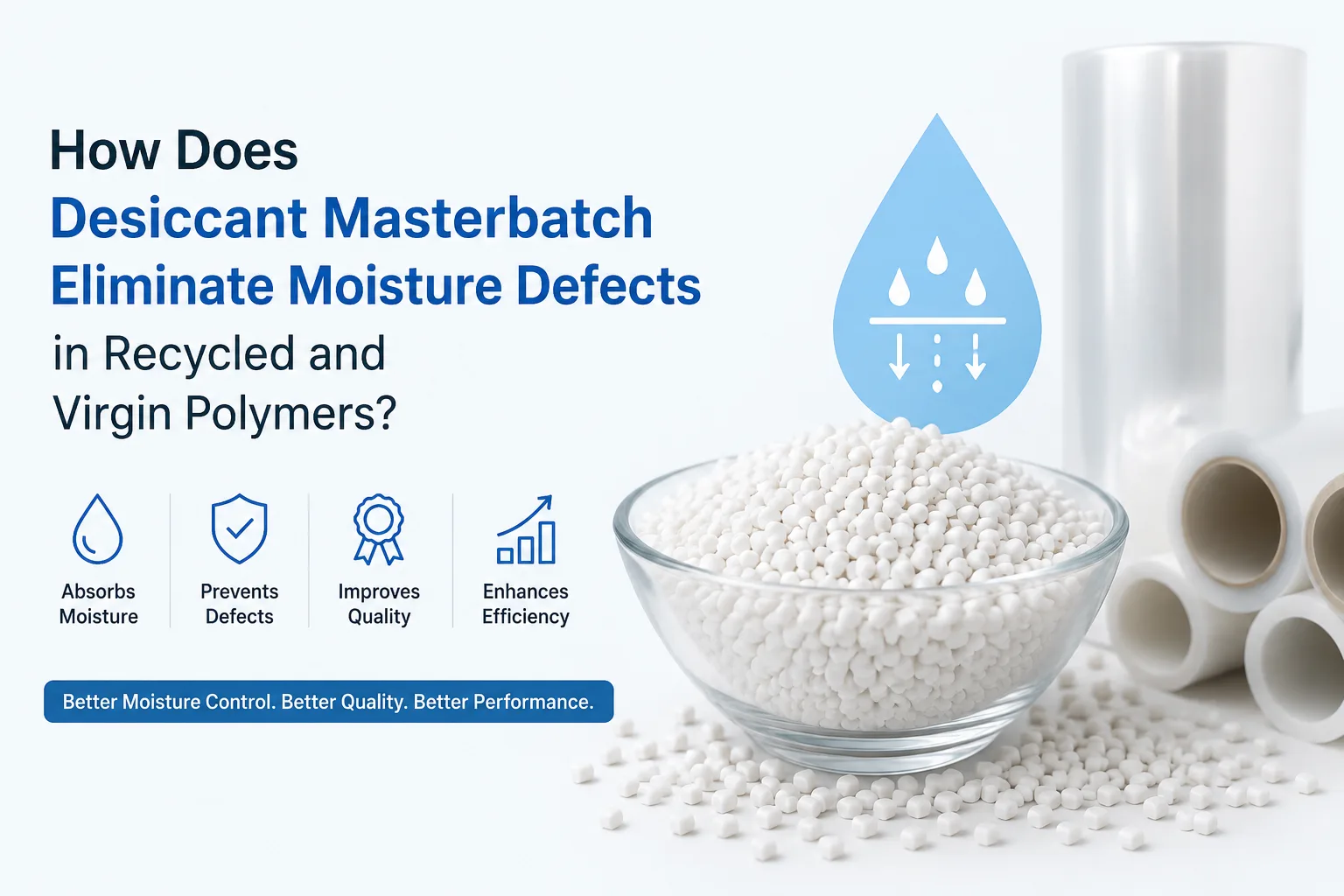
How Does Desiccant Masterbatch Eliminate Moisture Defects in Recycled and Virgin Polymers?
Introduction
Moisture is one of the most common yet overlooked causes of defects in plastic manufacturing. Whether processing recycled polymers or virgin resins, even a small amount of trapped moisture can lead to bubbles, voids, silver streaks, poor surface finish, reduced mechanical strength, and inconsistent product quality. These issues not only increase production waste but also raise manufacturing costs and affect customer satisfaction.
As industries increasingly adopt sustainable materials, recycled polymer processing has become more common. However, recycled plastics naturally absorb more moisture during collection, washing, storage, and handling, making plastic processing moisture control more challenging than ever. Even virgin polymer processing can experience moisture-related issues if raw materials are stored improperly or exposed to humid environments.
This is where Desiccant Masterbatch plays a critical role. By effectively absorbing moisture during processing, it helps manufacturers minimize defects, improve processing efficiency, and produce stronger, more consistent plastic products without additional drying equipment in many applications.
At Vin Group, quality-driven additive solutions are designed to support modern plastic manufacturing by improving process stability, reducing rejection rates, and enhancing the performance of both recycled and virgin polymers. This guide explains how Desiccant Masterbatch works, why it is especially valuable in recycled plastics, and how manufacturers can use it effectively to eliminate moisture-related defects.
How Does Desiccant Masterbatch Eliminate Moisture Defects in Recycled and Virgin Polymers?
Moisture present inside plastic materials turns into steam when exposed to processing temperatures during extrusion, blow moulding, injection moulding, or film production. The trapped steam creates internal pressure that leads to various manufacturing defects.
Desiccant Masterbatch works by chemically absorbing this moisture before it can convert into steam during processing. Instead of allowing water molecules to create bubbles or voids, the desiccant reacts with moisture and binds it, resulting in smoother processing and improved product quality.
Unlike external drying systems that remove moisture before processing, Desiccant Masterbatch functions directly inside the polymer melt, making it particularly effective for materials with variable moisture levels.
Its ability to improve moisture removal in plastics has made it an essential processing aid across industries manufacturing films, pipes, containers, packaging materials, moulded products, and recycled plastic compounds.
Why Moisture Is a Major Challenge in Plastic Manufacturing
Moisture contamination can occur at multiple stages of production.
Common sources include:
- Improper raw material storage
- Exposure to humid environments
- Washing processes during recycling
- Condensation during transportation
- Poor packaging of raw materials
- Long-term warehouse storage
Although the amount of moisture may appear insignificant, even small quantities can create serious moisture defects in plastic during processing.
For manufacturers, identifying and controlling moisture is essential for maintaining consistent production quality.
What defects are caused by moisture in plastics?
One of the most frequently asked questions by manufacturers is:
What defects are caused by moisture in plastics?
Moisture affects both product appearance and mechanical performance.
Some of the most common defects include:
Bubble Formation
Water trapped inside molten plastic vaporizes during processing, creating air pockets and bubbles.
These bubbles weaken structural integrity and reduce product strength.
Silver Streaks
Moisture escaping from the melt often appears as silver lines on finished plastic products.
This defect is especially common in injection moulded parts and transparent plastics.
Surface Voids
Trapped moisture may leave small cavities or pinholes on product surfaces.
These imperfections reduce visual quality and may affect product performance.
Poor Surface Finish
Excess moisture creates rough surfaces, inconsistent gloss, and uneven textures.
Manufacturers producing consumer goods or automotive components often consider this unacceptable.
Reduced Mechanical Strength
Voids and internal bubbles reduce tensile strength, impact resistance, and dimensional stability.
Products become more susceptible to cracking and premature failure.
Processing Instability
Moisture may cause unstable extrusion, inconsistent melt flow, poor mould filling, and production interruptions.
These defects increase rejection rates while reducing manufacturing efficiency.
How exactly does desiccant masterbatch work?
Understanding the working principle helps manufacturers optimize its use.
Most Desiccant Masterbatch formulations contain calcium oxide desiccant masterbatch technology as the active moisture-absorbing component.
Calcium oxide has a strong chemical affinity for water.
During processing:
- Moisture enters the polymer melt.
- Calcium oxide reacts chemically with water molecules.
- Moisture converts into a stable compound.
- Steam formation is prevented.
- Processing continues smoothly.
Because moisture is chemically absorbed rather than simply evaporated, manufacturers experience significantly fewer moisture-related defects.
This approach provides efficient plastic processing moisture control without interrupting production.
Modern formulations also disperse uniformly throughout the polymer, allowing consistent moisture absorption across the entire material.
Why Calcium Oxide Is Commonly Used
Calcium oxide desiccant masterbatch is widely preferred because it offers several advantages.
These include:
- High moisture absorption capacity
- Excellent thermal stability
- Good compatibility with many polymers
- Cost-effective processing
- Reliable performance during extrusion and moulding
Its effectiveness has made it one of the most widely used moisture control solutions in the plastics industry.
Why is it especially useful for recycled polymers?
Among all plastic materials, recycled polymers are significantly more vulnerable to moisture contamination.
This is because recycled plastic manufacturing involves several moisture-generating stages.
These include:
- Washing
- Cleaning
- Outdoor storage
- Transportation
- Reprocessing
Even after drying, some moisture often remains trapped inside recycled materials.
During recycled polymer processing, this residual moisture creates bubbles, voids, and inconsistent product quality.
Using Desiccant Masterbatch helps manufacturers:
- Improve moisture removal in plastics
- Reduce bubble formation
- Improve extrusion stability
- Enhance surface finish
- Improve dimensional consistency
- Lower rejection rates
Its ability to compensate for variable moisture levels makes it especially valuable when processing recycled plastics with inconsistent quality.
Benefits During Virgin Polymer Processing
Although recycled materials benefit the most, virgin polymer processing can also experience moisture-related issues.
Materials exposed to humid storage conditions may absorb enough moisture to create processing defects.
Using Desiccant Masterbatch provides:
- Improved processing stability
- Better mould filling
- Reduced silver streaks
- Smoother surface finish
- More consistent product quality
Manufacturers handling moisture-sensitive polymers often use desiccant additives as an additional layer of process protection.
How much desiccant masterbatch do I need to use?
This is one of the most common production questions.
The required dosage depends on several factors, including:
- Moisture content
- Polymer type
- Recycling level
- Processing method
- Environmental humidity
For most applications, manufacturers typically use approximately 1% to 5% Desiccant Masterbatch, depending on the level of moisture contamination and the specific formulation recommended by the supplier.
Heavily contaminated recycled materials may require higher addition levels than clean virgin polymers.
Rather than using excessive quantities, manufacturers should evaluate moisture levels through production trials and quality testing to determine the optimum dosage.
Using the correct amount ensures efficient moisture removal in plastics without unnecessarily increasing production costs.
Applications of Desiccant Masterbatch
Because of its versatility, Desiccant Masterbatch is used across numerous plastic processing industries.
Common applications include:
- Blown film extrusion
- Injection moulding
- Blow moulding
- Pipe extrusion
- Sheet extrusion
- Woven sack manufacturing
- Packaging products
- Agricultural films
- Household products
- Automotive components
Its compatibility with many processing methods makes it one of the most widely used plastic extrusion additives for moisture control.
Best Practices for Effective Moisture Control
Manufacturers can maximize performance by following several best practices:
- Store raw materials in dry environments.
- Prevent prolonged exposure to humidity.
- Use high-quality Desiccant Masterbatch.
- Monitor moisture levels before processing.
- Optimize extrusion temperatures.
- Maintain consistent mixing throughout production.
- Conduct routine quality inspections.
- Adjust desiccant dosage based on recycled material quality.
These practices improve product consistency while reducing downtime and material waste.
Conclusion
Controlling moisture is essential for producing high-quality plastic products, whether using recycled or virgin polymers. Moisture-related defects such as bubbles, silver streaks, voids, poor surface finish, and reduced mechanical strength can significantly impact production efficiency and product reliability. By using the right Desiccant Masterbatch, manufacturers can improve plastic processing moisture control, enhance recycled polymer processing, and achieve more stable manufacturing performance without compromising product quality.
At Vin Group, we provide high-performance Desiccant Masterbatch solutions designed to meet the evolving needs of modern plastic manufacturers. Our advanced formulations help improve moisture removal in plastics, minimize moisture defects, and support efficient recycled plastic manufacturing as well as virgin polymer processing. With a strong focus on quality, consistency, and technical support, Vin Group helps manufacturers optimize processing, reduce production losses, and produce durable, defect-free plastic products across a wide range of industrial applications.
FAQs
1. What is Desiccant Masterbatch used for in plastic manufacturing?
Desiccant Masterbatch is used to absorb moisture during plastic processing, helping prevent bubbles, voids, silver streaks, and other moisture-related defects in both recycled and virgin polymers.
2. How exactly does Desiccant Masterbatch work?
Most formulations contain calcium oxide desiccant masterbatch, which chemically reacts with moisture present in the polymer melt. This prevents steam formation during processing and improves product quality.
3. Why is Desiccant Masterbatch especially useful for recycled polymer processing?
During recycled polymer processing, materials often retain moisture from washing, storage, and transportation. Desiccant Masterbatch helps eliminate this moisture, improving extrusion stability, reducing defects, and supporting consistent recycled plastic manufacturing.
4. How much Desiccant Masterbatch should be added during processing?
The recommended dosage generally ranges between 1% and 5%, depending on the moisture content, polymer type, and processing conditions. Manufacturers should conduct production trials to determine the optimum dosage for their application.
5. What moisture defects in plastic can Desiccant Masterbatch prevent?
It helps reduce common moisture defects in plastic such as:
- Air bubbles
- Pinholes
- Surface voids
- Silver streaks
- Poor surface finish
- Reduced mechanical strength
- Unstable extrusion
6. Can Desiccant Masterbatch be used for virgin polymer processing?
Yes. Although virgin polymer processing generally contains less moisture than recycled plastics, improper storage or humid conditions can still introduce moisture. Desiccant Masterbatch provides additional plastic processing moisture control and improves production consistency.
7. Is calcium oxide desiccant masterbatch suitable for all plastic processing applications?
Calcium oxide desiccant masterbatch is compatible with many common thermoplastics used in extrusion, blow moulding, injection moulding, film production, and pipe manufacturing. However, manufacturers should always confirm compatibility with the specific polymer grade before use.
8. How does Vin Group help manufacturers improve moisture removal in plastics?
Vin Group offers high-quality Desiccant Masterbatch solutions designed for efficient moisture removal in plastics. Our formulations help manufacturers reduce defects, improve processing stability, enhance recycled polymer performance, and achieve consistent product quality across a wide range of plastic manufacturing applications.