
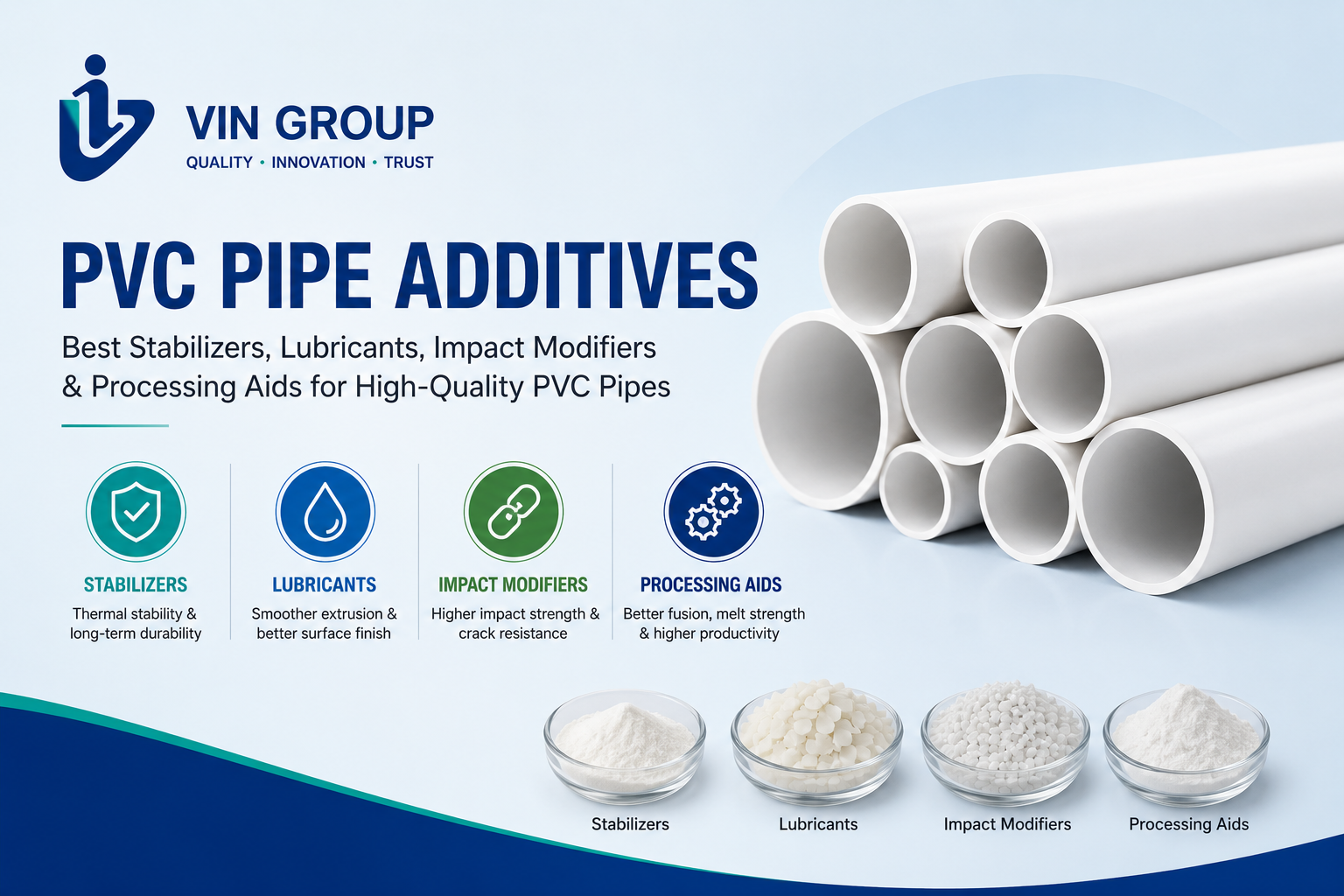
Best Stabilizers, Lubricants, Impact Modifiers & Processing Aids for PVC Pipes
Introduction
PVC pipes are among the most widely used piping solutions for water supply, drainage, agriculture, electrical conduits, and industrial applications due to their durability, corrosion resistance, and cost-effectiveness. However, the performance of a PVC pipe depends not only on the quality of the PVC resin but also on the PVC Pipe Additives used during manufacturing.
A well-balanced PVC compound formulation includes stabilizers, lubricants, impact modifiers, and processing aids that improve processing efficiency, mechanical strength, dimensional stability, and long-term service life. Selecting the right combination of additives for PVC pipes ensures smoother extrusion, better surface finish, improved weather resistance, and consistent product quality.
This guide explains the role of each additive, how they work together, and how manufacturers can optimize PVC pipe manufacturing for superior performance.
Best Stabilizers, Lubricants, Impact Modifiers & Processing Aids for PVC Pipes
Every PVC pipe application has unique performance requirements. Pressure pipes require excellent strength, electrical conduits demand dimensional stability, while drainage pipes require good impact resistance. Choosing the right PVC Pipe Additives helps manufacturers achieve these requirements while maintaining efficient production.
The major additive categories include:
- PVC stabilizers
- PVC lubricants
- PVC impact modifiers
- PVC processing aids
Together, these materials form the backbone of an effective PVC compound formulation.
What Stabilizers Are Used in PVC?
PVC naturally begins to degrade when exposed to high processing temperatures during extrusion. PVC stabilizers are added to protect the polymer from thermal degradation and maintain its physical properties throughout processing.
Common stabilizers used in PVC include:
Calcium-Zinc Stabilizers
Widely used because they offer excellent thermal stability, good weather resistance, and compliance with modern environmental regulations.
Organotin Stabilizers
Commonly used in rigid PVC pipes requiring excellent clarity, heat stability, and processing performance.
Mixed Metal Stabilizers
These stabilizers provide balanced processing characteristics and are used in various industrial PVC applications.
The right stabilizer system improves:
- Heat resistance
- Long-term durability
- Color stability
- Processing consistency
- Weather resistance
Selecting suitable PVC stabilizers is essential for producing reliable pipes that meet performance standards.
Why PVC Lubricants Are Important
During extrusion, PVC experiences high friction between the polymer melt and processing equipment. PVC lubricants reduce this friction, improving material flow and preventing overheating.
PVC lubricants are generally classified into:
Internal Lubricants
Internal lubricants reduce friction between PVC molecules, improving melt flow and fusion.
External Lubricants
External lubricants reduce friction between the PVC compound and machine surfaces such as screws, barrels, and dies.
Proper lubrication offers several advantages:
- Smoother extrusion
- Better surface finish
- Reduced die build-up
- Lower energy consumption
- Improved dimensional consistency
An optimized lubricant package significantly improves PVC pipe manufacturing efficiency.
What Is the Impact Modifier for PVC Pipe?
PVC is naturally rigid, but certain applications require additional toughness to resist cracking during transportation, installation, or service.
PVC impact modifiers improve the toughness of rigid PVC without significantly reducing stiffness.
Common impact modifiers include:
Acrylic Impact Modifiers (AIM)
Provide excellent weather resistance and maintain long-term mechanical performance.
Chlorinated Polyethylene (CPE)
Offers excellent impact strength and good low-temperature performance.
MBS Impact Modifiers
Used where impact resistance and surface appearance are equally important.
The correct PVC impact modifiers improve:
- Impact strength
- Crack resistance
- Pipe durability
- Low-temperature performance
- Service life
These modifiers are especially important for pressure pipes and outdoor applications.
What Are PVC Processing Aids?
PVC processing aids improve melt strength, fusion, and extrusion stability during manufacturing.
Unlike lubricants, processing aids directly influence polymer fusion and melt behavior.
Their benefits include:
- Faster fusion
- Better melt homogeneity
- Improved surface finish
- Higher extrusion output
- Better dimensional stability
- Reduced melt fracture
Modern PVC processing aids also help manufacturers achieve smoother production with fewer rejects.
How to Stabilize a PVC Pipe?
Proper stabilization begins with selecting compatible additives rather than relying on a single ingredient.
Manufacturers can stabilize PVC pipes by:
Choosing the Right Heat Stabilizer
Select stabilizers based on processing temperature and end-use requirements.
Optimizing Lubrication Balance
Too much lubrication delays fusion, while insufficient lubrication increases processing problems.
Improving Compound Formulation
A balanced PVC compound formulation ensures compatibility among stabilizers, lubricants, impact modifiers, and processing aids.
Maintaining Processing Temperatures
Stable extrusion temperatures prevent thermal degradation and improve pipe quality.
Using Quality Raw Materials
Consistent raw materials reduce variation during production and improve finished pipe performance.
What Additives Are Used in PVC Manufacturing?
Besides the primary additive categories, manufacturers often incorporate additional materials depending on pipe specifications.
Common additives for PVC pipes include:
Heat Stabilizers
Protect PVC during high-temperature processing.
Lubricants
Improve extrusion efficiency.
Impact Modifiers
Increase toughness and crack resistance.
Processing Aids
Enhance fusion and melt strength.
Fillers
Improve dimensional stability and reduce formulation costs.
Pigments
Provide color consistency and UV resistance.
UV Stabilizers
Protect outdoor pipes from sunlight degradation.
Each additive performs a specific function, making balanced formulation essential for high-quality PVC pipe manufacturing.
Factors to Consider When Selecting PVC Pipe Additives
Choosing additives involves more than simply improving one property.
Manufacturers should evaluate:
- Pipe application
- Pressure rating
- Processing temperature
- Extrusion speed
- Weather exposure
- Regulatory requirements
- Cost-performance balance
Proper selection ensures long-term product reliability while optimizing manufacturing efficiency.
Benefits of a Balanced PVC Compound Formulation
An optimized PVC compound formulation provides several manufacturing and performance advantages.
These include:
- Better extrusion stability
- Improved impact resistance
- Superior thermal stability
- Smoother surface finish
- Higher production output
- Lower rejection rates
- Longer pipe service life
- Consistent product quality
By balancing PVC stabilizers, PVC lubricants, PVC impact modifiers, and PVC processing aids, manufacturers achieve higher operational efficiency and customer satisfaction.
Common Challenges in PVC Pipe Manufacturing
Even experienced manufacturers may encounter production issues such as:
- Poor fusion
- Surface roughness
- Thermal degradation
- Brittle pipes
- Die build-up
- Dimensional instability
- Low impact strength
Most of these problems can be minimized through proper additive selection, equipment optimization, and formulation control.
Best Practices for Optimizing PVC Pipe Additives
Manufacturers can improve production performance by following these best practices:
- Use compatible additive packages.
- Maintain consistent raw material quality.
- Optimize stabilizer and lubricant balance.
- Monitor extrusion temperatures regularly.
- Select impact modifiers based on application requirements.
- Use processing aids to improve melt strength.
- Conduct regular quality testing.
- Continuously optimize formulations based on production feedback.
These practices help reduce waste while improving overall PVC pipe manufacturing efficiency.
Conclusion
Choosing the right PVC Pipe Additives is essential for producing durable, high-performance PVC pipes that meet modern industry standards. A carefully balanced combination of PVC stabilizers, PVC lubricants, PVC impact modifiers, and PVC processing aids improves processing efficiency, enhances mechanical properties, and extends product life. The right PVC compound formulation not only reduces production defects but also helps manufacturers achieve consistent quality, higher productivity, and long-term reliability.
At Vin Group, we provide advanced additive solutions tailored to the evolving needs of PVC pipe manufacturing. Our expertise in developing high-performance additives for PVC pipes enables manufacturers to optimize formulations, improve processing efficiency, enhance pipe durability, and maintain consistent product quality. Whether you’re producing pressure pipes, drainage systems, or conduit pipes, Vin Group helps you achieve reliable performance with innovative additive technologies.
FAQs
1. What are PVC Pipe Additives?
PVC Pipe Additives are specialized materials added to PVC compounds to improve processing, durability, thermal stability, impact resistance, and product performance.
2. What stabilizers are used in PVC?
The most common PVC stabilizers include calcium-zinc stabilizers, organotin stabilizers, and mixed metal stabilizers, depending on the application.
3. What is the impact modifier for PVC pipe?
Common PVC impact modifiers include acrylic impact modifiers, chlorinated polyethylene (CPE), and MBS modifiers, which improve toughness and crack resistance.
4. Why are PVC lubricants important?
PVC lubricants reduce friction during extrusion, improve melt flow, enhance surface finish, and increase processing efficiency.
5. What are PVC processing aids used for?
PVC processing aids improve fusion, melt strength, extrusion stability, and surface quality during PVC pipe manufacturing.
6. How do additives improve PVC pipe manufacturing?
A balanced PVC compound formulation enhances thermal stability, impact strength, processing efficiency, and long-term pipe performance.
7. Which additives are commonly used in PVC manufacturing?
Heat stabilizers, lubricants, impact modifiers, processing aids, fillers, pigments, and UV stabilizers are widely used additives for PVC pipes.
8. Why choose Vin Group for PVC Pipe Additives?
Vin Group offers high-quality additive solutions that help manufacturers optimize PVC pipe manufacturing, improve productivity, and produce durable, high-performance PVC pipes.