
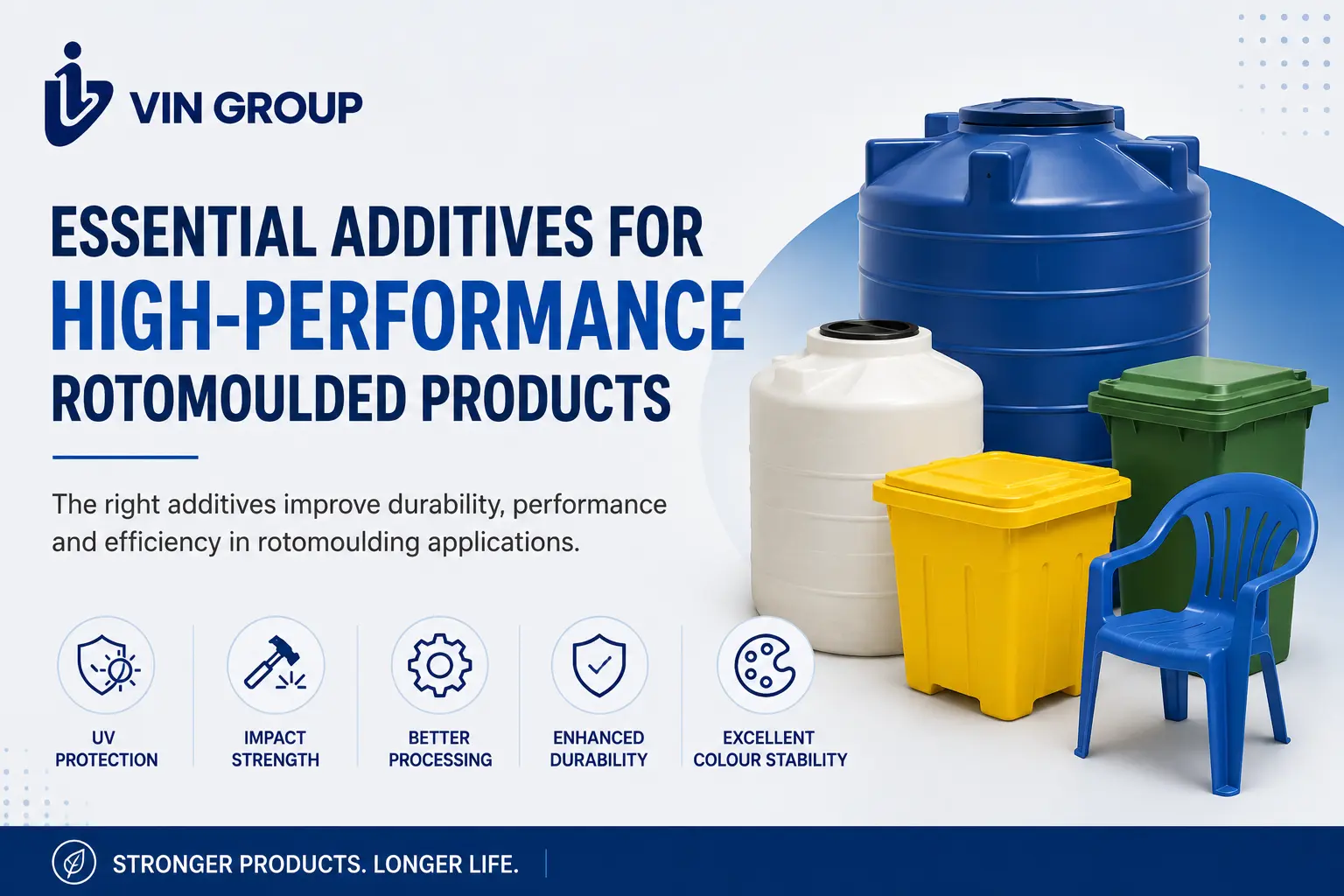
Essential Additives for High-Performance Rotomoulded Products
Rotational moulding, commonly known as rotomoulding, is widely used to manufacture hollow plastic products such as water storage tanks, industrial containers, playground equipment, automotive components, agricultural bins, and outdoor furniture. The process offers excellent design flexibility and cost-effective production, but achieving durable and high-performance products depends on more than selecting the right polymer. Carefully chosen Rotomoulding Additives play a critical role in improving mechanical strength, UV resistance, impact performance, and processing efficiency.
Since rotomoulded products are often exposed to sunlight, moisture, chemicals, and fluctuating temperatures, manufacturers must select additive packages that enhance long-term durability without compromising processability. UV stabilizers, impact modifiers, and processing aids are among the most important additives used to improve product quality and extend service life.
This guide explains the essential Rotomoulding Additives, their functions, and how manufacturers can choose the right combination for demanding applications.
Why Are Rotomoulding Additives Important?
Unlike injection moulding or extrusion, rotational moulding involves heating polymer powder inside a rotating mould until it melts and coats the mould surface. During this process, polymers experience prolonged heating, making them vulnerable to thermal degradation and oxidation.
The right Rotomoulding Additives help manufacturers:
- Improve UV resistance
- Increase impact strength
- Enhance thermal stability
- Improve flexibility
- Increase weather resistance
- Improve surface finish
- Extend product lifespan
- Maintain colour stability
- Reduce processing defects
A balanced additive formulation ensures that rotomoulded products maintain their structural integrity even under harsh outdoor conditions.
Key Types of Rotomoulding Additives
1. UV Stabilizers
Most rotomoulded products are designed for outdoor applications where prolonged sunlight exposure can degrade polymers over time.
UV stabilizers for polymers protect plastic products from ultraviolet radiation by reducing polymer degradation, colour fading, chalking, and surface cracking.
Benefits include:
- Longer outdoor life
- Improved colour retention
- Better weather resistance
- Reduced brittleness
- Improved mechanical strength
Selecting the appropriate UV stabilizer additive is essential for products such as water tanks, outdoor furniture, playground equipment, and agricultural containers.
- Impact Modifiers
Impact modifiers are additives designed to improve the toughness of polymers, enabling moulded parts to withstand sudden impacts and mechanical stress without cracking. Although polyethylene used in rotomoulding naturally offers good impact resistance, impact-modifying additive systems can be incorporated into specific PE formulations to further enhance toughness, particularly for products exposed to heavy-duty use or low-temperature environments.
Key advantages include:
- Higher impact strength
- Better low-temperature toughness
- Reduced risk of cracking under stress
- Improved durability in demanding applications
- Longer service life for rotomoulded products
In rotomoulding applications, impact performance is typically achieved through specialized polyethylene resin grades, optimized polymer blends, and additive packages rather than PVC- or PP-specific impact modifiers. Selecting the right formulation depends on the product’s end-use requirements, expected loading conditions, and environmental exposure.
3. Processing Aids
Processing aids improve polymer fusion and powder flow during rotational moulding.
Their key benefits include:
- Improved melt uniformity
- Better mould coverage
- Reduced pinholes
- Enhanced surface finish
- Improved dimensional consistency
- Higher production efficiency
Proper processing aids help manufacturers produce defect-free parts with consistent wall thickness and better overall appearance.
4. Antioxidants
During repeated heating cycles, polymers may undergo oxidation, leading to reduced mechanical performance.
Antioxidants help:
- Prevent thermal degradation
- Improve processing stability
- Maintain polymer strength
- Extend product lifespan
They are commonly used alongside UV stabilizers to provide comprehensive long-term protection.
5. Fillers and Reinforcements
Fillers improve stiffness, dimensional stability, and cost efficiency while maintaining acceptable processing characteristics.
Depending on the application, manufacturers may use:
- Calcium carbonate
- Talc
- Mineral fillers
- Natural fillers
Certain mineral and natural fillers may also contribute to improved UV stability by reducing the penetration of ultraviolet radiation into the polymer matrix.
6. Colour Masterbatches
Colour masterbatches provide uniform colour distribution while maintaining processing consistency.
Their advantages include:
- Better aesthetics
- Colour consistency
- Improved UV performance when combined with stabilizers
- Easy product identification
- Enhanced branding
How to Choose the Right Rotomoulding Additives
Selecting suitable Rotomoulding Additives requires evaluating the product’s operating environment, polymer type, and performance requirements.
Consider the End Application
Products used outdoors require stronger UV protection than indoor products. Similarly, industrial chemical tanks require additives that provide excellent chemical resistance, while playground equipment demands superior impact strength and weatherability.
Evaluate the Base Polymer
Different polymers respond differently to additive systems. Polyethylene, polypropylene, PVC, and engineering plastics all have unique processing behaviours, making additive compatibility an important consideration.
Assess Processing Conditions
Heating time, cooling rate, mould design, and processing temperature influence additive performance. Proper formulation ensures even dispersion and consistent product quality throughout production.
Balance Performance and Cost
The most effective formulation is one that delivers the required performance without unnecessary additive loading. Manufacturers should optimise stabilizers, impact modifiers, processing aids, and fillers together to achieve the best balance of quality, durability, and production efficiency.
Benefits of Using the Right Rotomoulding Additives
A carefully selected package of Rotomoulding Additives improves both manufacturing efficiency and the long-term performance of rotomoulded products.
Key benefits include:
- Improved UV and weather resistance
- Higher impact strength
- Better thermal stability during processing
- Enhanced colour retention
- Improved flexibility where required
- Better surface finish
- Reduced processing defects
- Longer product lifespan
- Consistent product quality
- Increased production efficiency
These advantages help manufacturers produce reliable products that perform consistently in outdoor and industrial environments.
What Are the Examples of UV Stabilizers?
A frequent question is, What are the examples of UV stabilizers?
Some common UV stabilizers examples include:
- Hindered Amine Light Stabilizers (HALS)
- Benzotriazole UV absorbers
- Benzophenone UV absorbers
- Triazine-based UV stabilizers
- Nickel-based stabilizers for specialised applications
These UV stabilizers for polymers help reduce degradation caused by ultraviolet radiation, improving colour stability, mechanical performance, and the outdoor lifespan of plastic products.
Which Polymer Additives Are Added to Improve Flexibility?
When greater flexibility is required, manufacturers may incorporate elastomeric modifiers, plasticizers (where compatible with the polymer system), impact modifiers, and specialised flexible polymer additives.
For rotomoulded products, the formulation depends on the base resin and application. While polyethylene grades often provide flexibility naturally, engineering polymers may require carefully selected modifiers to improve toughness and resistance to cracking without affecting processing performance.
What Are UV Absorbers for Polymers?
UV absorbers are additives that absorb harmful ultraviolet radiation before it can damage the polymer structure.
Unlike stabilizers that interrupt degradation reactions, UV absorbers convert UV energy into harmless heat, helping preserve colour, strength, and surface appearance. They are widely used in outdoor products such as water tanks, playground equipment, storage containers, automotive components, and agricultural products where long-term UV exposure is expected.
Conclusion
Selecting the right Rotomoulding Additives is essential for manufacturing durable, high-performance plastic products. UV stabilizers protect against sunlight degradation, impact modifiers improve toughness, processing aids enhance moulding efficiency, and antioxidants help maintain polymer stability during processing. Together, these additives improve product quality, extend service life, and support consistent manufacturing.
At Vin Group, we provide advanced additive solutions designed to meet the evolving needs of the plastics industry. Our portfolio includes UV stabilizers, impact modifiers, processing aids, antioxidants, and customised formulations that help manufacturers optimise processing, improve product durability, and achieve reliable production quality. Backed by technical expertise and a commitment to innovation, Vin Group works closely with customers to develop additive solutions that deliver long-term performance across a wide range of rotomoulding applications.
FAQs
1. What are Rotomoulding Additives?
Rotomoulding Additives are materials added to polymers to improve processing, UV resistance, impact strength, thermal stability, weatherability, and the overall performance of rotomoulded products.
2. Why are UV stabilizers important for rotomoulded products?
UV stabilizers for polymers protect products from sunlight by reducing fading, brittleness, cracking, and long-term degradation, making them ideal for outdoor applications.
3. What does a UV stabilizer additive do?
A UV stabilizer additive protects polymers from ultraviolet radiation, helping preserve colour, strength, surface finish, and long-term outdoor performance.
4. Which additives improve flexibility in rotomoulded plastics?
Impact modifiers, elastomeric modifiers, specialised polymer modifiers, and selected processing additives can improve flexibility while maintaining mechanical strength and processing efficiency.
5. How do Rotomoulding Additives improve product quality?
The right Rotomoulding Additives improve UV resistance, impact performance, thermal stability, processing efficiency, dimensional consistency, and the long-term durability of rotomoulded products.