
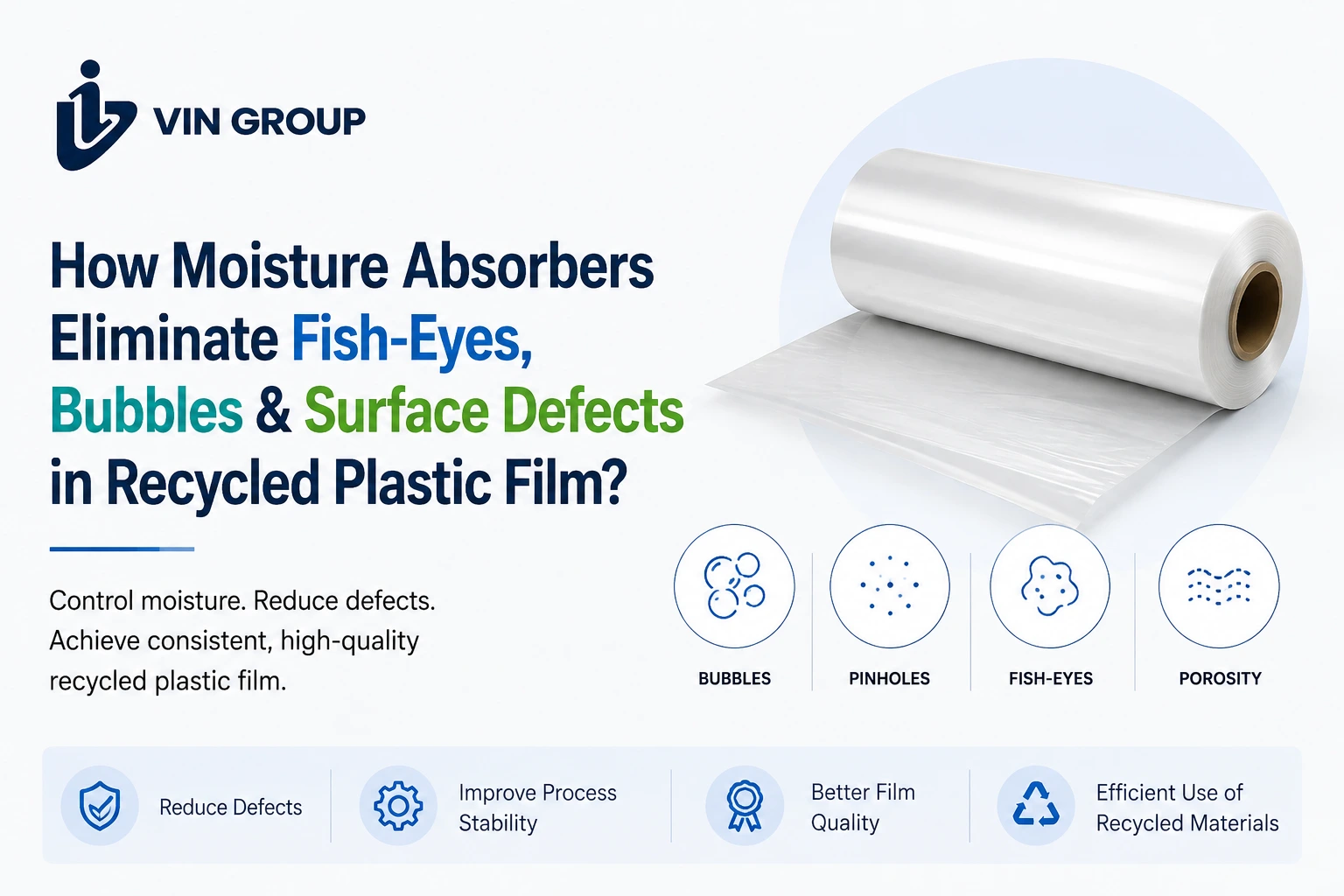
How Do Moisture Absorbers Eliminate Fish-Eyes, Bubbles & Surface Defects in Recycled Plastic Film?
Recycled plastic film offers manufacturers an effective way to reduce virgin polymer consumption, but maintaining consistent film quality can become challenging when recycled feedstock contains residual moisture. During extrusion, moisture can turn into vapour and interfere with melt formation, contributing to defects such as bubbles, pinholes, fish-eyes, porosity, and inconsistent surface appearance.
A moisture absorber for recycled plastic film can help manage this problem by binding or neutralizing residual moisture during processing. When properly selected and dosed, it can reduce moisture-related defects, improve extrusion stability, and support more consistent film quality.
However, moisture is not the only possible cause of film defects. Contamination, poor dispersion, unmelted particles, unsuitable processing conditions, and inconsistent recycled feedstock can also affect the finished film.
This guide explains how moisture contributes to common recycled-film defects, where moisture absorbers fit into the production process, and how manufacturers can choose an appropriate solution.
Why Does Moisture Cause Problems in Recycled Plastic Film?
Recycled polymers can experience greater moisture-management challenges because the material may pass through washing, drying, storage, and transportation before reaching the extrusion line.
Even when recycled material has been dried, residual moisture may remain, or the material may pick up moisture again during storage and handling.
When the material enters the extruder, heat can convert this residual moisture into vapour. If the vapour cannot escape effectively, it can disturb the molten polymer and contribute to visible or structural defects.
Common moisture-related problems include:
- Bubbles and voids
- Pinholes
- Porosity
- Fish-eyes or other surface imperfections
- Poor surface appearance
- Inconsistent film quality
- Increased scrap and rejection
The severity of the problem depends on factors such as moisture level, recycled-material quality, polymer type, extrusion conditions, and film specifications.
How Does Moisture Create Fish-Eyes in Plastic Film?
Fish-eye defects in plastic film are small, visible imperfections that can appear as spots, gels, or irregular areas in the finished film.
Moisture can contribute to these defects by disturbing melt uniformity during extrusion. However, it is important not to treat moisture as the only cause. Fish-eyes can also result from:
- Contaminated recycled feedstock
- Unmelted polymer particles
- Poor additive dispersion
- Incompatible materials
- Degraded polymer
- Inconsistent extrusion conditions
This means that simply adding a moisture absorber will not automatically solve every fish-eye problem.
If testing indicates that residual moisture is contributing to the defect, an appropriate moisture-management additive can help reduce the moisture-related component of the problem.
How Do Bubbles Form in Recycled Plastic Film?
Bubbles are among the clearest signs that moisture may be interfering with film extrusion.
When residual water is exposed to extrusion temperatures, it can form vapour. The resulting gas can become trapped in the polymer melt, creating bubbles, voids, or other irregularities.
Depending on their severity, these defects can affect:
- Film appearance
- Thickness consistency
- Mechanical performance
- Transparency
- Production stability
- Scrap rates
Effective moisture control in plastic processing therefore begins with proper storage and material handling and can be supported by a suitable moisture absorber when residual moisture remains a concern.
Can Moisture Cause Pinholes, Porosity and Other Surface Defects?
Yes, excessive or residual moisture can contribute to several defects in recycled plastic film.
These may include:
- Pinholes
- Porosity
- Bubbles
- Surface irregularities
- Poor gloss
- Uneven appearance
- Gassing during extrusion
However, manufacturers should diagnose the actual source before changing the formulation. Similar defects can have different causes.
For example, pinholes may be associated with moisture, contamination, poor melt quality or processing instability. A structured troubleshooting process can help determine whether moisture management is the appropriate corrective action.
How Does a Moisture Absorber for Recycled Plastic Film Work?
A moisture absorber for recycled plastic film is formulated to manage residual moisture in recycled or reclaimed polymer during processing.
Certain desiccant formulations chemically react with water molecules and convert the moisture into stable compounds rather than allowing it to generate problematic vapour during extrusion.
For example, Vin Group’s MoistGran is positioned as a desiccant masterbatch that irreversibly reacts with H₂O during processing. Its stated film-extrusion dosage is 1.5% to 2.5%, with the appropriate level depending on the quality of the recycled polymer.
This type of moisture-management approach can help reduce defects associated with residual moisture while supporting more stable processing.
The exact mechanism, dosage, and performance depend on the additive formulation and the recycled material being processed, so manufacturers should follow the relevant technical data and conduct line trials.
Does a Moisture Absorber Replace Drying Equipment?
Not necessarily.
A moisture absorber should not be viewed as a universal replacement for proper drying, especially when recycled material contains excessive moisture.
A more reliable approach is to control moisture throughout the process:
- Store recycled materials in dry, controlled conditions.
- Protect feedstock from unnecessary humidity exposure.
- Use appropriate drying procedures when material moisture is excessive.
- Monitor incoming recycled-material quality.
- Use a compatible moisture-management additive when residual moisture remains a processing concern.
- Optimize extrusion conditions based on the material and film specification.
A moisture absorber helps manage residual moisture during processing, not compensate for severely inadequate material preparation.
What Should Manufacturers Check Before Using a Moisture Absorber?
Before selecting an additive, manufacturers should identify the source and severity of the moisture problem.
Important considerations include:
Recycled Polymer Type
Different recycled materials can behave differently during processing. The additive should be appropriate for the polymer system and application.
Moisture Level
The moisture content and consistency of the incoming feedstock should be evaluated. Higher or more variable moisture levels may require a different approach from relatively dry material.
Film Manufacturing Process
Blown-film and other extrusion processes can have different operating conditions. Film thickness, extrusion temperature, output, and processing equipment should be considered when evaluating an additive.
Compatibility With the Formulation
The moisture absorber should work with the recycled polymer and other additives already present in the formulation.
Dosage
More additive does not automatically mean better results. Dosage should be optimized according to the recycled material, moisture level, formulation, and production conditions.
How Can Manufacturers Improve Moisture Control in Recycled Film Production?
Moisture management should be treated as a process-wide activity rather than a single additive decision.
Control Storage Conditions
Recycled flakes, pellets and other feedstock should be stored in clean, dry conditions. Preventing unnecessary exposure to humidity reduces the opportunity for the material to pick up moisture before extrusion.
Monitor Incoming Feedstock
Recycled material can vary considerably from batch to batch. Monitoring moisture and material quality helps identify changes before they cause significant production problems.
Check Drying Performance
If drying equipment is being used, manufacturers should ensure that it is operating correctly and is appropriate for the material being processed.
Maintain Extrusion Conditions
Temperature, screw speed, residence time, melt pressure, and other extrusion parameters should remain within suitable operating ranges.
Keep Equipment Clean
Contamination and material buildup can produce defects that may look similar to moisture-related problems. Regular equipment inspection and cleaning can therefore support more accurate troubleshooting.
When Should You Consider a Desiccant Masterbatch?
A desiccant masterbatch can be particularly relevant when recycled or reclaimed polymer continues to present residual-moisture problems despite appropriate material handling.
Vin Group’s Dessica Spl, for example, is a granulated desiccant masterbatch designed for recycled and reclaimed polymers. The product is positioned for film extrusion and is stated to address fish-eye, windows/lensing, and gassing while also improving strength, shine, surface finish, and flow. Its stated film-extrusion dosage is 1% to 2.5%, depending on recycled-material quality and moisture content.
Its granule format is also designed for clean handling, easier dosing, and uniform dispersion compared with loose powder formulations.
The right product should still be selected based on the specific polymer, recycled-material quality, and production conditions.
How Can Moisture Absorbers Improve Recycled Plastic Film Quality?
When residual moisture is a significant contributor to extrusion problems, an appropriate moisture absorber can provide several production benefits.
These may include:
- Fewer moisture-related bubbles
- Reduced pinholes and porosity
- Lower incidence of moisture-related surface defects
- More stable extrusion
- Improved film appearance
- Reduced material rejection
- Better consistency when processing variable recycled feedstock
The actual improvement depends on the starting material, moisture level, additive dosage, equipment, and overall formulation.
Therefore, manufacturers should evaluate performance through controlled trials rather than assuming that the same dosage or product will deliver identical results across every recycled polymer stream.
What Is the Best Way to Reduce Fish-Eyes and Bubbles in Recycled Film?
The first step is to identify whether moisture is actually contributing to the defect.
A practical troubleshooting sequence is:
Check the feedstock → assess moisture → inspect storage and drying → review extrusion conditions → check contamination and dispersion → trial an appropriate moisture-management additive → evaluate the finished film.
This approach helps prevent manufacturers from treating every fish-eye, bubble or pinhole as a moisture problem.
When moisture is confirmed as a significant factor, a suitable desiccant or moisture absorber can become an important part of the corrective strategy.
How Vin Group Supports Moisture Management in Plastic Processing
Vin Group is a plastic and rubber additive manufacturer with solutions for plastic recycling and film manufacturing. Its product portfolio includes moisture-management additives developed for recycled and reclaimed polymer processing.
For film applications, MoistGran is positioned as a desiccant masterbatch for recycled and reclaimed polymers, with a focus on reducing moisture-related problems such as fish-eye, windows/lensing, and porosity.
Dessica Spl is another granulated desiccant masterbatch from Vin Group, designed for a broad range of recycled and reclaimed polymers used in film extrusion and other plastic-processing applications.
The company also offers other moisture-management solutions for different recycled-plastic applications, allowing manufacturers to select additives according to their specific processing requirements.
For manufacturers facing recurring moisture-related defects, the objective should not simply be to add an additive. It should be to identify the moisture source, select a compatible solution, optimize dosage and integrate it into a broader process-control strategy.
Conclusion
Moisture can be a significant source of problems when processing recycled plastic film. When residual water becomes vapour during extrusion, it can contribute to bubbles, pinholes, porosity and other film-quality issues.
A suitable moisture absorber for recycled plastic film can help manage residual moisture during processing and reduce defects when moisture is a confirmed cause. However, it works best as part of a broader moisture-control strategy that includes proper storage, drying where required, feedstock inspection, equipment maintenance, and optimized extrusion conditions.
Vin Group provides plastic additive solutions for recycled polymer and film-processing applications, including desiccant masterbatches designed to address moisture-related processing challenges.
Frequently Asked Questions
1. What is a moisture absorber for recycled plastic film?
A moisture absorber is an additive designed to manage residual moisture in recycled or reclaimed polymers during processing. Depending on its formulation, it can help reduce moisture-related defects such as bubbles, pinholes, porosity, and other extrusion problems.
2. What causes fish-eyes in recycled plastic film?
Fish-eyes can have multiple causes, including moisture, contaminants, unmelted polymer, poor additive dispersion, and processing inconsistencies. Moisture should therefore be investigated rather than assumed to be the only cause.
3. Can moisture absorbers eliminate bubbles in recycled plastic film?
They can help reduce bubbles when residual moisture is a significant cause of the problem. Results depend on the recycled material, moisture level, additive selection, dosage, and extrusion conditions.
4. Do moisture absorbers replace industrial drying?
Not always. Materials containing excessive moisture may still require appropriate drying before extrusion. A moisture absorber is better viewed as part of an overall moisture-management strategy.
5. How do you choose a moisture absorber for recycled plastic?
Consider the recycled polymer, moisture level, extrusion process, film specification, existing formulation, required dosage, and compatibility with other additives. Line trials are recommended to determine the most suitable solution.
6. What is a desiccant masterbatch?
A desiccant masterbatch is a concentrated additive designed to manage moisture in plastic processing. Granulated products can offer easier handling, dosing, and dispersion compared with loose powders.
7. Can moisture control help improve recycled plastic film quality?
Yes. When moisture is contributing to extrusion defects, better moisture control can help improve film appearance, processing stability and consistency while reducing moisture-related rejection and waste.
8. Which Vin Group products are used for moisture management in recycled plastic?
Vin Group offers moisture-management products including MoistGran and Dessica Spl. MoistGran is positioned for recycled and reclaimed polymers in film extrusion, while Dessica Spl is a granulated desiccant masterbatch for recycled and reclaimed polymers across film and other plastic-processing applications.