
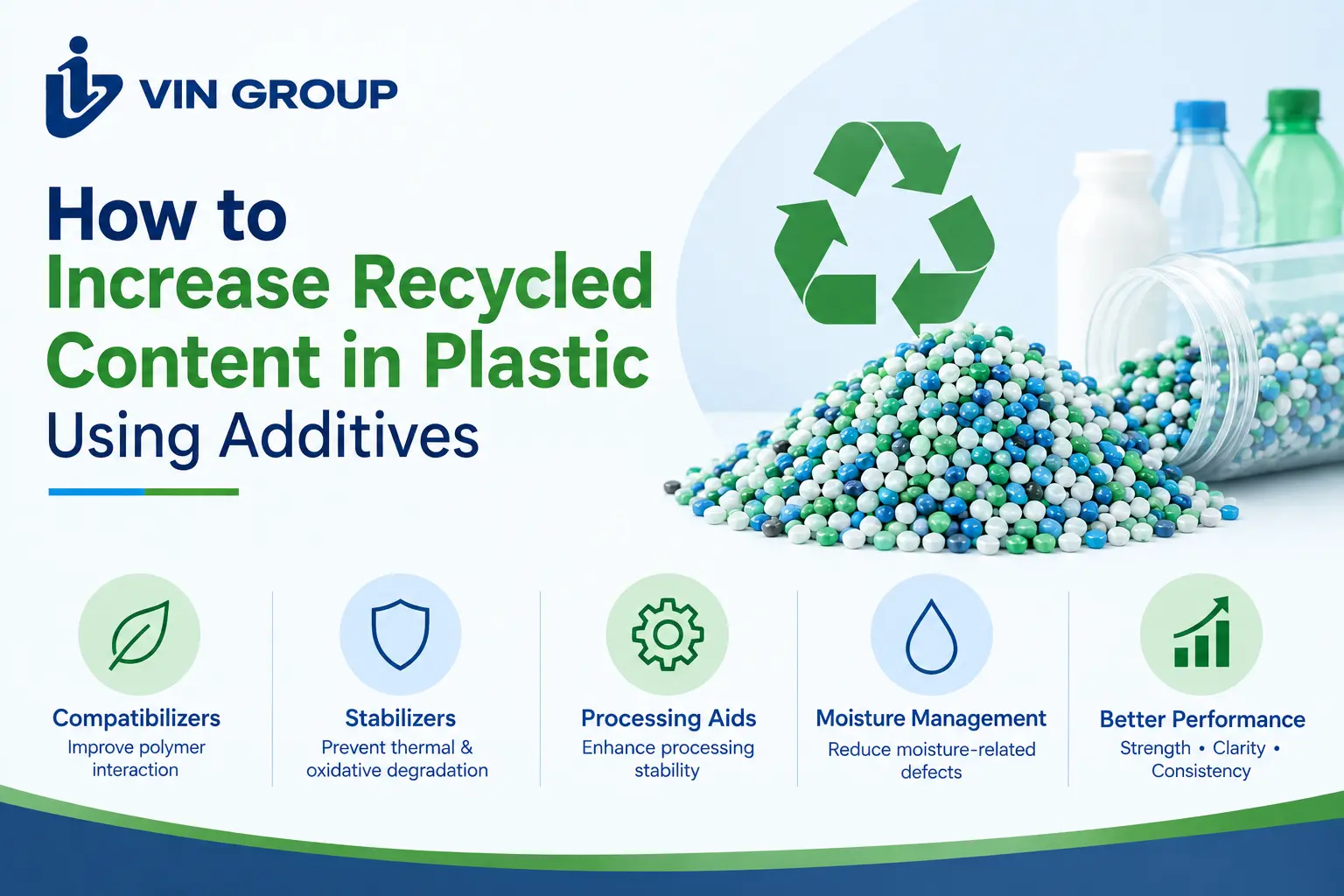
How Can You Increase Recycled Content in Plastic Products Using Compatibilizers & Stabilizers?
Increasing recycled content in plastic products can help manufacturers reduce their dependence on virgin polymers, improve material efficiency, and support circular manufacturing goals. However, simply increasing the percentage of recycled material can create challenges in processing and finished-product performance.
Recycled polymers may have a history of thermal and mechanical processing that affects their properties. Mixed polymer streams can also have poor compatibility, while repeated exposure to heat and oxygen can contribute to further degradation during processing.
This is where compatibilizers and stabilizers for recycled plastics can play an important role. Compatibilizers can improve the interaction between compatible-but-difficult polymer phases, while stabilizers can help protect susceptible polymers from further thermal and oxidative degradation during processing.
The objective is not to make recycled material identical to virgin resin. Instead, manufacturers can use targeted additive technologies to address specific limitations and create a formulation capable of handling a higher recycled content level while meeting the requirements of the finished product.
Why Is Increasing Recycled Content Challenging?
The quality of recycled plastic depends heavily on its source, collection, sorting, previous processing history, and polymer composition.
During repeated processing, polymers can experience heat, oxygen, shear, and other stresses. Recycled streams may also contain different grades or polymer types that behave differently during processing.
Common challenges include:
- Reduced toughness
- Changes in tensile performance
- Variable melt flow
- Poor compatibility between polymer phases
- Further thermal or oxidative degradation
- Moisture-related processing defects
- Surface inconsistencies
- Color variation
These issues can become more noticeable as the proportion of recycled material increases.
For this reason, manufacturers need to evaluate the recycled feedstock and identify the specific limitations before selecting an additive package.
What Is an Additive Strategy for Increasing Recycled Content?
An increase-recycled-content additive plastic strategy uses functional additives to address specific limitations that may restrict the amount of recycled polymer that can be incorporated into a product.
Depending on the application, the formulation may use:
- Compatibilizers
- Stabilizers
- Impact modifiers
- Processing aids
- Moisture-management additives
- Other application-specific additives
The purpose is to improve selected properties such as compatibility, processing stability, toughness, or resistance to further degradation.
There is no universal additive or dosage that allows every plastic product to use a higher recycled content. The appropriate solution depends on the polymer system, recycled-material quality, processing method, and finished-product specifications.
How Do Compatibilizers Help With Recycled Plastics?
One of the biggest challenges in recycled plastic processing is the presence of polymer phases that do not naturally interact well.
For example, recycled feedstock may contain a mixture of polymers that cannot be completely separated. When these materials are processed together without sufficient compatibility, poor interfacial adhesion and phase separation can affect mechanical performance.
Compatibilizers for recycled plastics are designed to improve interactions between selected polymer phases.
Depending on the polymer combination, they can help with:
- Interfacial adhesion
- Polymer-phase dispersion
- Blend uniformity
- Mechanical consistency
- Impact performance
- Processing stability
The effectiveness of a compatibilizer depends strongly on the polymers involved. It should therefore be selected for the specific polymer combination rather than treated as a universal solution for mixed plastic waste.
What Are Recycled Plastic Compatibilizers?
Recycled plastic compatibilizers are functional additives used to improve the compatibility of polymer blends that would otherwise have limited interaction.
They can be particularly useful when recycled material contains different polymer types or when manufacturers are developing recycled polymer alloys.
By improving interaction between polymer phases, a compatibilizer can help create a more uniform material structure.
Vin Group’s VinBond range includes grafted polymers and coupling agents such as PP-g-MAH, PE-g-MAH, and POE-g-MAH. These products are positioned for applications including recycled polymer alloys, WPC, and other plastic-compounding requirements.
The appropriate grade and dosage depend on the polymer system and application, so formulation trials are important before production-scale implementation.
Why Are Stabilizers Important for Recycled Plastics?
Recycled polymers can be more susceptible to additional degradation because they have already experienced previous processing cycles.
During extrusion, compounding, or moulding, exposure to elevated temperatures and oxygen can contribute to further polymer degradation.
Stabilizers for recycled plastics can help protect susceptible polymers during processing by limiting thermal and oxidative damage.
Depending on the stabilization system, potential benefits include:
- Better processing consistency
- Improved thermal stability
- Reduced further degradation
- Better retention of mechanical properties
- Improved color stability
- More consistent melt behavior
The stabilizer system should be matched to the polymer and its processing conditions.
What Are Stabilizer Additives in Plastic?
Stabilizer additives in plastic are functional additives used to protect polymers against specific degradation mechanisms.
Depending on the formulation, stabilization may involve:
- Heat stabilizers
- Antioxidants
- UV stabilizers
- Light stabilizers
- Processing stabilizers
Not every recycled plastic requires every type of stabilizer. For example, a product processed at high temperatures may require a different stabilization approach from an outdoor application where long-term UV exposure is also important.
The right system should therefore be selected based on both processing and end-use conditions.
How Do Polymer Stabilizers Support Recycled Materials?
Polymer stabilizers help protect susceptible polymer structures from further degradation during processing and, where applicable, service life.
This becomes increasingly relevant when recycled content is raised because the recycled polymer may already have experienced thermal and oxidative stress.
A suitable stabilization system can help manufacturers maintain more consistent processing and retain important properties.
However, stabilizers cannot reverse severe degradation. If the recycled feedstock has already undergone significant molecular breakdown, stabilizers alone cannot restore the original polymer structure.
This is why feedstock selection and processing control remain essential.
What Other Additives Can Support Higher Recycled Content?
Compatibilizers and stabilizers are important, but they are not the only tools available.
Other additives for recycled polymers may be required depending on the problem.
Impact Modifiers
Impact modifiers can be considered when recycled material has insufficient toughness or has become more brittle after previous processing.
Processing Aids
Processing aids can help improve melt behavior and processing stability when recycled material creates extrusion or surface-quality challenges.
Moisture Absorbers
Residual moisture can cause bubbles, pinholes, fish-eyes, porosity, and other moisture-related defects during processing. Desiccant or moisture-management additives can help address this specific problem.
Odor-Control Additives
Recycled feedstock may contain residues or contaminants that contribute to unwanted odors. Where odor is a limiting factor, dedicated odor-management technologies may be considered.
The important point is that each additive has a specific role. Manufacturers should select the package according to the actual limitations of the recycled feedstock.
How Can You Improve Recycled Plastic Performance?
To improve recycled plastic performance, manufacturers should optimize the material and process together.
Important factors include:
- Recycled feedstock quality
- Polymer composition
- Compatibility
- Moisture content
- Thermal history
- Stabilization
- Mechanical requirements
- Processing temperature
- Residence time
- Filtration and contamination control
For example, increasing recycled content in a polyethylene product may require a different strategy from increasing recycled content in a PVC, polypropylene, or engineering-plastic application.
The first step should always be identifying what prevents the existing recycled material from meeting the required specification.
How Do You Increase Recycled Content Successfully?
A controlled formulation-development process can help manufacturers determine the practical recycled-content range for a product.
Start With the Recycled Feedstock
Assess the polymer type, contamination, melt-flow characteristics, moisture, and previous processing history.
More consistent feedstock generally makes formulation development easier.
Establish a Virgin-Resin Baseline
Test the existing formulation so that changes in mechanical, thermal, optical, and processing properties can be measured objectively.
Increase Recycled Content Gradually
Rather than making a large change at once, evaluate incremental increases in recycled material.
This helps identify the point at which a particular property becomes limiting.
Identify the Main Limitation
Determine whether the problem is:
- Poor compatibility
- Thermal or oxidative degradation
- Brittleness
- Moisture
- Processing instability
- Contamination
- Another formulation-specific issue
Select the Additive Accordingly
Use a compatibilizer for a compatibility problem, a stabilizer where further degradation is the concern, or another functional additive when a different limitation is identified.
Validate the Finished Product
Test the formulation for the properties required by the application, such as:
- Tensile strength
- Impact resistance
- Elongation
- Dimensional stability
- Surface quality
- Thermal performance
- Processing consistency
This approach helps manufacturers increase recycled content without sacrificing the properties that matter most to the end product.
What Role Does Recycled Plastic Processing Play?
Additives cannot compensate for poor processing indefinitely.
Recycled plastic processing should be controlled to minimize additional degradation and maintain consistency.
Important parameters include:
Material Preparation
Sorting, cleaning, drying where required, and contamination control help provide a more consistent feedstock.
Temperature Control
Excessive processing temperatures can accelerate polymer degradation. Processing conditions should therefore be appropriate for the polymer and additive package.
Residence Time
Long residence times can expose polymers to additional thermal stress. Optimizing throughput and processing conditions can help limit unnecessary degradation.
Filtration
Effective filtration can remove unwanted contaminants and improve the consistency of recycled material where applicable.
Quality Monitoring
Regular testing of melt flow, mechanical properties, appearance, and other relevant characteristics helps identify changes in recycled-material quality.
How Can Increasing Recycled Content Improve Plastic Product Sustainability?
Increasing recycled content can contribute to plastic product sustainability by reducing reliance on virgin raw materials and keeping more material within productive use.
Potential benefits include:
- Reduced virgin polymer consumption
- Better use of recovered plastic
- Support for circular material flows
- Improved resource efficiency
- Reduced waste sent for disposal
However, sustainability should also be considered alongside product durability and manufacturing efficiency.
A higher recycled-content product that fails prematurely or generates excessive manufacturing scrap may not deliver the intended overall benefit. The objective should be to find the highest practical recycled content that meets the product’s performance and quality requirements.
Best Practices to Increase Recycled Content
Manufacturers can improve their chances of successfully increasing recycled content by following a structured approach.
Use Consistent Recycled Feedstock
Variation in incoming material can make formulation and processing unpredictable.
Characterize the Material
Measure relevant properties before changing the formulation. This establishes the actual limitations of the recycled material.
Match Additives to the Problem
Do not select an additive simply because it is marketed for recycled plastics. Identify the specific limitation first.
Protect the Polymer During Processing
Use appropriate processing temperatures, residence times, and stabilization to minimize further degradation.
Validate Compatibility
When different polymer phases are present, evaluate whether a compatibilizer is appropriate for the specific combination.
Test Incrementally
Increase recycled content in controlled steps and compare each formulation against the required product specifications.
Evaluate Production Economics
Consider additive cost, recycled-resin cost, processing efficiency, scrap, rejection rates, and finished-product performance when evaluating the overall benefit.
How Does Vin Group Support Higher Recycled Content?
Vin Group is a plastic and rubber additives manufacturer with in-house R&D focused on additive formulation, product customization, processing optimization, and customer-specific grade development.
Its product portfolio includes solutions for plastic recycling, film manufacturing, plastic compounding, PVC processing, and other polymer applications.
For recycled-polymer applications, Vin Group offers technologies addressing different formulation challenges. VinBond provides grafted polymers and coupling agents for applications including recycled polymer alloys, while PA-79 is a grafted elastomeric blend designed for strength and clarity in virgin and recycled plastic packaging applications.
Vin Group also provides moisture-management products such as MoistGran, Dessica, and Dessica Spl for applications where residual moisture is affecting recycled-polymer processing.
This application-focused approach allows manufacturers to evaluate additives according to their polymer, recycled content, process, and finished-product requirements rather than relying on a generic additive package.
Conclusion
Increasing recycled content successfully requires more than simply adding a larger percentage of recycled resin to an existing formulation. Recycled materials can have different levels of degradation, contamination, moisture, and polymer compatibility, all of which can affect processing and finished-product performance.
Compatibilizers for recycled plastics can help improve interactions between suitable polymer phases, while stabilizers for recycled plastics can help protect susceptible materials against further thermal and oxidative degradation during processing. Other additives, including impact modifiers, processing aids, and moisture-management solutions, may be appropriate when different limitations are present.
The most effective strategy is to characterize the recycled feedstock, identify the property limiting recycled-content levels, select the appropriate additive technology, and validate the formulation through controlled trials.
As a plastic and rubber additives manufacturer, Vin Group supports manufacturers with application-specific additive technologies and formulation expertise designed to improve recycled-polymer processing and performance. The right combination of material preparation, process control, and additive technology can help manufacturers increase recycled content while maintaining the quality and reliability required by the final application.
Frequently Asked Questions
1. How can manufacturers increase recycled content in plastic products?
Manufacturers can increase recycled content by using consistent recycled feedstock, identifying formulation limitations, selecting appropriate additives such as compatibilizers or stabilizers, and validating the finished product through controlled trials.
2. What are compatibilizers for recycled plastics?
Compatibilizers for recycled plastics are functional additives that improve interaction and interfacial adhesion between selected polymer phases that otherwise have limited compatibility.
3. What do stabilizers for recycled plastics do?
Stabilizers for recycled plastics help protect susceptible polymers against further thermal and oxidative degradation during processing, supporting more consistent material performance.
4. Can compatibilizers increase recycled content?
They can help in applications where poor compatibility between polymer phases limits the use of recycled material. Their effectiveness depends on the specific polymers being blended.
5. Can stabilizers restore degraded recycled plastic?
Stabilizers can help limit further degradation during processing, but they cannot completely reverse severe degradation that has already occurred in the polymer.
6. What other additives are used with recycled polymers?
Depending on the application, manufacturers may use impact modifiers, processing aids, moisture absorbers, odor-control additives, and other functional additives alongside compatibilizers and stabilizers.
7. How should manufacturers choose additives for recycled plastic?
Selection should be based on polymer type, recycled content, feedstock quality, contamination, moisture, processing conditions, and the specific property that needs improvement. Production trials are important for validating suitability and dosage.
8. How does Vin Group help manufacturers increase recycled content?
Vin Group provides plastic and rubber additive technologies, formulation expertise, and application-focused support for recycled polymers, including compatibilization, strength and clarity improvement, and moisture management.