
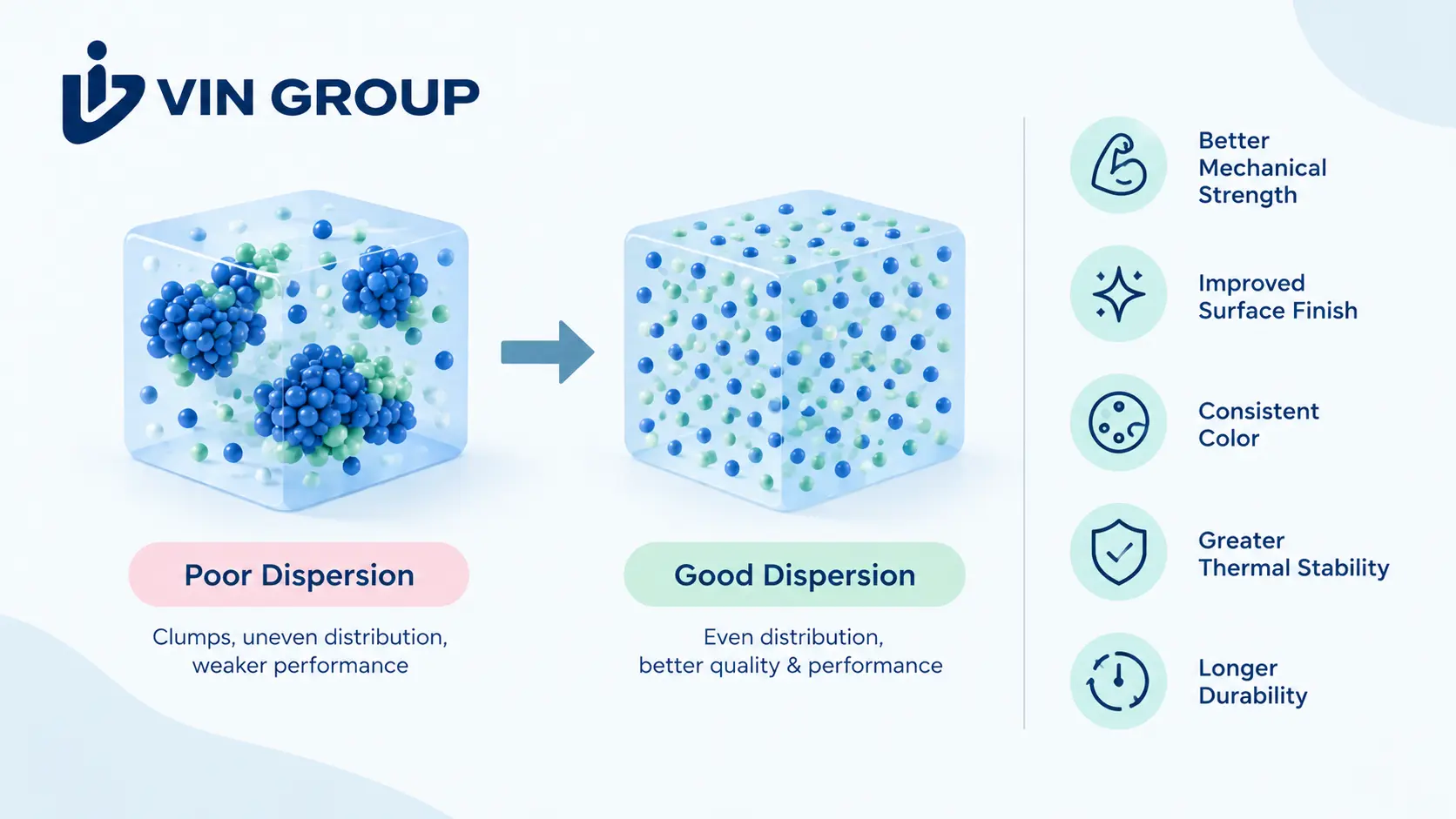
Causes of Poor Dispersion in Polymers
Dispersion plays a crucial role in determining the quality, consistency, and performance of polymer materials. In plastic manufacturing and polymer processing, poor dispersion can significantly reduce product strength, affect color uniformity, weaken mechanical properties, and lead to production defects. Whether working with fillers, additives, pigments, nanoparticles, or color masterbatches, achieving uniform distribution is essential for maintaining high-performance polymer systems.
Understanding the causes of poor dispersion in polymers helps manufacturers reduce defects, improve material consistency, and optimize production performance. At Vin Group, maintaining superior polymer quality standards includes ensuring proper material distribution and effective polymer processing methods.
In this guide, we will discuss polymer dispersion, causes of poor dispersion, stability factors, polymerization methods, and effective strategies for improving polymer performance.
What Is the Dispersion of Polymers?
One of the most frequently asked questions in polymer science is, what is the dispersion of polymers?
Polymer dispersion refers to the uniform distribution of additives, fillers, pigments, nanoparticles, or reinforcing materials within a polymer matrix. Proper dispersion ensures materials are spread evenly instead of forming clumps or agglomerates.
Good dispersion improves:
- Mechanical strength
- Surface finish
- Product consistency
- Thermal stability
- Color uniformity
- Material durability
Poor dispersion may create weak spots, inconsistent coloring, and reduced overall performance.
At Vin Group, maintaining effective dispersion remains essential for producing high-quality polymer solutions.
Why Is Proper Dispersion Important in Polymers?
Uniform dispersion directly affects the final properties of polymer products.
Improves Mechanical Strength
Well-dispersed particles improve structural integrity.
Enhances Surface Finish
Even distribution reduces visible defects.
Improves Color Consistency
Proper pigment distribution prevents streaking and uneven appearance.
Enhances Thermal Stability
Uniform additives improve heat performance.
Supports Product Reliability
Better material consistency improves long-term durability.
Poor dispersion, however, often creates serious manufacturing challenges.
Causes of Poor Dispersion in Polymers
Manufacturers often face challenges involving uneven material distribution. Understanding the causes of poor dispersion in polymers helps identify problems early.
Poor Material Compatibility
One of the most common reasons for poor dispersion is incompatibility between additives and the polymer matrix.
Incompatible materials often:
- Separate unevenly
- Form clusters
- Reduce performance
Selecting compatible materials significantly improves dispersion quality.
Inadequate Mixing
Improper mixing often prevents fillers and pigments from distributing evenly.
Low shear force during mixing may lead to:
- Particle agglomeration
- Uneven color
- Weak mechanical properties
Improper Processing Temperature
Temperature strongly affects polymer flow behavior.
If temperatures are too low:
- Materials may not mix properly.
If temperatures are too high:
- Material degradation may occur.
Proper temperature control helps improve material consistency.
High Material Viscosity
Very thick polymer melts reduce particle movement and distribution.
High viscosity may prevent additives from dispersing properly.
Poor Color Masterbatch Dispersion
Color inconsistency often occurs because pigments are not distributed evenly.
Poor masterbatch dispersion may cause:
- Color streaks
- Gloss differences
- Uneven pigmentation
At Vin Group, controlled processing methods help minimize these common issues.
What Is Dispersion and What Causes It?
A common question is, what is dispersion and what causes it?
Dispersion refers to the distribution of particles throughout a medium.
In polymer systems, dispersion occurs due to:
Mechanical Mixing
Mixing helps distribute additives.
Thermal Processing
Heat improves material flow.
Shear Force
Processing equipment creates forces that break particle clusters.
Chemical Compatibility
Compatible materials disperse more effectively.
Poor dispersion happens when one or more of these factors are not optimized.
Dispersion Polymerization Explained
Dispersion polymerization is an important polymer production method used to improve particle control and distribution.
In this process:
- Monomers dissolve in a solvent
- Polymerization begins during mixing
- Polymer particles form gradually
- Stabilizers help maintain uniformity
Benefits of Dispersion Polymerization
- Better particle consistency
- Controlled size distribution
- Improved material quality
- Enhanced performance
Dispersion polymerization is widely used in coatings, specialty polymers, and engineered materials.
Suspension Polymerization in Polymer Processing
Another important method is Suspension polymerization.
In suspension polymerization:
- Monomer droplets are suspended in liquid
- Polymerization occurs inside droplets
- Stabilizers prevent droplet merging
Benefits of Suspension Polymerization
- Better heat control
- Uniform particle size
- Efficient large-scale production
This method is commonly used for PVC and other industrial polymers.
Understanding polymerization methods helps improve material quality and consistency.
Common Signs of Poor Dispersion in Polymers
Poor dispersion often becomes visible during manufacturing.
Common signs include:
Color Streaking
Uneven pigment distribution creates visible streaks.
Surface Roughness
Poor filler distribution affects texture.
Weak Mechanical Strength
Agglomerated particles reduce durability.
Gloss Differences
Uneven additive dispersion creates inconsistent shine.
Reduced Product Reliability
Poor structure affects performance.
Early identification helps reduce waste and production losses.
How to Improve Polymer Dispersion
Manufacturers often ask how to improve dispersion effectively.
Here are several proven methods:
Use High-Shear Mixing
Improves particle separation.
Optimize Processing Temperature
Better material flow improves distribution.
Select Compatible Additives
Compatibility improves performance.
Use Dispersion Agents
Special additives help distribute particles evenly.
Improve Material Handling
Proper storage reduces contamination.
At Vin Group, maintaining optimized processing systems supports stronger and more reliable polymer manufacturing outcomes.
Best Practices for Better Polymer Stability and Dispersion
Manufacturers can improve performance by:
Using High-Quality Materials
Better raw materials improve consistency.
Monitoring Processing Conditions
Stable temperatures improve quality.
Improving Equipment Performance
Advanced machinery improves mixing.
Conducting Material Testing
Routine inspections reduce production risks.
Maintaining Moisture Control
Dry materials improve processing stability.
These strategies significantly improve polymer quality and long-term reliability.
Conclusion
Uniform dispersion is the foundation of high-quality polymer manufacturing. By addressing common causes such as poor compatibility, insufficient mixing, and unstable processing conditions, manufacturers can achieve better material consistency and unlock the full potential of their formulations.
Vin Group supports manufacturers with reliable polymer materials and processing solutions that simplify dispersion challenges while improving overall product performance. Our focus is on helping customers build stronger, more consistent polymer products that meet evolving industry demands.