
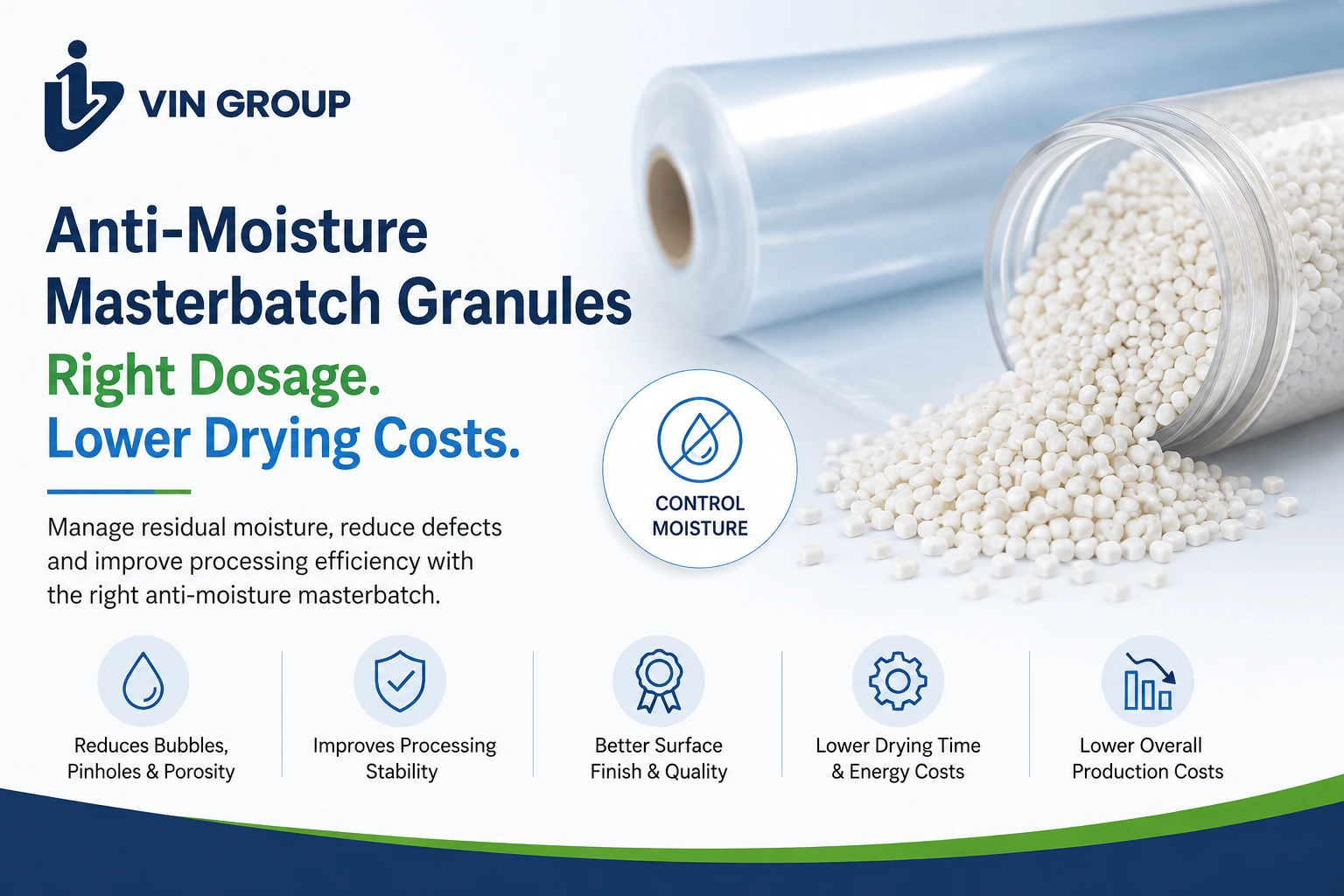
What Dosage & Applications Make Anti-Moisture Masterbatch Granules Cut Drying Costs?
Moisture can create significant processing challenges when manufacturers work with recycled and reclaimed plastics. Residual water in recycled polymers can generate bubbles, pinholes, porosity, surface imperfections, and unstable extrusion when exposed to processing temperatures.
Traditional drying methods can help remove moisture before extrusion, but they also consume energy and add time to the production process. For manufacturers processing large volumes of recycled material, controlling these costs without compromising product quality is an important part of production optimization.
An anti-moisture masterbatch granule can help manage residual moisture during plastic processing. These additives are formulated to react with or bind moisture during processing, reducing the amount of water available to form vapour and contribute to moisture-related defects.
However, performance depends on several factors, particularly the recycled material, moisture level, polymer type, processing conditions, and additive dosage. An anti-moisture masterbatch should therefore be selected and optimized for the specific application rather than treated as a universal replacement for drying.
This guide explains how anti-moisture masterbatch works, how dosage is determined, where it is commonly used, and how it can contribute to lower overall processing costs.
What Is an Anti-Moisture Masterbatch Granule?
An anti-moisture masterbatch granule is a functional additive used to manage residual moisture in plastic materials during processing.
Depending on its formulation, the active components react with or bind residual water so that it is less likely to form problematic vapour during extrusion or other high-temperature processing operations.
This can help manufacturers achieve:
- More stable processing
- Fewer moisture-related bubbles
- Reduced pinholes and porosity
- Improved surface appearance
- More consistent production
- Lower material rejection
- Better utilization of recycled polymers
The granule format can also make the additive easier to handle and dose than loose powder-based solutions.
For recycled plastic processors, this type of additive can be particularly useful when residual moisture remains after normal material preparation or when recycled feedstock has variable moisture levels.
Why Does Moisture Create Problems During Plastic Processing?
Recycled plastics can encounter moisture at several stages of their lifecycle, including washing, drying, transportation, storage, and handling.
If material picks up moisture after drying or is inadequately dried before processing, the water can become a problem once the polymer reaches processing temperatures.
Moisture can contribute to:
- Bubbles and voids
- Pinholes
- Porosity
- Surface imperfections
- Gassing
- Poor surface finish
- Processing instability
- Increased scrap
The extent of the problem depends on the polymer, moisture level, equipment, and processing conditions.
This is why moisture control in plastic processing should begin before the material enters the extruder and continue throughout production.
How Does an Anti-Moisture Masterbatch Work?
An anti-moisture additive for plastics contains moisture-reactive components designed to manage residual water during processing.
When exposed to processing conditions, the active components can react with available moisture and convert it into more stable forms. This reduces the likelihood of free water generating vapour inside the polymer melt.
As a result, manufacturers may see improvements such as:
- Reduced moisture-related bubbles
- Lower porosity
- Smoother film or product surfaces
- More stable melt processing
- Reduced production interruptions
- Improved consistency
The precise mechanism varies by formulation. Therefore, manufacturers should evaluate the technical specifications of the selected product rather than assuming that every moisture absorber operates in the same way.
What Determines Anti-Moisture Masterbatch Dosage?
Anti-moisture masterbatch dosage is one of the most important variables affecting performance and cost.
There is no single dosage that works for every recycled plastic application. The appropriate level depends on factors such as:
Moisture Content
Higher or more variable moisture levels may require a different additive strategy from relatively dry feedstock.
Polymer Type
PE, PP, and mixed recycled polymers can have different processing characteristics. The additive should be compatible with the polymer being processed.
Recycled Material Quality
Post-consumer, post-industrial and reclaimed materials can vary significantly in contamination, moisture and polymer composition.
Processing Conditions
Extrusion temperature, screw speed, residence time and production rate can influence additive performance.
End-Product Requirements
Film, bags, pipes, molded components and compounds have different appearance and performance requirements.
The best dosage should therefore be established through controlled production trials. Using an unnecessarily high dosage can increase formulation costs without providing proportional benefits, while insufficient dosage may not adequately control residual moisture.
What Are the Main Applications of Anti-Moisture Masterbatch?
The applications of anti-moisture masterbatch extend across several plastic-processing operations, particularly those involving recycled or reclaimed polymers.
Recycled Plastic Film
Film extrusion is one of the key applications because residual moisture can contribute to bubbles, pinholes, porosity, and poor surface appearance.
A suitable moisture-management additive can help improve film consistency when moisture is a significant contributor to the defect.
Plastic Bags
Recycled polymer used for bag production may contain variable moisture levels. Moisture management can help support smoother extrusion and more consistent film quality.
Agricultural Films
Agricultural films require consistent thickness and surface quality. Managing residual moisture can help reduce moisture-related defects during extrusion.
Recycled PP Products
Moisture-management additives can support more stable processing when recycled PP contains residual moisture after washing, handling, or storage.
Pipe Extrusion
Moisture can contribute to surface and processing defects in recycled polymer used for pipe applications. An appropriate additive can help manage residual moisture when it is identified as a contributing factor.
Blow Moulding
Moisture control can be relevant when recycled materials are used in blow-moulding applications where trapped moisture may affect appearance and processing consistency.
Injection Moulding
Moisture-sensitive materials can develop processing defects when excess moisture is present. Where applicable, moisture-management additives can form part of the overall processing strategy.
Recycled Polymer Compounding
Moisture control is also important when producing recycled polymer compounds. Managing residual moisture can contribute to more stable processing and consistent compound quality.
The correct product and dosage will vary considerably between these applications.
Why Is Anti-Moisture Masterbatch Useful for Recycled Plastics?
The use of masterbatch for recycled plastics is becoming increasingly important as manufacturers process higher volumes of reclaimed material.
Recycled feedstock is often more variable than virgin resin. Moisture can be introduced during washing, exposed during storage, or remain because of inconsistent drying.
A suitable moisture-management masterbatch can help processors address residual moisture without relying entirely on extended drying cycles.
Potential benefits include:
- Better extrusion stability
- Fewer moisture-related defects
- Improved surface quality
- Lower rejection
- Better production consistency
- More efficient processing of recycled material
However, the additive should complement, not replace, proper material preparation.
How Can It Reduce Plastic Drying Costs?
The potential for plastic drying cost reduction comes from improving the overall moisture-management process rather than simply eliminating drying altogether.
Lower Energy Consumption
Industrial drying systems require energy to heat and move air or otherwise remove moisture from plastic feedstock. Where an additive can effectively manage residual moisture, manufacturers may be able to optimize drying requirements and avoid unnecessarily long drying cycles.
Shorter Preparation Time
If material can be prepared efficiently and residual moisture is managed during processing, production may spend less time waiting for material preparation.
Lower Scrap
Bubbles, pinholes, porosity, and other moisture-related defects can result in rejected products. Reducing these defects means more of the processed material can potentially become saleable output.
Fewer Production Interruptions
Unstable extrusion caused by moisture can lead to adjustments, stoppages, and troubleshooting. Better moisture management can support more consistent production.
Better Raw-Material Utilization
When recycled feedstock can be processed more consistently, manufacturers may reduce losses associated with moisture-related defects.
The actual cost savings should therefore be evaluated using total production economics rather than comparing the price of the additive with the price of drying alone.
Is an Anti-Moisture Masterbatch a Cost-Effective Moisture Absorber?
It can be, provided the additive delivers measurable improvement under the manufacturer’s actual production conditions.
The most useful way to evaluate a cost-effective moisture absorber is to compare the overall production impact before and after implementation.
Manufacturers can monitor:
- Drying energy consumption
- Drying time
- Additive cost
- Scrap percentage
- Rejection rate
- Production output
- Downtime
- Film or product quality
For example, an additive that costs more per kilogram but significantly reduces scrap and energy consumption may provide a better overall return than a cheaper additive that produces limited processing improvement.
Can Anti-Moisture Masterbatch Affect Product Quality?
When the additive is compatible with the polymer and used at an appropriate dosage, its purpose is to improve processing and reduce moisture-related defects rather than compromise the finished product.
Potential quality improvements include:
Better Surface Appearance
Reducing moisture-related bubbles, pinholes, and porosity can produce smoother and more consistent surfaces.
Improved Processing Consistency
Better moisture management can support more stable melt processing and reduce fluctuations caused by residual moisture.
Fewer Moisture-Related Defects
Controlling residual water can reduce defects that would otherwise lead to rejection or reprocessing.
More Consistent Production
When moisture levels are better controlled, manufacturers may achieve greater consistency between batches.
However, additive selection should always consider the end-use requirements of the finished product. Compatibility and performance should be confirmed through production trials.
Can You Use Anti-Moisture Masterbatch With Drying?
Yes.
Using an anti-moisture masterbatch granule does not mean that manufacturers must eliminate drying from the process.
In many applications, the two approaches can complement each other.
Drying can remove a substantial amount of moisture before processing, while the additive can help manage residual moisture that remains in the recycled material.
A practical approach may therefore involve:
Material inspection → appropriate drying → moisture-management additive → controlled extrusion → finished-product evaluation
This is particularly relevant when recycled material has inconsistent or relatively high moisture levels.
An additive should not be used as a justification for processing severely moisture-contaminated material without adequate preparation.
What Are the Limitations of Anti-Moisture Masterbatch?
Anti-moisture masterbatch is not a solution for every extrusion or product-quality problem.
Performance can be affected by:
- Excessive initial moisture
- Poor storage conditions
- Inadequate drying
- Polymer incompatibility
- Contamination
- Incorrect dosage
- Unsuitable processing temperatures
- Poor equipment condition
- Inconsistent recycled feedstock
For example, a fish-eye or surface defect may result from contamination or unmelted polymer rather than moisture. Increasing the moisture-absorber dosage would not necessarily solve such a problem.
Manufacturers should therefore identify the root cause before changing the formulation.
What Are the Best Practices for Using Anti-Moisture Masterbatch?
To get consistent results, manufacturers should integrate the additive into a broader process-control strategy.
Store Recycled Material Properly
Protect pellets, flakes, and other feedstock from unnecessary exposure to humidity.
Check Incoming Material
Monitor changes in moisture and recycled-material quality between batches.
Optimize Dosage
Determine the anti-moisture masterbatch dosage through controlled trials rather than relying on an assumed universal concentration.
Maintain Stable Processing Conditions
Control extrusion temperature, screw speed, residence time, and melt conditions according to the material and equipment.
Check Additive Compatibility
Ensure the moisture-management additive works appropriately with stabilizers, processing aids, slip agents, antiblock additives, and other formulation components.
Track Production Results
Measure defect rates, scrap, output, energy consumption, and finished-product quality to determine whether the additive is delivering a meaningful production benefit.
How Should Manufacturers Select the Right Moisture-Management Additive?
The right additive depends on the material and application rather than simply the manufacturer’s desired dosage.
Before selecting a product, evaluate:
- Polymer type – PE, PP, mixed polyolefin or another polymer system.
- Moisture level – Determine how much residual moisture is actually present.
- Processing method – Film extrusion, pipe extrusion, injection moulding, blow moulding, or compounding.
- End-product requirements – Appearance, strength, clarity, thickness and other specifications.
- Existing formulation – Consider compatibility with other additives.
- Required dosage – Establish the optimum level through trials.
- Economic impact – Compare additive cost against savings from reduced scrap, energy, and production losses.
This approach helps manufacturers select an additive based on actual production requirements rather than price or dosage alone.
How Vin Group Helps With Moisture Management in Plastic Processing
Vin Group is a plastic and rubber additive manufacturer serving applications including plastic recycling and film manufacturing.
Its moisture-management portfolio includes products developed for recycled and reclaimed polymers. MoistGran, for example, is a desiccant masterbatch for recycled and reclaimed polymers used in film extrusion. The product is designed to react with moisture during processing and is positioned to help reduce issues including fish-eye, windows/lensing and porosity.
Vin Group also offers Dessica Spl, a granulated desiccant masterbatch for recycled and reclaimed polymers. It is positioned for applications involving PE, PP and other polymer systems, including film extrusion, with benefits including moisture management, improved surface appearance and processing performance.
The appropriate product and dosage depend on the polymer, recycled-material quality, moisture level, and processing conditions. Technical evaluation and production trials are therefore important when implementing a moisture-management solution.
Conclusion
An anti-moisture masterbatch granule can play an important role in managing residual moisture during recycled plastic processing. By controlling moisture that remains after material preparation, it can help reduce bubbles, pinholes, porosity, and other moisture-related defects while supporting more stable production.
The key to achieving cost benefits is not simply using the highest possible dosage. Manufacturers should determine the appropriate anti-moisture masterbatch dosage based on moisture content, polymer type, processing conditions, and product requirements.
The potential for plastic drying cost reduction should also be evaluated as part of total production economics, including energy consumption, drying time, scrap, rejection and downtime.
Most importantly, anti-moisture masterbatch should be considered part of a broader moisture-management strategy. Proper storage, material inspection, drying where necessary, compatible formulations, and stable processing conditions remain essential.
Vin Group provides additive solutions for recycled plastic and film-processing applications, helping manufacturers address moisture-related processing challenges and improve production consistency.
Frequently Asked Questions
1. What is an anti-moisture masterbatch granule?
An anti-moisture masterbatch granule is a functional additive designed to manage residual moisture in plastic materials during processing. It can help reduce moisture-related bubbles, pinholes, porosity, and other processing defects.
2. What is the correct anti-moisture masterbatch dosage?
There is no universal dosage. The appropriate anti-moisture masterbatch dosage depends on the polymer, moisture level, recycled-material quality, processing conditions, and product requirements. Production trials should be used to establish the optimum level.
3. Can anti-moisture masterbatch reduce plastic drying costs?
It can contribute to plastic drying cost reduction by helping manage residual moisture during processing and potentially reducing energy use, scrap, and production losses. Actual savings depend on the specific production setup.
4. Does anti-moisture masterbatch replace drying?
Not necessarily. Heavily moisture-contaminated material may still require proper drying. The additive is generally best used as part of a broader moisture-management strategy.
5. What are the applications of anti-moisture masterbatch?
Applications can include recycled plastic film, bags, agricultural films, pipe extrusion, blow moulding, injection moulding and recycled polymer compounding, depending on product compatibility and processing requirements.
6. Can anti-moisture masterbatch be used with recycled plastics?
Yes. Moisture-management additives are particularly relevant to recycled plastics because recycled feedstock can have variable moisture levels resulting from washing, storage and handling.
7. How can I choose a cost-effective moisture absorber?
Evaluate more than additive price. Compare dosage, moisture-control performance, scrap reduction, energy consumption, production stability, and finished-product quality to determine the overall cost impact.
8. What anti-moisture solutions does Vin Group offer?
Vin Group offers moisture-management solutions for recycled and reclaimed polymers, including MoistGran and Dessica Spl, with applications covering film extrusion and other plastic-processing requirements.