
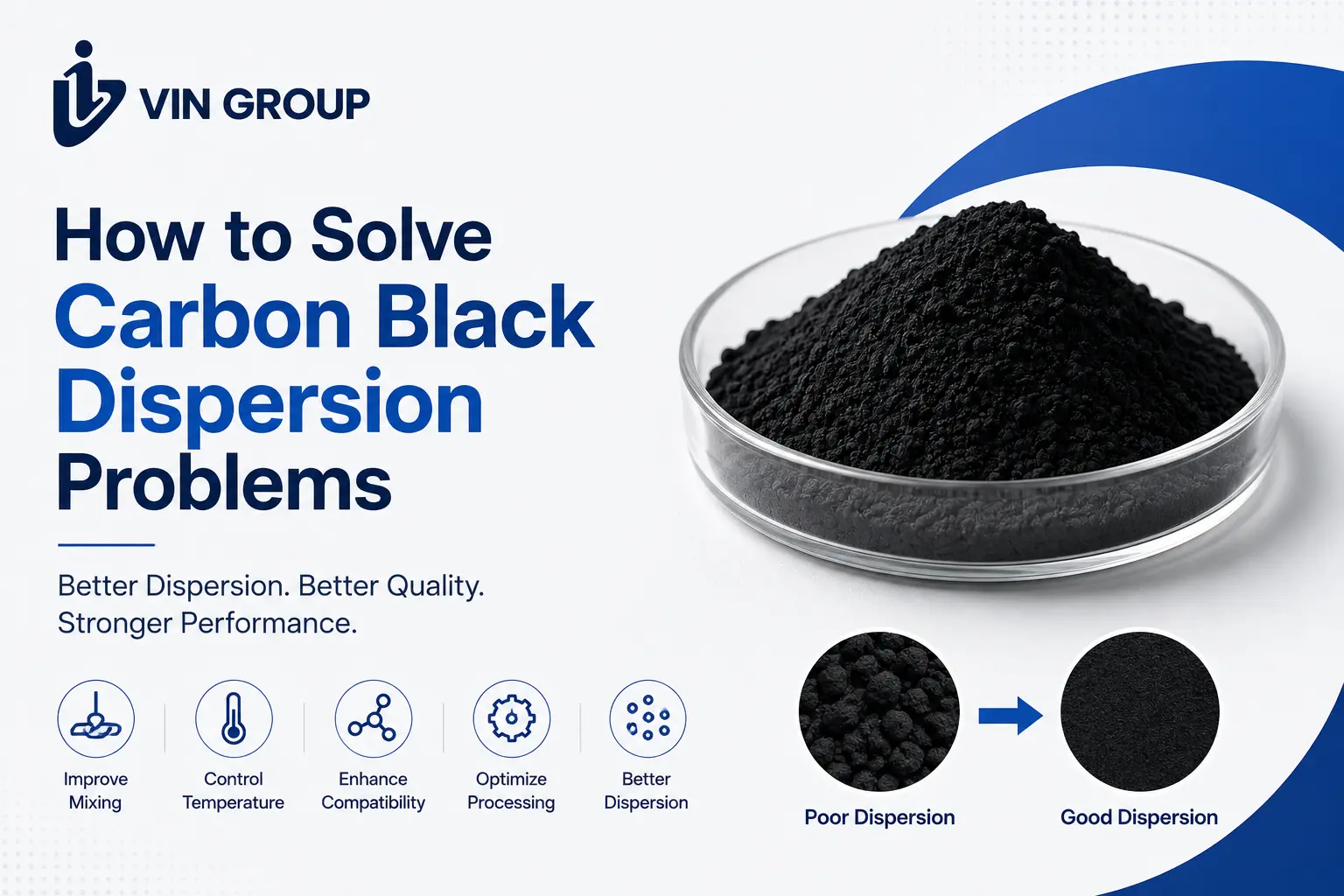
How To Solve Carbon Black Dispersion Problems: A Complete Guide for Better Manufacturing Performance
In polymer processing, masterbatch production, EVA compounds, and molded plastic manufacturing, achieving uniform carbon black distribution is essential for product quality. Poor dispersion can lead to visible defects such as uneven coloration, reduced blackness, brittleness, low gloss, streak marks, coarse particles, and processing failures during extrusion.
Manufacturers frequently face challenges when carbon black particles fail to distribute evenly within the polymer matrix. Without proper processing control, agglomerates can form, resulting in inconsistent performance and product rejection.
This is why industries increasingly seek a reliable poor carbon black dispersion solution to improve consistency, appearance, and mechanical performance.
At Vin Group, manufacturing quality depends on understanding the root causes of carbon black problems and implementing process improvements that support smoother production and stronger product performance.
How To Solve Carbon Black Dispersion Problems
Successfully solving dispersion issues requires a systematic approach involving material selection, processing optimization, mixing improvements, and additive compatibility.
A strong poor carbon black dispersion solution generally focuses on:
- Better raw material compatibility
- Improved mixing conditions
- Proper equipment settings
- Controlled processing temperatures
- Reduced agglomeration risks
- Better dispersing technologies
When properly dispersed, carbon black improves pigmentation, UV stability, conductivity, and product durability.
However, poor carbon black dispersion can negatively affect both aesthetics and mechanical performance.
Why Does Poor Carbon Black Dispersion Happen?
Carbon black naturally forms particle clusters because of strong intermolecular attraction. During production, these clusters become difficult to break apart if mixing conditions are poor.
Common causes include:
Inadequate Mixing Energy
Low shear mixing prevents proper particle separation.
Poor Material Compatibility
Improper resin compatibility reduces effective particle distribution.
Incorrect Temperature Control
Excessive or insufficient heat affects polymer flow and particle movement.
Improper Feeding Ratios
Excess carbon black concentration often increases agglomeration.
Low-Quality Processing Equipment
Outdated systems may fail to generate enough dispersion force.
Identifying the root cause is essential when implementing an effective poor carbon black dispersion solution.
Why Are My Products Showing Brown Tints, Low Gloss, and Decreased Blackness?
This issue generally occurs when carbon black is unevenly dispersed within the polymer system.
Poor dispersion causes:
- Inconsistent pigment distribution
- Reduced light absorption
- Uneven surface reflection
- Weak color saturation
As a result, products may appear faded, brownish, or less glossy.
Manufacturers can solve this problem by:
Improving Mixing Efficiency
Higher shear force helps distribute particles more evenly.
Using a Carbon Black Dispersion Agent
A suitable carbon black dispersion agent improves compatibility between particles and polymers.
Optimizing Processing Temperature
Balanced thermal conditions improve polymer flow and dispersion.
Switching to Pre Dispersed Carbon Black
Many manufacturers prefer pre dispersed carbon black because it reduces agglomeration risks and improves consistency.
Improved dispersion significantly enhances gloss and deep black color performance.
What Causes Visible Streaks and Inconsistencies in the End Product (e.g., Films or Molded Plastics)?
These defects often result from incomplete carbon black distribution.
Poorly dispersed particles create:
- Uneven pigmentation
- Flow inconsistencies
- Surface streaking
- Visible shade variations
This issue becomes particularly noticeable in films, molded plastic products, EVA compounds, and injection-molded parts.
To improve carbon black dispersion, manufacturers should:
Increase Mixing Intensity
Twin-screw extrusion systems often improve particle breakdown.
Improve Resin Compatibility
Choosing the right polymer matrix improves dispersion consistency.
Use Proper Processing Additives
A carbon black dispersion agent helps stabilize particle distribution.
Consistent dispersion significantly reduces visible defects and improves product appearance.
Why Do I See Small “Gel-Like” Agglomerates, “Sand,” or Coarse Spots in My Color Paste or Plastic Solution?
These defects are typically caused by incomplete carbon black separation.
When particles fail to disperse fully, they form:
- Hard clumps
- Gel-like agglomerates
- Sand-like textures
- Surface imperfections
In severe cases, coarse particles may damage product appearance and weaken performance.
A reliable poor carbon black dispersion solution includes:
Better Particle Wetting
Improved wetting helps separate particle clusters.
Using Pre Dispersed Carbon Black
Pre dispersed carbon black reduces manual dispersion challenges and improves consistency.
Improving Extrusion Conditions
Balanced screw speed and shear improve breakdown of agglomerates.
Monitoring Material Quality
Low-grade carbon black often creates additional processing challenges.
Manufacturers should remember that carbon black dissolves differently than traditional pigments. Instead of fully dissolving, carbon black disperses physically throughout the material system. This makes mixing quality extremely important.
Why Do I Get Brittle Material, Hopper Bridging, and Broken Strands During Extrusion?
These issues generally occur because agglomerated carbon black interferes with polymer flow.
Common results include:
- Weak structural consistency
- Material brittleness
- Interrupted feeding
- Uneven melt behavior
- Strand breakage during extrusion
Manufacturers can solve this issue by:
Improving Material Flow
Balanced polymer viscosity improves movement through processing systems.
Optimizing Extruder Settings
Screw speed and temperature strongly influence dispersion quality.
Using Carbon Black Dispersion Agent
A reliable carbon black dispersion agent improves material uniformity and processing behavior.
Preventing Moisture Contamination
Moisture often worsens hopper feeding problems.
Proper process optimization helps manufacturers avoid extrusion-related failures while improving final product quality.
Does Carbon Black Dissolve?
Many manufacturers ask whether carbon black dissolves during processing.
The answer is no.
Carbon black does not chemically dissolve like salt or liquid pigments. Instead, it physically disperses into the polymer matrix.
This means manufacturers must focus on:
- Shear force optimization
- Particle separation
- Better wetting systems
- Improved compatibility additives
Proper distribution is far more important than dissolution in achieving a stable black formulation.
Benefits of Pre Dispersed Carbon Black
Many industries increasingly adopt pre dispersed carbon black because it simplifies processing and improves consistency.
Benefits include:
Better Uniformity
Improves pigmentation consistency.
Reduced Agglomeration
Pre-treated materials reduce clustering risks.
Better Processing Efficiency
Requires less mixing effort.
Improved Surface Quality
Creates smoother and more visually appealing products.
For businesses struggling with repeated black masterbatch problems, pre-dispersed solutions often provide a strong long-term improvement strategy.
Best Practices for Better Carbon Black Dispersion
Manufacturers aiming to improve carbon black dispersion should follow these best practices:
- Use high-quality carbon black grades
- Maintain proper temperature control
- Optimize shear force during mixing
- Improve material compatibility
- Use a reliable carbon black dispersion agent
- Consider pre dispersed carbon black for consistency
- Monitor feeding and extrusion conditions regularly
These improvements significantly reduce defects while improving color depth, gloss, and mechanical performance.
Final Thoughts
Achieving consistent carbon black dispersion is essential for producing high-quality polymer products with superior color depth, surface finish, mechanical strength, and processing stability. By optimizing raw material selection, mixing parameters, processing temperatures, and dispersion techniques, manufacturers can effectively eliminate common issues such as agglomeration, streaking, brittleness, and poor blackness, resulting in improved production efficiency and reduced material waste.
At Vin Group, advanced compounding expertise and process-driven manufacturing practices help industries overcome carbon black dispersion challenges with reliable, high-performance solutions. Through optimized formulations, precision processing, and strict quality control, Vin Group enables manufacturers to achieve uniform dispersion, enhanced product consistency, and long-lasting performance across a wide range of polymer and EVA applications.