
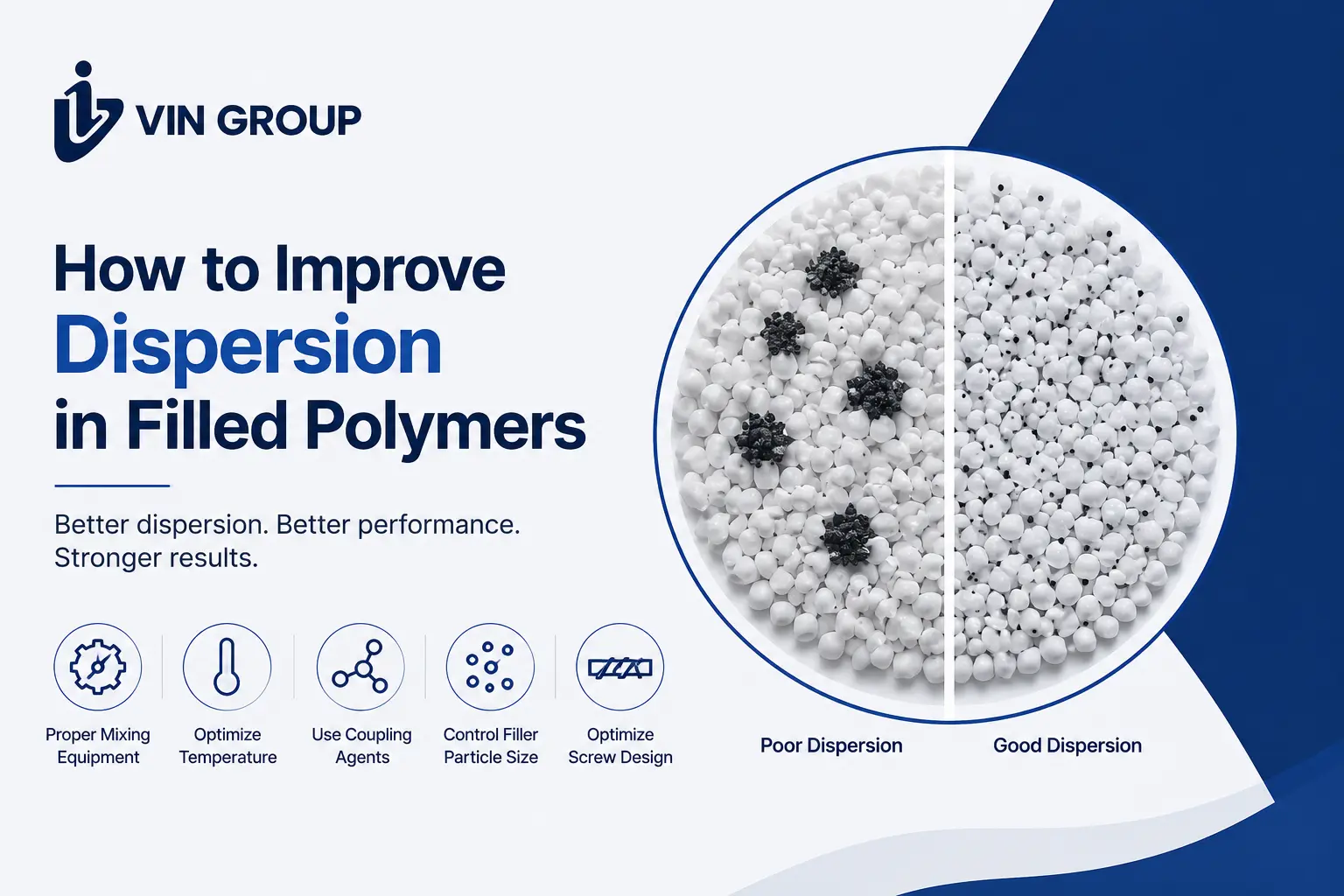
How to Improve Dispersion in Filled Polymers
Introduction
Filled polymers are widely used across industries because they offer enhanced mechanical strength, thermal stability, cost efficiency, and improved performance. Manufacturers commonly add fillers to polymer systems to improve product properties, reduce production costs, and enhance durability. However, one of the most common manufacturing challenges is poor filler distribution.
Improper filler mixing often leads to a dispersion issue, reducing product consistency, mechanical strength, appearance, and long-term performance. Understanding how to improve dispersion in polymer systems is essential for manufacturers seeking better product quality and stable processing conditions.
At Vin Group, maintaining quality-focused polymer processing practices means optimizing filler distribution, material compatibility, and manufacturing parameters to achieve reliable performance. This guide explores effective methods for improving filler distribution, the role of fillers, and best practices for achieving better polymer performance.
Understanding Dispersion in Polymer Systems
Before exploring solutions, it is important to understand dispersion in polymer systems.
Dispersion refers to the uniform distribution of fillers, additives, or reinforcing materials throughout a polymer matrix.
Good dispersion in polymer helps improve:
- Mechanical strength
- Surface finish
- Thermal stability
- Dimensional consistency
- Product durability
- Processing performance
Poor filler distribution creates weak points, uneven performance, and visible product defects.
For manufacturers, controlling dispersion of fillers is critical for maintaining product consistency.
Why Dispersion Issues Occur in Filled Polymers
Many manufacturers face a recurring dispersion issue because of poor processing conditions or material incompatibility.
Common causes include:
Poor Material Mixing
Insufficient mixing prevents fillers from spreading evenly.
Filler Agglomeration
Fillers may cluster together, reducing performance.
Incompatible Materials
Poor compatibility between polymer and filler affects bonding.
Incorrect Processing Temperature
Improper temperature settings reduce mixing efficiency.
High Filler Loading
Excessive filler content increases the risk of uneven distribution.
Understanding the root cause of a dispersion issue helps improve manufacturing quality.
Why Are Fillers Used in Polymers?
Manufacturers add fillers to polymers for several reasons.
Improve Mechanical Strength
Certain fillers improve toughness and rigidity.
Reduce Production Costs
Fillers may reduce material consumption.
Improve Thermal Stability
Heat resistance improves in many applications.
Enhance Product Performance
Fillers improve durability, dimensional stability, and wear resistance.
Improve Surface Characteristics
Some fillers help improve finish and appearance.
The proper dispersion of fillers determines whether these benefits are achieved effectively.
How to Improve Dispersion in Filled Polymers
Several practical methods can significantly improve filler distribution.
Use Proper Mixing Equipment
High-performance mixers improve filler uniformity.
Twin-screw extruders are commonly used to improve mixing efficiency.
Optimize Processing Temperature
Correct temperature improves melt flow and filler distribution.
Excessively low temperatures reduce dispersion efficiency, while overheating may degrade materials.
Use Coupling Agents
Coupling agents improve compatibility between fillers and polymers.
This improves bonding and reduces separation.
Control Filler Particle Size
Smaller and more uniform particles generally disperse more effectively.
Optimize Screw Design
Proper screw geometry improves shear mixing and filler distribution.
At Vin Group, optimizing processing parameters helps manufacturers improve consistency and reduce filler-related defects.
Factors Affecting Dispersion of Fillers
Several factors influence dispersion of fillers in polymer systems.
Filler Type
Different fillers behave differently during processing.
Examples include:
- Calcium carbonate
- Talc
- Carbon black
- Glass fiber
- Mineral fillers
Polymer Compatibility
The interaction between polymer and filler significantly affects dispersion.
Mixing Time
Insufficient mixing creates uneven distribution.
Processing Speed
Balanced processing improves homogeneity.
Equipment Capability
Advanced extrusion systems improve mixing performance.
Manufacturers seeking how to improve dispersion should carefully evaluate these variables.
What Are the Factors of Dispersion That Can Influence the Properties of Composites?
Several dispersion-related factors directly affect composite performance.
Filler Distribution Uniformity
Evenly distributed fillers improve consistency.
Particle Size and Shape
Smaller particles generally improve interaction with polymers.
Interfacial Bonding
Strong bonding improves strength and durability.
Mixing Efficiency
Better mixing reduces weak spots.
Filler Concentration
Excessive loading may increase agglomeration.
Good dispersion improves composite quality and long-term performance.
How Can One Improve the Properties of Polymers?
Several methods help improve polymer performance.
Better Filler Distribution
Improved dispersion in polymer enhances strength and consistency.
Additives and Stabilizers
Additives improve flexibility, heat resistance, and durability.
Optimized Processing Conditions
Correct temperature and pressure improve material performance.
Material Compatibility Improvements
Coupling agents improve polymer-filler bonding.
Quality Raw Materials
Consistent raw material quality improves end-product reliability.
Improving filler distribution remains one of the most effective solutions.
What Is the Rigidity of a Polymer?
Rigidity refers to a material’s ability to resist deformation under stress.
In polymer manufacturing, rigidity depends on:
- Polymer structure
- Filler concentration
- Molecular arrangement
- Processing quality
The proper dispersion of fillers often increases rigidity by improving structural stability.
However, excessive filler loading may reduce flexibility.
Balanced formulation is important for optimal performance.
Common Dispersion Problems in Polymer Manufacturing
Manufacturers frequently experience several dispersion issue challenges.
Filler Clustering
Agglomerated fillers reduce performance.
Surface Defects
Poor dispersion may create uneven textures.
Mechanical Weakness
Weak bonding affects strength.
Inconsistent Product Quality
Uneven filler distribution creates product variation.
Poor Processability
Improper mixing affects extrusion and molding.
Addressing these issues improves manufacturing reliability.
Best Practices to Improve Dispersion
Manufacturers can improve filler performance through several best practices.
Use High-Shear Mixing
Strong shear improves filler breakdown.
Pre-Treat Fillers
Surface treatment improves compatibility.
Maintain Correct Processing Temperature
Balanced temperatures improve polymer flow.
Avoid Overloading Fillers
Excess filler content increases agglomeration risk.
Monitor Production Parameters
Regular process monitoring improves consistency.
At Vin Group, quality-focused manufacturing emphasizes optimized mixing and controlled processing to improve polymer performance.
Importance of Dispersion in Polymer Performance
Good dispersion in polymer significantly impacts final product quality.
Benefits include:
- Better strength
- Improved rigidity
- Enhanced thermal resistance
- Smoother surface finish
- Better dimensional consistency
- Reduced defects
Manufacturers that improve dispersion of fillers often achieve better processing stability and customer satisfaction.
Future Trends in Filled Polymer Manufacturing
Modern polymer manufacturing increasingly focuses on:
Advanced Mixing Technology
Improved extruders enhance filler dispersion.
Smart Additives
Compatibility-enhancing additives improve performance.
Sustainable Materials
Recycled and eco-friendly fillers are becoming more common.
Better Composite Engineering
Advanced material formulations improve durability.
These developments continue improving polymer performance across industries.
Conclusion
Achieving uniform filler dispersion is essential for producing high-performance polymer products with consistent strength, durability, and processing efficiency. By selecting the right materials, optimizing compounding processes, and maintaining precise manufacturing conditions, businesses can minimize dispersion-related issues and enhance overall product quality.
Vin Group supports manufacturers by providing advanced polymer solutions and technical expertise that help optimize filler distribution, improve material compatibility, and streamline production processes. With a strong focus on innovation, quality assurance, and customer-specific requirements, Vin Group enables industries to manufacture reliable, high-quality filled polymers that deliver consistent performance across a wide range of applications.