
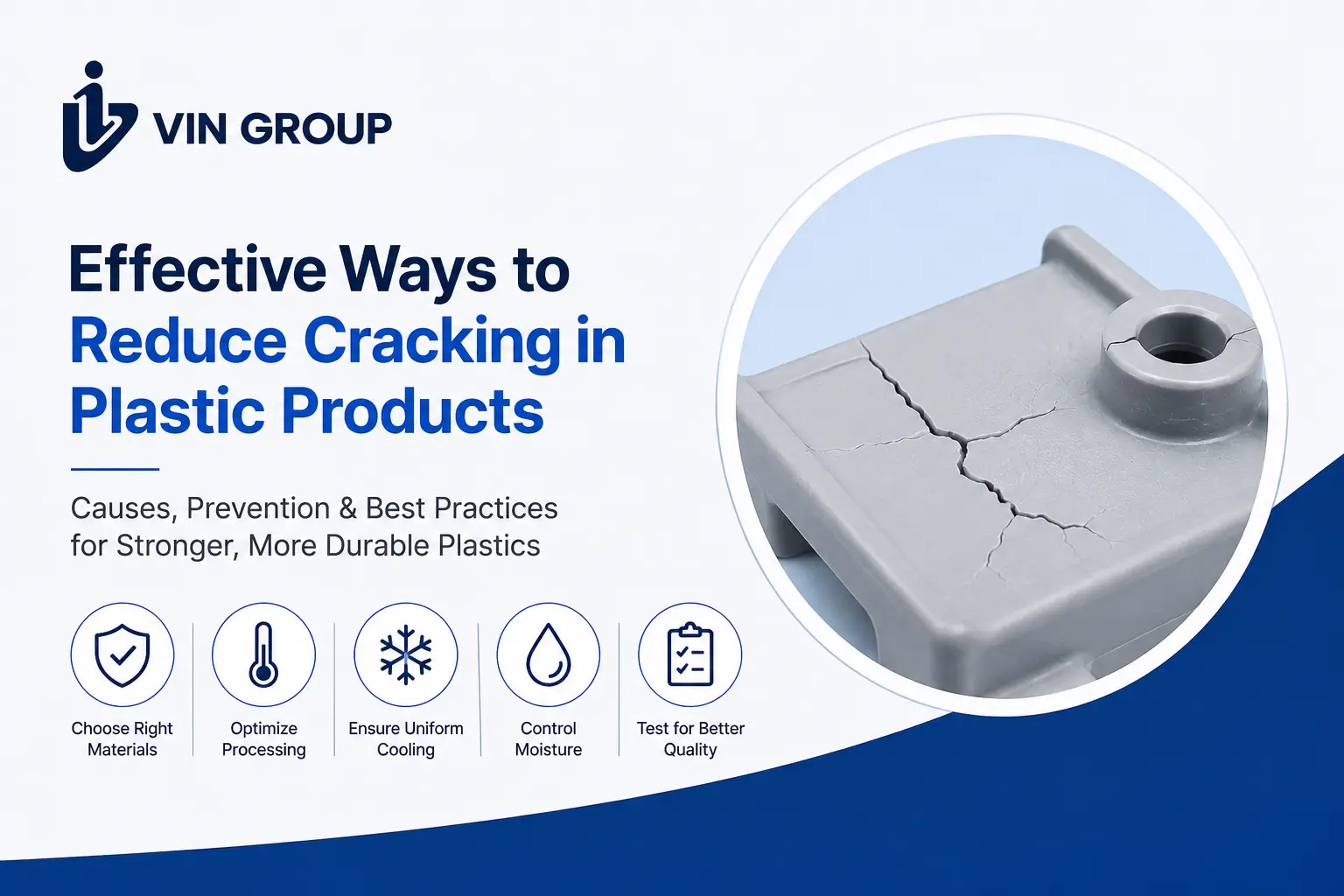
Effective Ways to Reduce Cracking in Plastic Products
Introduction
Plastic products are widely used across industries because of their durability, flexibility, lightweight nature, and cost-effectiveness. From automotive components and packaging materials to containers, household products, and industrial applications, plastics play a major role in modern manufacturing. However, one common challenge manufacturers face is cracking plastic products.
Cracks in plastics not only reduce product quality but also affect durability, performance, and customer satisfaction. Understanding the causes and implementing effective solutions is essential for manufacturers aiming to improve product lifespan and reduce production losses.
At Vin Group, quality-focused manufacturing practices emphasize material consistency, proper processing conditions, and defect prevention to improve plastic product performance. This blog explores the common causes of cracking, prevention methods, repair options, and practical ways to improve plastic durability.
Understanding Stress Cracking in Plastics
Before discussing prevention methods, it is important to understand stress cracking in plastics.
Stress cracking refers to fractures or surface cracks that develop when plastic materials experience environmental stress, mechanical pressure, chemical exposure, or poor processing conditions.
Several factors contribute to stress cracking in plastics, including:
- Improper material selection
- Internal stress during molding
- Chemical exposure
- Excessive pressure
- Moisture contamination
- Extreme temperature fluctuations
If ignored, stress cracks may expand over time and compromise product performance.
Common Causes of Plastic Cracking
Manufacturers often experience cracking because of multiple processing or environmental issues.
Material Degradation
Excessive processing temperatures may weaken polymer structure.
Overheated plastics become more vulnerable to cracks.
Poor Material Compatibility
Using incompatible additives or recycled materials may affect strength.
Internal Stress During Manufacturing
Improper cooling or excessive molding pressure creates internal stress.
Chemical Exposure
Certain cleaning agents or chemicals may weaken plastics.
Environmental Conditions
Heat, UV exposure, and moisture may reduce durability over time.
Identifying root causes is essential for reducing cracking in plastic products.
How to Prevent Plastic From Cracking?
Several preventive measures can significantly improve plastic durability.
Use High-Quality Raw Materials
Material quality plays a major role in crack resistance.
Choosing suitable polymers improves strength and performance.
Optimize Processing Temperature
Balanced processing temperatures reduce internal stress and material degradation.
Improve Cooling Systems
Uniform cooling prevents uneven shrinkage and cracking.
Reduce Mechanical Stress
Design improvements can distribute pressure more evenly.
Avoid Chemical Exposure
Use compatible cleaning and maintenance materials.
At Vin Group, maintaining stable manufacturing conditions helps improve product consistency and reduce defects.
Manufacturing Techniques That Help Reduce Cracking in Plastic Products
Preventing cracks during manufacturing is far more effective than repairing damaged products later. By optimizing material selection, processing parameters, and product design, manufacturers can significantly improve the durability and performance of plastic components.
Optimize Material Selection
Selecting the right polymer for the intended application is the first step in preventing cracks. Different plastics offer varying levels of impact resistance, flexibility, and chemical stability. Manufacturers should evaluate factors such as load-bearing requirements, operating temperatures, UV exposure, and environmental conditions before choosing a material.
Maintain Proper Processing Conditions
Incorrect processing parameters can introduce residual stress that later develops into cracks. Maintaining the recommended melt temperature, mould temperature, injection pressure, and cooling cycle helps ensure uniform material flow and minimizes internal stress.
Ensure Uniform Cooling
Uneven cooling often leads to differential shrinkage, warpage, and stress concentration within the part. Proper mould cooling design and controlled cooling rates help produce dimensionally stable components with improved crack resistance.
Control Moisture Levels
Certain engineering plastics absorb moisture before processing. If these materials are not dried correctly, moisture can cause hydrolytic degradation, reducing mechanical strength and increasing the likelihood of cracking. Using properly dried raw materials helps maintain product integrity.
Improve Part Design
Well-designed plastic components distribute stress more evenly during service. Features such as generous corner radii, uniform wall thickness, smooth transitions, and the elimination of sharp edges help reduce stress concentration and improve long-term durability.
Use High-Quality Additives
Performance additives can significantly improve the resistance of plastic products to cracking. Depending on the application, manufacturers may incorporate impact modifiers, UV stabilizers, antioxidants, processing aids, or heat stabilizers to enhance toughness, weather resistance, and long-term performance.
Perform Regular Quality Testing
Routine quality inspections help identify defects before products reach the customer. Tests for impact strength, tensile strength, dimensional stability, and environmental stress crack resistance (ESCR) enable manufacturers to validate product quality and maintain consistent production standards.
Does WD-40 Make Plastic Brittle?
Another frequently asked question is: Does WD-40 make plastic brittle?
The answer depends on the type of plastic.
Certain plastics may react negatively to chemical exposure over time.
In some cases, prolonged chemical contact may weaken plastic surfaces or affect durability.
Manufacturers should always verify chemical compatibility before use.
Best Practices to Reduce Cracking in Plastic Products
Manufacturers can reduce cracking risks by following these best practices:
Improve Material Selection
Choose polymers suitable for the application.
Monitor Processing Conditions
Maintain stable temperatures and pressures.
Reduce Residual Stress
Balanced cooling improves structural strength.
Conduct Quality Testing
Regular inspections identify weak areas early.
Prevent Moisture Contamination
Dry materials before processing.
At Vin Group, consistent manufacturing practices support stronger, longer-lasting plastic products.
Conclusion
Key Takeaways
Reducing cracks in plastic products starts with understanding their root causes. Factors such as material degradation, residual stress, improper cooling, moisture contamination, chemical exposure, and unsuitable processing conditions can all contribute to cracking and reduced product performance. By selecting high-quality raw materials, optimizing molding parameters, maintaining consistent cooling, and conducting regular quality inspections, manufacturers can significantly improve product durability while minimizing production defects.
Final Thoughts
Crack prevention is not just about repairing damaged products, it begins with designing and manufacturing plastics that are strong, reliable, and built to perform under demanding conditions. A combination of proper material selection, controlled processing, preventive maintenance, and effective quality control helps manufacturers extend product lifespan, reduce waste, and improve customer satisfaction.
At Vin Group, we believe that consistent manufacturing practices and continuous process optimization are the foundation of high-performance plastic products. By focusing on defect prevention and material excellence, we help manufacturers achieve reliable production, superior product quality, and long-term operational success.