
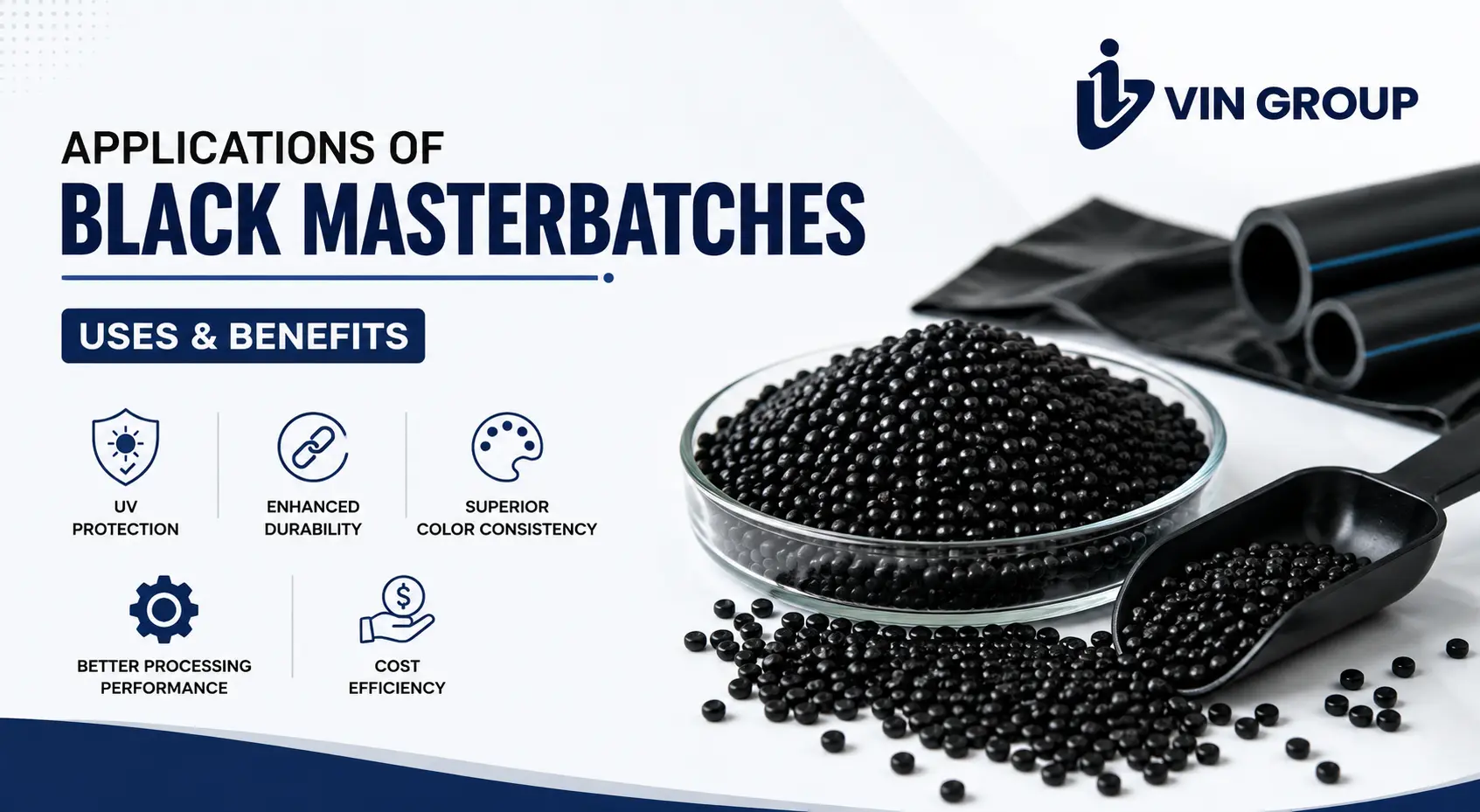
Applications of Black Masterbatches | Uses & Benefits
Black masterbatch plays an essential role in modern plastic manufacturing by improving product appearance, durability, UV resistance, and processing performance. Widely used across industries such as packaging, automotive, agriculture, construction, and consumer goods, black masterbatch helps manufacturers achieve consistent color while improving the overall quality of plastic products.
Understanding the Applications of Black Masterbatches | Uses & Benefits is important for manufacturers seeking better product performance, long-term durability, and reliable coloration in polymer-based products. Whether used for injection molding, extrusion, films, or pipes, black masterbatch remains one of the most widely used additives in plastic processing.
At Vin Group, maintaining high-quality polymer standards includes understanding advanced additive technologies that improve durability, functionality, and product consistency.
In this guide, we will explore the applications, benefits, compatibility, safety, and industrial importance of black masterbatch.
What Is Black Masterbatch?
Before discussing applications, it is important to understand what black masterbatch is.
Black masterbatch is a concentrated mixture of:
- Carbon black pigments
- Polymer carrier resin
- Processing additives
This mixture is added to plastics during manufacturing to create a uniform black color while enhancing performance properties.
A black color masterbatch for plastic helps improve:
- Color consistency
- UV resistance
- Surface appearance
- Mechanical durability
- Processing efficiency
Black masterbatch is widely used because it offers both visual and functional benefits.
At Vin Group, quality-focused material solutions help improve polymer performance across industries.
Applications of Black Masterbatches
There are several important black masterbatch applications in plastic manufacturing.
Packaging Industry
Black masterbatch is widely used in packaging materials because of its aesthetic appeal and protective performance.
Applications include:
- Plastic containers
- Films
- Packaging sheets
- Food trays
Automotive Industry
Automotive manufacturers use black masterbatch for:
- Interior plastic components
- Exterior trims
- Cable insulation
- Protective covers
Agriculture Industry
Agricultural films and irrigation systems commonly use black masterbatch for UV resistance.
Construction Industry
Used in:
- Pipes
- Insulation materials
- Plastic sheets
- Cable protection systems
Consumer Products
Many household and industrial products rely on black masterbatch for plastic products to achieve consistent appearance and durability.
These diverse black masterbatch applications demonstrate its importance across industries.
Uses of Black Masterbatch in Plastics
The uses of black masterbatch in plastics extend beyond coloration.
Manufacturers use black masterbatch to:
Improve Appearance
Provides deep, consistent black color.
Enhance UV Protection
Improves resistance to sunlight degradation.
Improve Durability
Helps materials resist environmental damage.
Improve Heat Stability
Some formulations improve thermal performance.
Improve Processing Efficiency
Enhances dispersion during production.
At Vin Group, proper additive selection supports better long-term product reliability.
Benefits of Black Masterbatch
There are several important benefits of black masterbatch for plastic manufacturers.
Superior Color Consistency
Provides uniform black pigmentation.
Better UV Resistance
Improves outdoor durability.
Improved Mechanical Strength
Some formulations improve material stability.
Cost Efficiency
Concentrated pigments reduce processing complexity.
Better Weather Resistance
Improves resistance to environmental conditions.
Easy Processing
Compatible with multiple polymer systems.
These benefits of black masterbatch make it an essential additive in polymer manufacturing.
How Does It Improve Plastic Durability?
A frequently asked question is, how does it improve plastic durability?
Black masterbatch improves durability primarily through carbon black reinforcement.
UV Protection
Carbon black helps absorb harmful UV radiation.
This reduces:
- Cracking
- Fading
- Material degradation
Thermal Stability
Improved heat resistance enhances long-term performance.
Better Mechanical Properties
Certain formulations improve toughness and structural integrity.
Environmental Resistance
Materials resist weathering more effectively.
This makes black masterbatch for UV protection especially valuable for outdoor applications.
Black Masterbatch for UV Protection
One of the most important applications is black masterbatch for UV protection.
UV exposure may weaken plastic materials over time.
Black masterbatch helps by:
Blocking UV Radiation
Carbon black absorbs sunlight and reduces degradation.
Preventing Cracking
Improved durability minimizes brittleness.
Preserving Appearance
Products retain color longer.
Increasing Product Lifespan
Outdoor products last significantly longer.
This is especially important for pipes, films, and agricultural applications.
Carbon Black Masterbatch Uses
Several carbon black masterbatch uses help improve polymer performance.
Common applications include:
Plastic Pipes
Improves UV resistance and durability.
Cable Insulation
Protects electrical systems.
Industrial Films
Improves weather resistance.
Automotive Components
Enhances toughness and aesthetics.
Consumer Goods
Provides strong coloration and durability.
Carbon black remains one of the most widely used additives in black masterbatch technology.
What Polymers Are Compatible With It?
A common question is, what polymers are compatible with it?
Black masterbatch is compatible with several polymer systems.
Common compatible materials include:
Polyethylene (PE)
Widely used in films and pipes.
Polypropylene (PP)
Used for packaging and industrial products.
Polystyrene (PS)
Suitable for molded products.
ABS
Common in automotive and electronics.
PVC
Used in pipes and cable insulation.
Selecting compatible carrier resins improves dispersion and performance.
At Vin Group, polymer compatibility remains essential for maintaining product consistency.
Black Masterbatch in Injection Molding
Black masterbatch in injection molding is commonly used for creating durable molded plastic products.
Benefits include:
Uniform Color Distribution
Consistent appearance across products.
Better Surface Finish
Improves product aesthetics.
Enhanced Durability
Improves structural performance.
Easy Processing
Blends efficiently during molding.
Injection molding industries widely rely on black masterbatch for consistent product quality.
Black Masterbatch in Extrusion Process
Another important application is black masterbatch in the extrusion process.
Extrusion products include:
- Plastic pipes
- Films
- Profiles
- Sheets
Benefits include:
Better Dispersion
Uniform pigment distribution improves consistency.
Improved UV Stability
Outdoor products perform better.
Higher Product Quality
Enhanced durability improves lifespan.
The black masterbatch in extrusion process helps manufacturers improve reliability across large-scale production systems.
Is It Safe to Use in Food-Contact Packaging?
Many manufacturers ask, is it safe to use in food-contact packaging?
Certain black masterbatch formulations are designed specifically for food-contact applications.
However, safety depends on:
- Regulatory approval
- Pigment formulation
- Material composition
- Intended use
Manufacturers should verify food-grade compliance before use.
At Vin Group, maintaining quality and regulatory standards supports safer polymer applications.
What Industries Use Black Masterbatch?
A common question is, what industries use black masterbatch?
Several industries depend on black masterbatch.
Packaging Industry
For films and containers.
Automotive Industry
For trims and molded parts.
Agriculture
For irrigation and protective films.
Construction
For pipes and insulation.
Electronics
For wire insulation and protective components.
Consumer Goods
For durable molded products.
Its versatility makes black masterbatch one of the most widely used additives in plastics.
Best Practices for Using Black Masterbatch
Manufacturers can improve results by:
Selecting Compatible Polymers
Better compatibility improves dispersion.
Maintaining Proper Dosage
Balanced concentration improves consistency.
Optimizing Processing Conditions
Stable temperatures improve performance.
Choosing Quality Carbon Black
Premium pigments improve durability.
Conducting Quality Testing
Routine testing ensures product reliability.
At Vin Group, maintaining superior additive performance helps improve polymer quality across industries.
Conclusion
Selecting the right black masterbatch is an important step toward producing plastic products that offer lasting performance, visual consistency, and resistance to environmental challenges. By balancing colour quality with functional benefits, manufacturers can improve product value while reducing production-related issues.
With extensive experience in polymer additives, Vin Group delivers black masterbatch solutions that support efficient processing and reliable product performance. Our focus on quality, innovation, and customer success helps manufacturers achieve consistent results across diverse industries.