
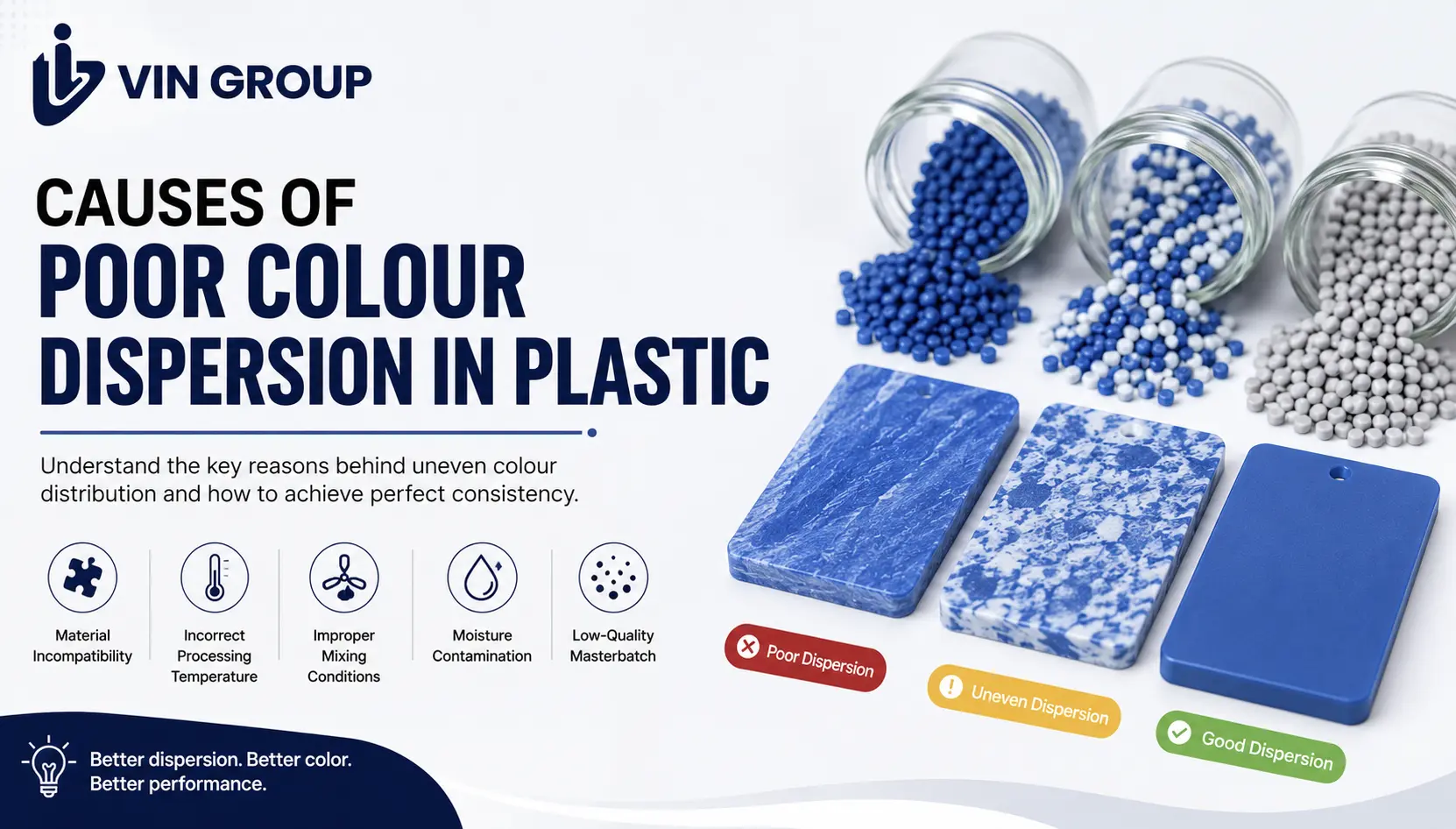
Causes of Poor Colour Dispersion in Plastic
Plastic coloration plays an important role in product appearance, branding, functionality, and market value. In industries such as packaging, automotive, consumer goods, electronics, and construction, consistent and uniform coloring significantly affects product quality. However, one of the most common manufacturing challenges is uneven color distribution, commonly referred to as poor colour dispersion.
Understanding the causes of poor colour dispersion in plastic is essential for manufacturers looking to improve consistency, reduce product rejection, and maintain high production standards. Poor color mixing often leads to streaks, discoloration, gloss variations, uneven pigmentation, and structural inconsistencies.
At Vin Group, maintaining high-quality polymer processing standards includes ensuring uniform color distribution and minimizing defects that affect final product performance.
In this guide, we will discuss the major causes of poor colour dispersion in plastic, methods for improvement, discoloration issues, shrinkage-related defects, and effective solutions for consistent manufacturing outcomes.
What Is Colour Dispersion in Plastic?
Before understanding defects, it is important to understand the dispersion of plastic.
Dispersion in plastics refers to the uniform distribution of pigments, fillers, or additives throughout a polymer matrix. Good color dispersion ensures pigments spread evenly, resulting in consistent color, gloss, and surface quality.
Poor dispersion may result in:
- Color streaking
- Uneven pigmentation
- Surface inconsistency
- Weak mechanical performance
- Product rejection
Achieving uniform color distribution improves aesthetics and material reliability.
At Vin Group, optimized polymer processing supports stronger and more visually consistent plastic products.
Causes of Poor Colour Dispersion in Plastic
Manufacturers frequently face challenges with poor dispersion during processing. Understanding the root causes helps reduce defects and improve consistency.
Poor Material Compatibility
One of the major causes of uneven color distribution is incompatibility between pigments and the polymer resin.
When materials are incompatible:
- Pigments may cluster together
- Color distribution becomes uneven
- Surface defects increase
Choosing compatible masterbatch and polymer systems significantly improves results.
Improper Mixing Conditions
Insufficient mixing often leads to poor pigment distribution.
Weak shear force during compounding may result in:
- Color streaks
- Uneven shade variation
- Pigment clumping
Proper mixing improves the dispersion of plastic and enhances final product appearance.
Incorrect Processing Temperature
Temperature strongly affects pigment flow and distribution.
Low temperatures may prevent pigments from dispersing evenly.
Excessively high temperatures may:
- Burn pigments
- Cause discoloration
- Damage polymer properties
Stable temperature control helps reduce color inconsistency.
Low-Quality Color Masterbatch
Low-grade masterbatch often causes uneven pigmentation and weak color consistency.
Poor-quality pigments may:
- Disperse unevenly
- Fade quickly
- Cause gloss differences
High-quality masterbatch improves consistency and long-term performance.
Moisture Contamination
Excess moisture may interfere with polymer flow and color consistency.
Moisture-related issues may lead to:
- Surface defects
- Poor dispersion
- Material degradation
Proper drying helps maintain uniform color.
What Causes Dispersion Problems in Plastics?
A commonly searched topic is what causes dispersion issues in polymers.
Dispersion problems usually occur because of:
Agglomeration of Pigments
Pigments cluster together rather than spreading evenly.
Poor Equipment Performance
Inadequate mixing systems reduce efficiency.
Incompatible Additives
Poor compatibility weakens pigment distribution.
Incorrect Processing Parameters
Temperature and pressure significantly affect performance.
Inconsistent Material Quality
Poor raw materials increase defect risks.
Understanding what causes dispersion helps manufacturers optimize production quality.
What Causes Plastic to Change Color?
Manufacturers often ask, what causes plastic to change color during or after production.
Several factors may affect plastic coloration.
Heat Degradation
Excess heat may damage pigments.
UV Exposure
Sunlight can fade color over time.
Oxidation
Exposure to oxygen may alter appearance.
Poor Color Dispersion
Uneven pigment mixing creates shade inconsistencies.
Contamination
Foreign particles sometimes affect the final color.
At Vin Group, stable manufacturing practices support long-term color consistency.
What Causes Discoloration in Injection Molding?
Another frequently asked question is, what causes discoloration in injection molding?
Common reasons include:
Overheating
Excessive temperatures burn material.
Material Contamination
Contaminants alter appearance.
Poor Masterbatch Distribution
Uneven mixing causes color variation.
Improper Residence Time
Material remaining too long in the barrel may degrade.
Equipment Residue
Residual materials sometimes contaminate production batches.
Proper maintenance and optimized settings help reduce injection molding discoloration.
How Does Plastic Get Colored?
A common technical question is, how does plastic get colored?
Plastic coloring generally occurs through:
Color Masterbatch
Concentrated pigments are blended with polymers.
Liquid Colorants
Liquid pigments are added during processing.
Dry Pigments
Powder-based pigments are mixed into plastic.
Compounded Coloring
Pre-colored compounds create a uniform appearance.
Color masterbatch remains one of the most widely used methods due to its consistency and processing efficiency.
Causes of Plastic Shrinkage
Although color problems are common, manufacturers often encounter dimensional defects as well.
Understanding the causes of plastic shrinkage helps reduce product inconsistencies.
Common causes include:
Uneven Cooling
Different cooling rates affect dimensions.
Improper Mold Design
Poor mold design may increase shrinkage.
Material Characteristics
Some polymers naturally shrink more than others.
Incorrect Processing Conditions
Pressure and temperature affect material contraction.
Shrinkage often indirectly affects color consistency by changing surface appearance.
Causes of Plastic Shrinkage Cracking
Manufacturers also ask about the causes of plastic shrinkage cracking.
Cracking may occur because of:
Excess Internal Stress
Rapid cooling creates tension.
Uneven Material Distribution
Poor structure weakens integrity.
Improper Processing Temperature
Incorrect heat settings may damage material structure.
Poor Dispersion
Uneven additive distribution weakens material performance.
Reducing poor dispersion helps minimize cracking risks.
How to Restore Color in Plastic?
A common consumer and industrial question is, how to restore color in plastic?
Several methods may improve faded appearance.
Surface Cleaning
Removing dirt improves visual clarity.
Plastic Polish
Polishing may restore shine.
Heat Restoration
Controlled heat sometimes improves appearance.
Protective Coatings
UV protectants help preserve color.
Recoloring Methods
Industrial recoloring improves faded plastic surfaces.
Preventive manufacturing practices remain the most effective long-term solution.
How to Improve Colour Dispersion in Plastic
Manufacturers can improve results by:
Using High-Quality Masterbatch
Premium pigments improve uniformity.
Improving Mixing Efficiency
High-shear mixing reduces agglomeration.
Optimizing Temperature
Stable heat improves pigment flow.
Drying Raw Materials
Reduced moisture improves consistency.
Maintaining Equipment
Clean processing systems reduce contamination.
At Vin Group, maintaining advanced polymer processing standards helps ensure visually appealing and reliable plastic products.
Best Practices for Preventing Poor Colour Dispersion
To reduce defects, manufacturers should:
Improve Material Compatibility
Compatible systems improve blending.
Monitor Processing Conditions
Stable settings improve consistency.
Use Better Mixing Equipment
Advanced machinery improves dispersion.
Conduct Quality Testing
Routine testing detects problems early.
Optimize Masterbatch Ratios
Balanced formulations improve color quality.
These practices significantly reduce production issues.
Conclusion
Poor colour dispersion often signals underlying processing or material challenges that can affect both product appearance and structural performance. Addressing these issues through better mixing, compatible formulations, and stable processing conditions not only improves colour uniformity but also enhances manufacturing efficiency and reduces costly product rejections.
At Vin Group, we combine premium polymer solutions with practical industry expertise to help manufacturers overcome colour dispersion challenges. Our focus on consistent quality enables businesses to produce visually appealing, durable, and dependable plastic products.