
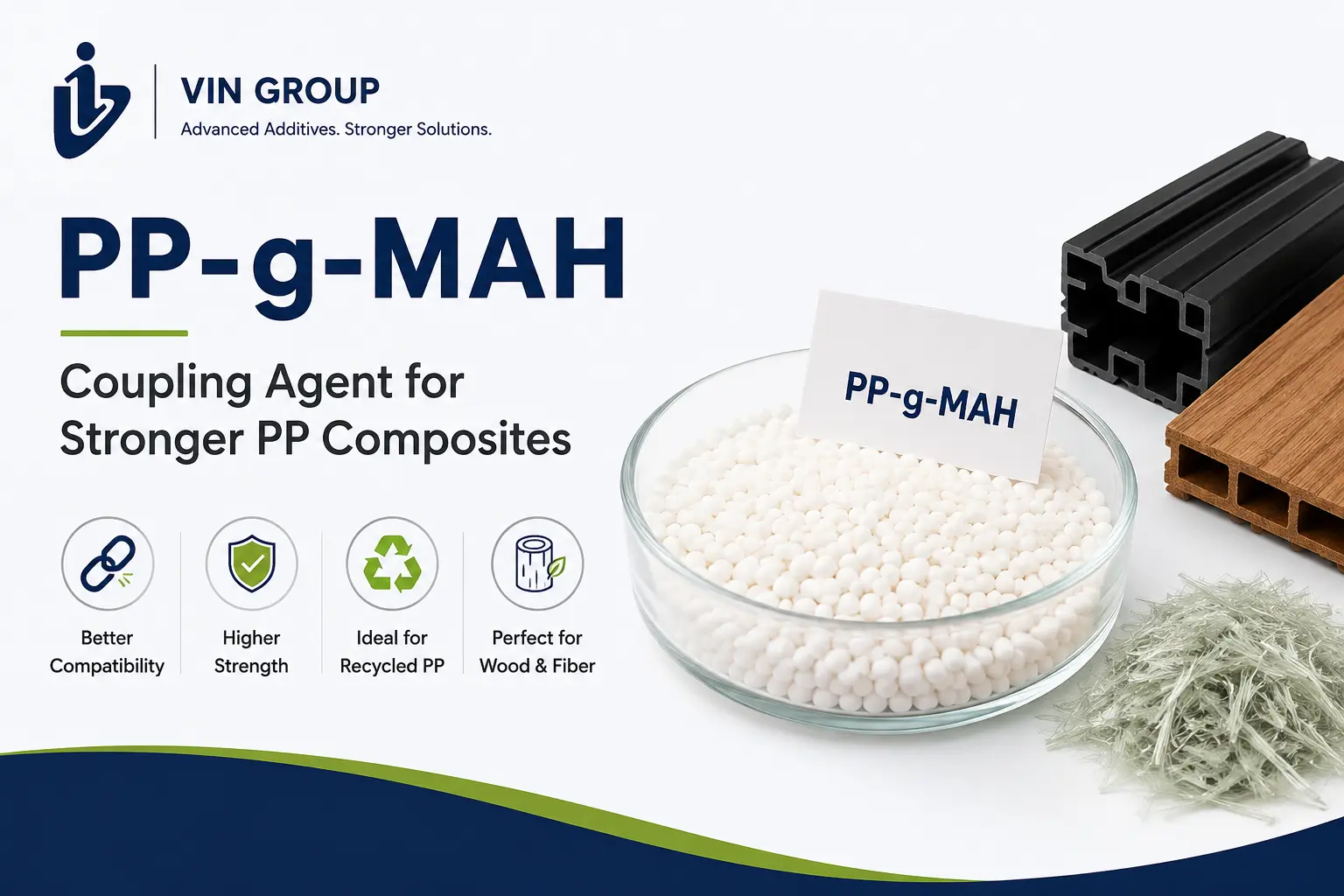
PP-g-MAH Coupling Agent Explained: Benefits for Glass, Wood & Recycled PP Composites
Polypropylene (PP) is one of the most widely used thermoplastics because of its lightweight nature, chemical resistance, and cost-effectiveness. However, when polypropylene is reinforced with glass fibers, natural fibers, wood flour, or recycled plastics, achieving strong interfacial bonding between the different materials becomes a major challenge. This is where PP-g-MAH plays a critical role.
As a highly effective PP-g-MAH coupling agent, it improves compatibility between polypropylene and reinforcing materials, resulting in stronger composites with better mechanical performance, durability, and processing characteristics. Whether manufacturing automotive components, wood-plastic composites (WPCs), consumer products, or recycled PP blends, selecting the right compatibilizer is essential for producing high-quality materials.
This guide explains how PP-g-MAH improves compatibility, its benefits in various polypropylene applications, and why it has become one of the most widely used polymer coupling agents in modern plastic manufacturing.
What Is PP-g-MAH?
PP-g-MAH, also known as maleic anhydride grafted polypropylene, is a modified polypropylene in which maleic anhydride functional groups are chemically grafted onto the polypropylene backbone.
The maleic anhydride groups interact with polar materials such as glass fibers, wood fibers, mineral fillers, and recycled polymers, while the polypropylene backbone remains compatible with the PP matrix. This dual compatibility allows the material to act as a bridge between dissimilar materials, significantly improving interfacial adhesion.
Because of these properties, PP-g-MAH coupling agent technology is widely used in reinforced plastics, recycled polymers, and composite manufacturing.
Why Is PP-g-MAH Important?
Many reinforcement materials are naturally polar, whereas polypropylene is non-polar. Without a compatibilizer, the weak interaction between these materials often results in poor mechanical performance, low impact strength, and inadequate filler dispersion.
Using PP-g-MAH helps manufacturers:
- Improve interfacial adhesion
- Increase tensile strength
- Improve impact resistance
- Enhance flexural properties
- Improve filler dispersion
- Reduce moisture sensitivity
- Improve dimensional stability
- Increase long-term durability
- Enhance processing consistency
These advantages make PP-g-MAH an essential additive in advanced polypropylene formulations.
How Does PP-g-MAH Work?
The effectiveness of maleic anhydride grafted polypropylene comes from its unique molecular structure.
The polypropylene backbone mixes uniformly with the PP matrix, while the maleic anhydride groups react or interact with hydroxyl groups present on glass fibers, wood fibers, natural fibers, and certain recycled polymers.
This improved bonding leads to:
- Better stress transfer
- Reduced interfacial separation
- Improved filler wetting
- Higher composite strength
- Better resistance to crack formation
The result is a stronger, more durable composite with improved overall performance.
Applications of PP-g-MAH
1. Glass Fiber Reinforced Polypropylene
One of the largest applications of PP-g-MAH is in glass fiber reinforced polypropylene.
Glass fibers significantly improve stiffness and strength, but without proper adhesion, these benefits cannot be fully realised.
Adding a polypropylene coupling agent helps:
- Improve fiber-matrix bonding
- Increase tensile strength
- Improve impact resistance
- Enhance fatigue resistance
- Reduce fiber pull-out
- Improve dimensional stability
These properties make glass fiber reinforced polypropylene suitable for automotive parts, electrical components, appliances, and industrial products.
2. Wood-Plastic Composites
Wood-plastic composites combine polypropylene with wood flour or natural fibers.
Because wood is highly polar while polypropylene is non-polar, poor compatibility can reduce product quality.
Using wood plastic composite additives such as PP-g-MAH improves:
- Fiber adhesion
- Mechanical strength
- Water resistance
- Surface finish
- Dimensional stability
- Long-term durability
This makes PP-g-MAH an essential material for decking, outdoor furniture, fencing, and construction products.
3. Recycled PP Blends
Recycled plastics often contain polymers with varying properties, making compatibility a major challenge.
Using a recycled PP compatibilizer helps improve adhesion between recycled polypropylene and other polymer phases, resulting in better mechanical performance and more consistent processing.
Manufacturers producing sustainable plastic products increasingly rely on compatibilizers to improve recycled material quality while maintaining production efficiency.
Benefits of Using PP-g-MAH
A properly selected PP-g-MAH coupling agent offers numerous advantages across different composite applications.
Major benefits include:
- Improved PP blend compatibility
- Better filler dispersion
- Higher mechanical strength
- Increased impact resistance
- Improved thermal performance
- Better moisture resistance
- Enhanced dimensional stability
- Improved processing efficiency
- Longer product lifespan
These benefits allow manufacturers to produce lightweight, durable, and high-performance polypropylene composites suitable for demanding industrial applications.
How to Select the Right PP-g-MAH
Choosing the appropriate PP-g-MAH depends on several factors.
Base Polymer
The compatibilizer should be compatible with the polypropylene grade being used.
Reinforcement Material
Glass fibers, wood flour, mineral fillers, and recycled polymers each require different levels of interaction, making compatibilizer selection application-specific.
Processing Conditions
Extrusion temperature, screw configuration, mixing efficiency, and filler loading all influence compatibilizer performance.
Performance Requirements
Manufacturers should evaluate strength, impact resistance, stiffness, durability, and environmental exposure before selecting the appropriate formulation.
A properly optimised additive package helps maximise both processing efficiency and finished product performance.
How Much PP-g-MAH Should Be Added for Optimal Results?
The ideal dosage of PP-g-MAH depends on the polymer formulation, type of reinforcement, filler loading, and desired mechanical properties. In most polypropylene composite applications, manufacturers typically use a relatively small percentage of PP-g-MAH coupling agent, as excessive loading may increase material costs without delivering proportional performance improvements.
The optimum concentration is generally determined through laboratory testing and production trials. Manufacturers evaluate tensile strength, impact resistance, filler dispersion, and processing behaviour before finalising the formulation. Selecting the correct dosage ensures strong interfacial bonding while maintaining cost-effective production.
Can PP-g-MAH Improve Recycled or Mixed PP Blends?
Yes. One of the most valuable applications of PP-g-MAH is improving the performance of recycled and mixed polypropylene materials.
When recycled plastics are blended, differences in polymer structure often result in poor interfacial adhesion and inconsistent mechanical properties. A recycled PP compatibilizer such as PP-g-MAH enhances compatibility between different polymer phases, leading to:
- Better filler and polymer dispersion
- Improved tensile and impact strength
- Higher dimensional stability
- More consistent processing
- Reduced risk of phase separation
Improved PP blend compatibility allows manufacturers to produce higher-quality recycled products while supporting sustainability and material reuse initiatives.
Why Is PP-g-MAH Essential for Wood-Plastic Composites (WPCs)?
Wood fibers naturally contain hydroxyl groups that do not bond well with non-polar polypropylene. Without an effective compatibilizer, the composite may experience weak adhesion, poor mechanical strength, and increased moisture absorption.
As one of the most effective wood plastic composite additives, maleic anhydride grafted polypropylene forms a stronger interface between wood fibers and the PP matrix. This results in:
- Better fiber dispersion
- Higher flexural and tensile strength
- Reduced water absorption
- Improved weather resistance
- Greater dimensional stability
- Enhanced durability in outdoor applications
These benefits make PP-g-MAH a key component in decking boards, fencing, furniture, and construction materials manufactured from wood-plastic composites.
How Does PP-g-MAH Help with Glass Fiber Reinforced PP?
In glass fiber reinforced polypropylene, the strength of the final composite depends heavily on the bond between the glass fibers and the polypropylene matrix.
A PP-g-MAH coupling agent improves this interface by enhancing adhesion between the reinforcing fibers and the polymer. Better bonding enables stress to transfer more efficiently throughout the composite, leading to:
- Increased tensile strength
- Improved impact resistance
- Higher stiffness
- Better fatigue performance
- Reduced fiber pull-out
- Improved dimensional stability
These improvements are particularly valuable in automotive, electrical, industrial, and consumer applications where lightweight materials with high mechanical performance are required.
Conclusion
Selecting the right PP-g-MAH is essential for manufacturing high-performance polypropylene composites. As an effective polypropylene coupling agent, it improves compatibility between polypropylene and reinforcing materials such as glass fibers, wood fibers, mineral fillers, and recycled polymers. The result is better mechanical strength, improved processing, enhanced durability, and greater long-term reliability.
At Vin Group, we offer advanced additive solutions that help manufacturers optimise polypropylene formulations for diverse industrial applications. Our portfolio includes high-quality PP-g-MAH coupling agent solutions and other polymer coupling agents designed to improve compatibility, processing efficiency, and composite performance. With strong technical expertise and a focus on innovation, Vin Group partners with customers to develop customised solutions that enhance product quality, increase manufacturing efficiency, and support sustainable material development.
FAQs
1. What is PP-g-MAH?
PP-g-MAH is maleic anhydride grafted polypropylene used as a compatibilizer to improve bonding between polypropylene and reinforcing materials such as glass fibers, wood fibers, mineral fillers, and recycled plastics.
2. What is a PP-g-MAH coupling agent used for?
A PP-g-MAH coupling agent improves interfacial adhesion, filler dispersion, impact strength, and overall composite performance in polypropylene-based materials.
3. Why is polypropylene coupling agent important?
A polypropylene coupling agent improves compatibility between polypropylene and polar reinforcements, resulting in stronger, more durable composites with better processing characteristics.
4. How does maleic anhydride grafted polypropylene improve composites?
Maleic anhydride grafted polypropylene creates stronger bonding between polypropylene and fillers, improving mechanical strength, dimensional stability, moisture resistance, and long-term durability.
5. Why is PP-g-MAH recommended for glass fiber reinforced polypropylene?
In glass fiber reinforced polypropylene, PP-g-MAH improves fiber-matrix adhesion, increases tensile strength, enhances impact resistance, and reduces fiber pull-out during service.
6. Is PP-g-MAH suitable for recycled PP applications?
Yes. As a recycled PP compatibilizer, PP-g-MAH improves compatibility between recycled polymer phases, resulting in better PP blend compatibility, processing consistency, and mechanical performance.
7. Which industries commonly use polymer coupling agents?
Polymer coupling agents are widely used in the automotive, construction, electrical, consumer goods, packaging, and wood-plastic composite industries to improve composite performance.
8. Can PP-g-MAH improve wood-plastic composite additives performance?
Yes. Among wood plastic composite additives, PP-g-MAH is highly effective at improving bonding between wood fibers and polypropylene, increasing strength, reducing moisture absorption, and enhancing weather resistance.