
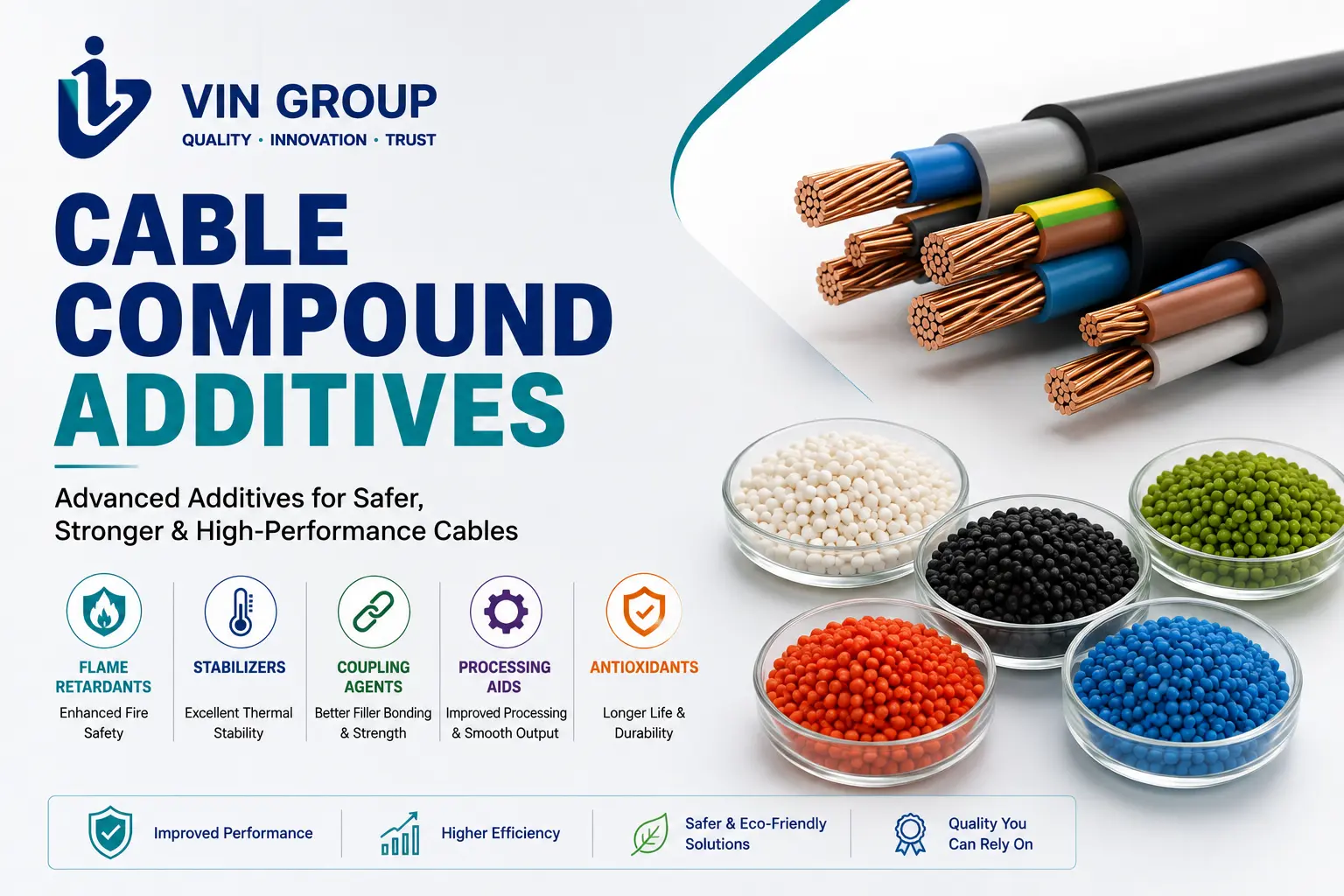
Best Flame Retardants, Stabilizers & Coupling Agents for PVC & HFFR Cable Compounds
The demand for safer, more durable, and environmentally responsible cables has led manufacturers to focus on advanced material formulations that deliver excellent fire performance without compromising mechanical or electrical properties. Whether producing conventional PVC-insulated cables or modern HFFR cable compounds, selecting the right Cable Compound Additives is essential for ensuring product reliability, processing efficiency, and compliance with international safety standards.
Cable compounds are exposed to heat, electrical stress, UV radiation, moisture, and mechanical wear throughout their service life. As a result, manufacturers use a combination of flame retardants, stabilizers, coupling agents, and processing additives to enhance fire resistance, thermal stability, flexibility, and long-term durability.
This guide explains how different Cable Compound Additives improve the performance of PVC and HFFR cable compounds and how manufacturers can select the most suitable additive package for demanding cable applications.
Why Are Cable Compound Additives Important?
Base polymers alone cannot meet the stringent performance requirements of modern cable insulation and sheathing. Carefully selected additive systems improve both processing characteristics and end-use performance.
The right Cable Compound Additives help manufacturers:
- Improve flame resistance
- Enhance thermal stability
- Increase mechanical strength
- Improve filler dispersion
- Reduce smoke generation
- Enhance weather resistance
- Improve processing efficiency
- Extend cable service life
- Meet industry safety standards
A balanced formulation also helps reduce production defects while ensuring consistent product quality across high-volume manufacturing.
Major Types of Cable Compound Additives
1. Flame Retardants
Flame retardants are among the most critical additives used in cable manufacturing because they help reduce ignition and slow flame propagation during fire exposure.
Modern flame retardants for PVC improve fire performance while maintaining mechanical properties and processing stability. Depending on application requirements, manufacturers may use metal hydroxides, phosphorus-based systems, or other specialised flame-retardant technologies.
For HFFR cable compounds, flame retardants play an even more important role. These formulations are designed to minimise smoke generation and eliminate halogen-containing materials, making them suitable for applications where fire safety and low smoke emission are priorities, such as public buildings, transportation, tunnels, and industrial facilities.
2. Heat Stabilizers
PVC is sensitive to elevated processing temperatures and can degrade if not properly stabilised.
PVC stabilizers protect the polymer during extrusion and long-term service by:
- Preventing thermal degradation
- Improving colour stability
- Enhancing processing consistency
- Increasing product durability
- Extending service life
Modern stabilizer systems commonly include calcium-zinc and other environmentally preferred technologies that provide excellent thermal performance while supporting regulatory compliance.
3. Coupling Agents
As cable formulations incorporate high levels of mineral flame retardants and fillers, strong adhesion between fillers and the polymer matrix becomes increasingly important.
Coupling agents for cable compounds improve compatibility between inorganic fillers and polymer resins.
Their benefits include:
- Better filler dispersion
- Improved mechanical strength
- Enhanced flexibility
- Reduced moisture absorption
- Better electrical performance
- Improved processing efficiency
Proper filler-polymer interaction is particularly important in highly filled HFFR cable compounds, where maintaining mechanical properties can be challenging.
4. Processing Aids
Processing aids improve melt flow, dispersion of additives, and extrusion consistency.
Advantages include:
- Better surface finish
- Faster processing
- Improved extrusion stability
- Reduced die build-up
- More uniform cable insulation
These additives help manufacturers achieve smooth, defect-free cable jackets with consistent dimensions.
5. Antioxidants
Cable compounds experience thermal and oxidative stress during both processing and service.
Antioxidants help:
- Prevent oxidation
- Improve heat ageing performance
- Maintain mechanical strength
- Extend cable lifespan
They are commonly used alongside stabilizers to provide long-term thermal protection.
PVC Cable Compound Additives vs HFFR Cable Compounds
Although both materials are widely used in cable manufacturing, their additive requirements differ significantly.
PVC Cable Compound Additives
Traditional PVC cable compound additives typically include:
- Heat stabilizers
- Flame retardants
- Plasticizers (where flexibility is required)
- Lubricants
- Processing aids
- Antioxidants
- Pigments
These formulations offer good electrical insulation, processing efficiency, and cost-effectiveness for a wide range of cable applications.
HFFR Cable Compounds
In contrast, HFFR cable compounds rely heavily on non-halogen flame-retardant filler systems to achieve fire resistance while reducing smoke and toxic gas emissions.
These compounds commonly contain:
- Metal hydroxide flame retardants
- Coupling agents
- Processing aids
- Antioxidants
- UV stabilizers (for outdoor applications)
The result is a safer cable compound suitable for environments where fire performance and occupant safety are critical.
How to Select the Right Cable Compound Additives
Choosing suitable Cable Compound Additives requires evaluating multiple technical factors.
Consider the End Application
Power cables, communication cables, automotive wiring, railway cables, and building cables all require different performance characteristics. The additive formulation should align with the intended operating environment.
Evaluate Fire Safety Requirements
Manufacturers should select additive systems capable of meeting applicable fire, smoke, and toxicity standards without compromising electrical or mechanical performance.
Assess Processing Conditions
Extrusion temperature, screw design, line speed, and filler loading influence additive effectiveness. Selecting additives compatible with existing processing equipment improves manufacturing efficiency and product consistency.
Balance Performance and Cost
The best formulation is one that achieves the required fire performance, durability, and processing efficiency while maintaining commercially viable production costs.
Benefits of Using the Right Cable Compound Additives
Selecting the right Cable Compound Additives improves both manufacturing efficiency and the long-term performance of PVC and HFFR cable compounds.
Key benefits include:
- Enhanced flame resistance
- Improved thermal stability
- Better filler dispersion
- Higher mechanical strength
- Reduced smoke generation
- Improved electrical insulation
- Better processing consistency
- Longer service life
- Improved weather resistance
- Compliance with fire safety standards
These advantages help manufacturers produce reliable cable compounds that meet demanding industrial and infrastructure requirements.
What Are the Flame Retardant Additives for PVC?
A common question is, What are the flame retardant additives for PVC?
Several flame-retardant systems are used depending on the application and performance requirements. Common flame retardants for PVC include metal hydroxides such as aluminium hydroxide (ATH) and magnesium hydroxide (MDH), phosphorus-based flame retardants, zinc borate, antimony-based synergists (where regulations permit), and specialised halogen-free flame-retardant systems. The selection depends on factors such as fire performance targets, smoke suppression, electrical properties, and processing conditions.
Which Chemical Is Commonly Used as a Flame Retardant?
There is no single flame-retardant chemical suitable for every cable formulation. Instead, manufacturers choose additives based on the polymer system and required fire performance.
In modern HFFR cable compounds, aluminium hydroxide (ATH) and magnesium hydroxide (MDH) are among the most widely used flame-retardant fillers because they release water when heated, helping cool the material and slow flame propagation. Phosphorus-based additives and zinc borate are also used in selected formulations to enhance fire resistance and smoke suppression.
What Is the Coupling Agent in Composite?
A coupling agent is an additive that improves the bond between inorganic fillers and the polymer matrix.
In cable compounds, coupling agents for cable compounds enhance adhesion between mineral flame-retardant fillers and polymers, resulting in:
- Better filler dispersion
- Improved tensile strength
- Higher impact resistance
- Reduced moisture absorption
- Enhanced electrical properties
- Better long-term durability
Coupling agents are particularly important in highly filled HFFR cable compounds, where strong filler-polymer interaction is essential for maintaining mechanical performance.
Conclusion
Selecting the right Cable Compound Additives is essential for manufacturing safe, durable, and high-performance cable insulation and sheathing materials. Flame retardants improve fire resistance, stabilizers protect polymers during processing, coupling agents enhance filler compatibility, and processing additives improve extrusion efficiency. Together, these additives help manufacturers achieve excellent mechanical properties, reliable electrical insulation, and compliance with stringent fire safety standards.
At Vin Group, we provide advanced additive solutions for modern cable compound manufacturing. Our portfolio includes PVC cable compound additives, high-performance PVC stabilizers, specialised flame retardants for PVC, additive solutions for HFFR cable compounds, and coupling agents for cable compounds designed to improve processing efficiency and product performance. With extensive technical expertise and a commitment to quality, Vin Group partners with manufacturers to develop customised formulations that enhance safety, productivity, and long-term reliability across diverse cable applications.
FAQs
1. What are Cable Compound Additives?
Cable Compound Additives are materials added to PVC and HFFR compounds to improve flame resistance, thermal stability, mechanical strength, electrical performance, and processing efficiency.
2. Why are PVC cable compound additives important?
PVC cable compound additives help improve extrusion stability, heat resistance, fire performance, durability, and the long-term reliability of cable insulation and sheathing.
3. What are HFFR cable compounds?
HFFR cable compounds are Halogen-Free Flame-Retardant materials designed to reduce smoke and toxic gas emissions during fire while maintaining excellent electrical and mechanical performance.
4. Which flame retardants are commonly used for PVC?
Common flame retardants for PVC include aluminium hydroxide, magnesium hydroxide, phosphorus-based systems, zinc borate, and other specialised flame-retardant technologies selected according to application requirements.
5. What do PVC stabilizers do?
PVC stabilizers protect PVC from thermal degradation during processing, improve colour stability, enhance long-term durability, and support consistent manufacturing.
6. Why are coupling agents used in cable compounds?
Coupling agents for cable compounds improve bonding between mineral fillers and polymers, leading to better mechanical strength, filler dispersion, electrical performance, and durability.
7. How do Cable Compound Additives improve fire safety?
The right Cable Compound Additives reduce flame spread, improve thermal stability, minimise smoke generation, and help cable compounds comply with international fire safety standards.
8. How can manufacturers choose the right cable compound additives?
Manufacturers should evaluate the polymer type, application, fire performance requirements, processing conditions, regulatory standards, and long-term durability before selecting an additive formulation.