
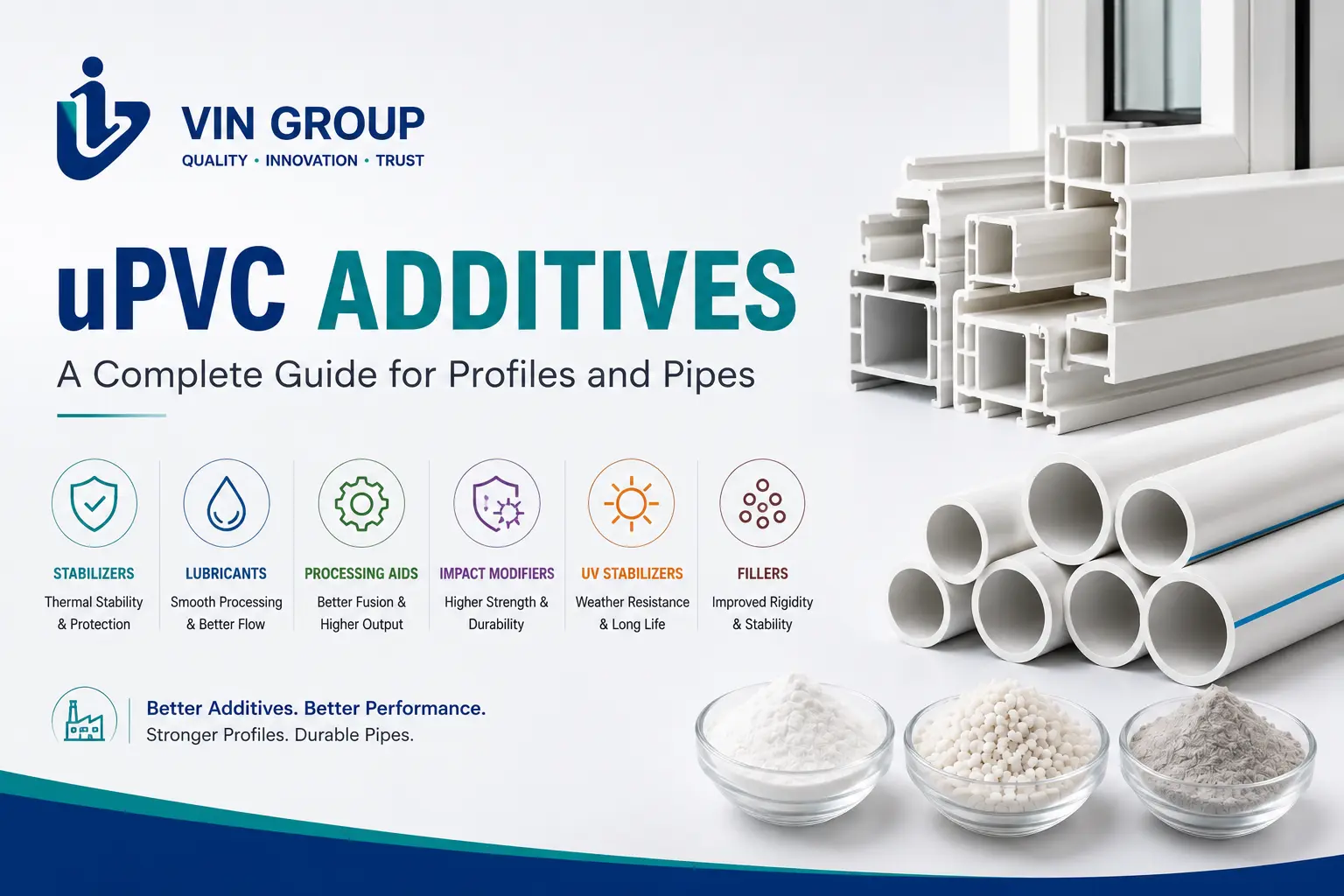
A Complete Guide to uPVC Additives for Profiles and Pipes
Unplasticized Polyvinyl Chloride (uPVC) is one of the most widely used materials for manufacturing window profiles, doors, plumbing systems, electrical conduits, and pressure pipes. Its popularity comes from its excellent strength, corrosion resistance, weatherability, and long service life. However, the performance of uPVC products depends not only on the quality of the resin but also on the proper selection of uPVC Additives.
During processing, uPVC resin is exposed to high temperatures and mechanical stress, making it susceptible to degradation if used without suitable additives. Carefully selected stabilizers, lubricants, impact modifiers, and processing aids improve processing efficiency while enhancing the mechanical and thermal properties of the finished product.
This guide explains the different types of uPVC Additives, their functions, and how manufacturers can choose the right formulation for high-quality profiles and pipes.
Why Are uPVC Additives Important?
Unlike flexible PVC, uPVC contains no plasticizers, making it naturally rigid and durable. However, rigid PVC still requires additives to improve processing and long-term performance.
A balanced additive package helps manufacturers:
- Improve thermal stability during processing
- Enhance impact strength
- Improve weather resistance
- Reduce processing defects
- Increase dimensional stability
- Improve surface finish
- Extend product lifespan
- Enhance production efficiency
The correct formulation also reduces machine wear and ensures consistent product quality throughout large-scale manufacturing.
Major Types of uPVC Additives
1. Heat Stabilizers
Heat stabilizers are among the most important uPVC stabilizers because PVC begins degrading at high processing temperatures.
Their primary functions include:
- Preventing thermal degradation
- Maintaining polymer strength
- Improving colour stability
- Increasing weather resistance
- Extending product life
Modern manufacturers commonly use calcium-zinc and organotin stabilizer systems depending on product applications and regulatory requirements. Selecting suitable heat stabilizers for uPVC ensures stable extrusion and consistent product quality.
2. Lubricants
Proper lubrication is essential during extrusion to maintain smooth material flow and reduce friction inside processing equipment.
uPVC lubricants are generally divided into two categories.
Internal Lubricants
Internal lubricants reduce friction between polymer molecules, improving melt flow and processing efficiency.
Benefits include:
- Better fusion
- Reduced torque
- Improved processing consistency
- Lower energy consumption
External Lubricants
External lubricants reduce friction between the molten compound and processing equipment.
Advantages include:
- Smooth extrusion
- Easier die release
- Reduced machine wear
- Better surface finish
- Lower risk of sticking
Maintaining the right balance between internal and external lubrication is essential because excessive lubrication may reduce fusion, while insufficient lubrication can increase processing defects.
3. Impact Modifiers
One of the most widely used uPVC impact modifiers improves the toughness of rigid PVC products without significantly affecting rigidity.
These additives help increase:
- Impact strength
- Crack resistance
- Low-temperature performance
- Product durability
- Service life
Impact modifiers are especially important for pressure pipes, outdoor profiles, electrical conduits, and window systems that experience mechanical stress or harsh environmental conditions.
4. Processing Aids
uPVC processing aids improve fusion between PVC particles during extrusion.
Their benefits include:
- Faster fusion
- Improved melt strength
- Better dimensional stability
- Enhanced surface finish
- Higher production output
- Reduced processing defects
Processing aids are particularly valuable when manufacturing complex profiles or high-speed extrusion lines.
5. Fillers
Fillers improve rigidity, dimensional stability, and cost efficiency while maintaining acceptable processing characteristics.
Calcium carbonate remains one of the most commonly used fillers in rigid PVC formulations because it provides good stiffness and improves processing consistency when incorporated in appropriate proportions.
6. Pigments and UV Stabilizers
Outdoor uPVC products require protection against prolonged sunlight exposure.
Pigments provide colour consistency, while UV stabilizers protect products from fading, chalking, brittleness, and surface degradation.
These additives are widely used in:
- Window profiles
- Door frames
- Roofing products
- Exterior cladding
- Outdoor piping systems
Choosing the Right uPVC Compound Formulation
Selecting the appropriate uPVC compound formulation requires balancing processing efficiency, mechanical properties, durability, and overall production costs.
Manufacturers should evaluate several important factors before finalising their formulation.
Product Application
Different products require different additive systems.
For example:
- Window profiles require superior weather resistance.
- Pressure pipes require excellent impact strength.
- Electrical conduits require dimensional stability.
- Industrial pipes require enhanced chemical resistance.
The formulation should match the product’s intended operating conditions.
Processing Conditions
Extrusion temperature, screw configuration, cooling systems, and production speed all influence additive performance.
Selecting additives compatible with existing production equipment improves productivity while reducing rejection rates.
Regulatory Compliance
Products used in drinking water systems, construction, or infrastructure projects may require compliance with national and international quality standards. Selecting certified additive systems helps manufacturers meet these requirements.
Cost Versus Performance
The best formulation is not necessarily the one with the highest additive loading. Instead, manufacturers should optimise the combination of stabilizers, lubricants, processing aids, and impact modifiers to achieve the desired performance while maintaining cost-effective production.
Additives for uPVC Profiles and Pipes
Although many additives are common across rigid PVC applications, formulations often differ depending on the end product.
Additives for uPVC profiles typically prioritise:
- UV resistance
- Colour retention
- Surface finish
- Weatherability
- Long-term dimensional stability
On the other hand, additives for uPVC pipes focus on:
- Pressure resistance
- Impact strength
- Thermal stability
- Long service life
- Consistent extrusion quality
Similarly, specialised PVC profile additives are selected to improve extrusion efficiency while ensuring excellent surface appearance and mechanical performance in architectural applications.
Benefits of Using the Right uPVC Additives
A well-balanced package of uPVC Additives improves both manufacturing efficiency and the long-term performance of finished products.
Some of the key benefits include:
- Improved thermal stability during extrusion
- Better impact resistance
- Enhanced weather and UV resistance
- Consistent colour and surface finish
- Higher extrusion efficiency
- Reduced machine wear
- Improved dimensional stability
- Longer product service life
- Lower production defects
- Better overall product quality
These advantages help manufacturers produce reliable uPVC profiles and pipes that meet stringent industry standards while reducing maintenance and production costs.
What Stabilizer Is Used in PVC Resin?
A common question among manufacturers is, What stabilizer is used in PVC resin?
PVC resin is typically processed using heat stabilizers that prevent degradation during high-temperature extrusion. Today, calcium-zinc stabilizers and organotin stabilizers are among the most widely used systems for rigid PVC applications. Calcium-zinc stabilizers are increasingly preferred for their environmental profile and excellent thermal performance, while organotin stabilizers are commonly used where high transparency or superior long-term heat stability is required.
Selecting the appropriate heat stabilizers for uPVC depends on the product application, processing conditions, and applicable regulatory standards.
What Is the Role of Impact Modifier in PVC Pipe?
The primary role of uPVC impact modifiers is to improve the toughness of rigid PVC without sacrificing its structural strength.
Impact modifiers help:
- Increase resistance to sudden impacts
- Reduce cracking during transportation and installation
- Improve low-temperature performance
- Extend product service life
- Enhance long-term durability under mechanical stress
They are especially important for pressure pipes, underground piping systems, and outdoor applications where pipes may be exposed to varying environmental conditions.
Conclusion
Selecting the right uPVC Additives is essential for manufacturing durable, high-performance profiles and pipes. Heat stabilizers protect PVC during processing, lubricants improve extrusion efficiency, processing aids enhance fusion, and impact modifiers increase toughness and long-term durability. When properly balanced, these additives help manufacturers achieve consistent quality, excellent weather resistance, improved dimensional stability, and efficient production.
At Vin Group, we provide high-quality additive solutions designed to support modern uPVC manufacturing. Our portfolio includes uPVC stabilizers, uPVC lubricants, uPVC impact modifiers, processing aids, and customised additive systems developed to meet diverse application requirements. With a strong focus on quality, technical expertise, and customer support, Vin Group helps manufacturers optimise formulations, improve production efficiency, reduce defects, and produce reliable uPVC profiles and pipes that meet demanding industry standards.
FAQs
1. What are uPVC Additives?
uPVC Additives are materials blended with rigid PVC resin to improve processing, thermal stability, impact strength, weather resistance, lubrication, and the overall performance of uPVC products.
2. Which uPVC stabilizers are commonly used?
The most common uPVC stabilizers include calcium-zinc stabilizers and organotin stabilizers. The choice depends on the application, processing conditions, and regulatory requirements.
3. Why are uPVC lubricants important?
uPVC lubricants reduce friction during extrusion, improve material flow, minimise machine wear, and help achieve smoother surfaces and consistent product dimensions.
4. What are the advantages of uPVC impact modifiers?
uPVC impact modifiers improve toughness, crack resistance, low-temperature performance, and the long-term durability of rigid PVC pipes and profiles.
5. What are uPVC processing aids used for?
uPVC processing aids improve fusion, increase melt strength, enhance surface finish, reduce processing defects, and support higher extrusion productivity.
6. What is included in a uPVC compound formulation?
A typical uPVC compound formulation includes PVC resin, stabilizers, lubricants, processing aids, impact modifiers, fillers, pigments, and UV stabilizers, depending on the product’s intended application.
7. Which additives are best for uPVC profiles?
The best additives for uPVC profiles typically include heat stabilizers, lubricants, processing aids, UV stabilizers, pigments, and impact modifiers to ensure excellent weather resistance, colour retention, and surface quality.
8. Which additives are recommended for uPVC pipes?
Common additives for uPVC pipes include heat stabilizers, lubricants, processing aids, impact modifiers, and fillers that improve extrusion performance, impact strength, thermal stability, and long-term durability.