
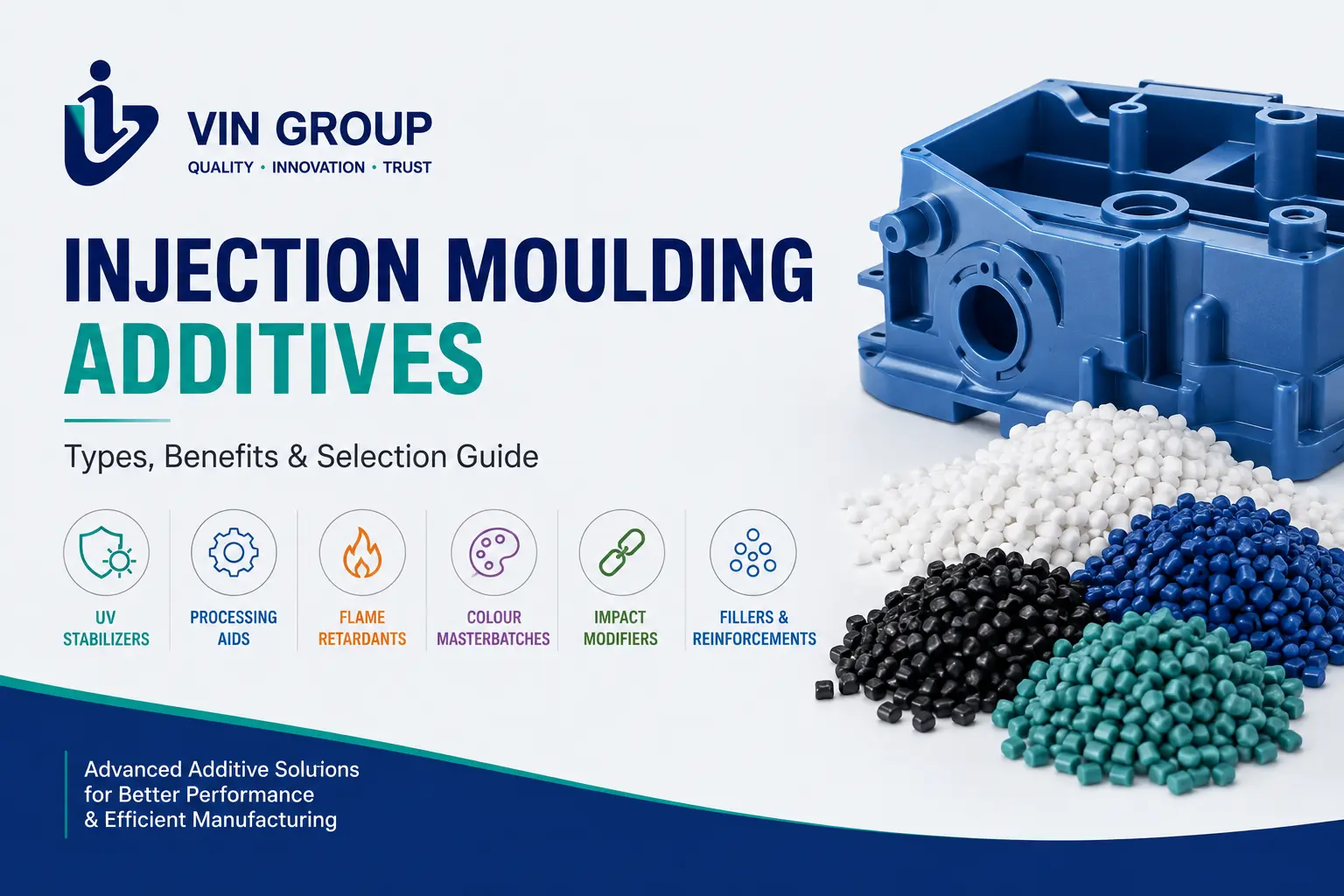
Injection Moulding Additives Explained: Types, Benefits & Selection Guide
Plastic injection moulding has become one of the most efficient manufacturing processes for producing high-quality plastic components across industries. From automotive and electrical parts to consumer goods and packaging, manufacturers rely on carefully selected materials and additives to achieve the desired performance. While the choice of base polymer is important, Injection Moulding Additives play an equally significant role in improving processing efficiency, product durability, appearance, and functionality.
Whether you are manufacturing precision engineering components or mass-produced consumer products, selecting the right additive can reduce production issues, improve product quality, and extend the service life of finished parts. However, with numerous additive options available, choosing the most suitable one requires understanding the material properties, application requirements, processing conditions, and compliance standards.
This guide explains the different types of injection moulding additives, their benefits, and how manufacturers can select the right solution for specific applications.
What Are Injection Moulding Additives?
Injection Moulding Additives are substances mixed with base polymers before or during processing to enhance the physical, mechanical, thermal, optical, or processing characteristics of plastic parts. These additives are generally added in small quantities but can significantly influence the final product’s performance.
Depending on the application, additives can:
- Improve UV and weather resistance
- Increase impact strength
- Enhance flame retardancy
- Improve colour consistency
- Reduce processing defects
- Improve dimensional stability
- Increase product lifespan
- Improve surface finish
Manufacturers often combine multiple additives to achieve a balance between performance, cost, and manufacturability.
Why Are Injection Moulding Additives Important?
Modern industries demand plastic products that perform reliably under different environmental and mechanical conditions. Without additives, many polymers would not provide sufficient durability or processing efficiency.
Some major advantages include:
- Improved production efficiency
- Better mechanical properties
- Enhanced heat resistance
- Superior weatherability
- Longer product life
- Better aesthetics
- Reduced manufacturing defects
- Improved processing consistency
For manufacturers producing the best injection moulding products, selecting the correct additive package is often as important as choosing the polymer itself.
Types of Injection Moulding Additives
1. UV Stabilizers
Plastic products used outdoors are constantly exposed to ultraviolet radiation, which can cause fading, brittleness, and surface cracking over time.
UV stabilizers protect polymers from sunlight degradation, making them suitable for:
- Outdoor furniture
- Agricultural products
- Electrical enclosures
- Automotive exterior parts
- Construction materials
These additives significantly extend product life while maintaining colour and mechanical strength.
2. Antioxidants
High processing temperatures during injection moulding can oxidize polymers, causing degradation.
Antioxidants help:
- Prevent thermal degradation
- Maintain polymer strength
- Improve long-term durability
- Extend shelf life
They are commonly used in engineering plastics and high-performance polymers.
3. Processing Aids
Processing aids improve polymer flow during mould filling, resulting in smoother production and better part quality.
Benefits include:
- Faster mould filling
- Reduced cycle time
- Better surface finish
- Lower machine wear
- Improved productivity
These additives are especially useful when manufacturing complex components with intricate geometries.
4. Colour Masterbatches
Colour additives provide consistent and vibrant colours without affecting production efficiency.
Advantages include:
- Uniform colour distribution
- Better batch consistency
- Reduced colour variation
- Improved product appearance
- Easy colour customization
Colour masterbatches are widely used in packaging, consumer products, toys, and household appliances.
5. Flame Retardants
Products used in electrical, automotive, aerospace, and industrial applications often require enhanced fire resistance.
Flame retardants help plastics:
- Resist ignition
- Slow flame spread
- Meet safety regulations
- Improve product safety
Selection depends on the polymer type and regulatory requirements.
6. Fillers and Reinforcements
Fillers improve mechanical strength while reducing material costs.
Common fillers include:
- Calcium carbonate
- Talc
- Glass fibre
- Carbon fibre
- Mineral fillers
These additives improve:
- Stiffness
- Dimensional stability
- Impact resistance
- Heat resistance
- Surface hardness
When reviewing an Injection mould material list, manufacturers often consider filler compatibility alongside polymer selection.
7. Lubricants and Release Agents
Lubricants reduce friction during processing and help components eject smoothly from the mould.
Key benefits include:
- Easier demoulding
- Reduced mould wear
- Lower cycle times
- Better surface quality
- Reduced defects
8. Impact Modifiers
Some engineering plastics are naturally rigid and may crack under sudden impact.
Impact modifiers improve:
- Toughness
- Flexibility
- Crack resistance
- Low-temperature performance
These are commonly used in automotive, appliance, and industrial applications.
How to Choose the Right Injection Moulding Additives
Selecting the correct additive requires evaluating several technical factors rather than choosing based solely on cost.
Understand the End Application
Products designed for outdoor environments require UV protection, while electrical components may require flame retardants. Medical and food-grade applications may also require compliance with industry regulations.
Consider the Base Polymer
Different polymers respond differently to additives.
Some commonly used Types of plastic moulding materials include:
- Polypropylene (PP)
- Polyethylene (PE)
- ABS
- Nylon (PA)
- Polycarbonate (PC)
- PBT
- Acetal (POM)
- PET
Each material has unique processing characteristics, making additive compatibility essential.
Evaluate Mechanical Requirements
Consider whether the product needs:
- Higher strength
- Better flexibility
- Increased impact resistance
- Improved wear resistance
- Enhanced thermal stability
The additive package should support these performance objectives without negatively affecting processing.
Focus on Mould Material Selection
Proper Mould material selection involves more than choosing the polymer. Manufacturers should evaluate processing temperature, expected loading conditions, environmental exposure, and production volume before selecting additives.
Even the quality of the Injection mold steel material influences cooling efficiency, surface finish, and dimensional accuracy, making both mould design and additive selection critical for achieving consistent production.
Consider Processing Conditions
Factors such as:
- Melt temperature
- Injection pressure
- Cooling rate
- Cycle time
- Screw speed
all influence additive performance. Proper processing ensures additives disperse evenly throughout the polymer matrix.
Balance Cost and Performance
The most expensive additive is not always the best option. Manufacturers should optimise formulations to achieve the required performance while maintaining production efficiency and overall product cost.
Understanding Material Selection in Injection Moulding
Selecting materials goes hand in hand with additive selection. Manufacturers often compare different engineering plastics based on strength, flexibility, temperature resistance, and processing characteristics.
Many engineers also refer to resources discussing Protolabs injection molding materials to compare common thermoplastics used in industrial manufacturing. Such comparisons help evaluate processing behaviour, dimensional stability, and application suitability before finalising material specifications.
Likewise, understanding different Types of injection molding processes—such as standard injection moulding, insert moulding, overmoulding, gas-assisted moulding, and multi-shot moulding—can influence both material and additive choices, ensuring optimal product performance across various manufacturing requirements.
Common Mistakes When Selecting Injection Moulding Additives
Choosing the right Injection Moulding Additives requires more than selecting a product from a catalogue. Incorrect additive selection can lead to processing issues, inconsistent product quality, higher production costs, and even product failure in the field. Some of the most common mistakes include:
Ignoring End-Use Requirements
Every plastic component is designed for a specific environment. A product intended for outdoor use requires UV protection, while electrical components often need flame-retardant properties. Selecting additives without considering the final application can reduce product lifespan and performance.
Overloading Additives
Adding more additive does not always improve performance. Excessive concentrations may cause:
- Poor surface finish
- Colour inconsistency
- Reduced mechanical strength
- Processing difficulties
- Increased production costs
Following recommended dosage levels ensures the desired balance between performance and processability.
Overlooking Additive Compatibility
Not every additive works well with every polymer. Compatibility between the additive and the base resin is essential to prevent issues such as phase separation, poor dispersion, or reduced effectiveness. Manufacturers should always verify compatibility before large-scale production.
Skipping Material Testing
Laboratory testing and production trials help confirm that the selected additive package delivers the required properties under real manufacturing conditions. Testing mechanical strength, thermal stability, colour consistency, and dimensional accuracy helps identify potential problems before mass production begins.
Benefits of Using the Right Injection Moulding Additives
Selecting suitable additives offers advantages throughout the manufacturing process and throughout the product’s lifecycle.
Improved Product Performance
Proper additive selection enhances strength, impact resistance, weatherability, chemical resistance, and thermal stability, allowing products to perform reliably in demanding applications.
Better Manufacturing Efficiency
Processing aids, lubricants, and release agents improve polymer flow, reduce cycle times, minimise machine wear, and lower rejection rates, resulting in higher production efficiency.
Enhanced Product Appearance
Colour masterbatches, optical brighteners, and surface modifiers help achieve consistent colour, improved gloss, and a premium finish that enhances the overall appearance of the finished product.
Longer Service Life
UV stabilizers, antioxidants, and heat stabilizers protect polymers from degradation caused by sunlight, heat, and oxidation. This helps products retain their mechanical properties and appearance for longer periods.
Reduced Overall Costs
Although additives increase raw material costs, they often reduce production defects, minimise maintenance, improve processing efficiency, and extend product life, delivering better long-term value.
Industry Applications of Injection Moulding Additives
Today, Injection Moulding Additives are used across numerous industries where product performance, durability, and manufacturing efficiency are critical.
Automotive
Automotive manufacturers use additives to improve impact resistance, heat stability, UV resistance, and dimensional stability in both interior and exterior components.
Electrical and Electronics
Flame retardants, anti-static additives, and heat stabilizers help electrical housings, connectors, and appliance components meet safety and performance standards.
Packaging
Packaging manufacturers rely on colour masterbatches, processing aids, slip additives, and antioxidants to improve appearance, processing speed, and product durability.
Medical Devices
Medical-grade plastics often require carefully selected additives that maintain material purity while improving processing and long-term performance.
Consumer Goods
Household products, toys, furniture, storage containers, and appliances benefit from additives that improve colour consistency, strength, scratch resistance, and UV protection.
Do Additives Affect the Recyclability of the Plastic?
Yes, Injection Moulding Additives can influence the recyclability of plastics, but the impact depends on the type and concentration of the additive used.
Many commonly used additives, such as antioxidants, processing aids, and colour masterbatches, are compatible with recycling processes and have minimal impact when used appropriately. However, certain flame retardants, fillers, or specialised performance additives may affect recycling efficiency or limit the applications of recycled material.
Manufacturers aiming to improve sustainability should consider additive formulations that support circular economy initiatives and are compatible with existing recycling systems. Selecting recyclable polymers and environmentally responsible additive packages can help reduce waste while maintaining product performance.
Can I Mix Additives Myself?
Technically, additives can be blended with polymers before processing, but doing so without proper knowledge and equipment is not recommended.
Professional compounders use precise formulations, specialised mixing equipment, and quality control systems to ensure uniform additive dispersion. Improper mixing may lead to:
- Uneven colour distribution
- Poor mechanical properties
- Processing defects
- Surface imperfections
- Inconsistent product quality
For reliable production, manufacturers should use pre-compounded materials or work with experienced additive suppliers that provide customised formulations based on application requirements.
Do Additives Change the Shrinkage of the Part?
Yes, additives can significantly influence the shrinkage behaviour of injection-moulded components.
For example:
- Glass fibre and mineral fillers generally reduce shrinkage and improve dimensional stability.
- Processing aids may influence material flow and cooling behaviour.
- Certain impact modifiers can slightly alter shrinkage characteristics depending on the polymer system.
- Reinforcing fillers help minimise warpage in large or complex parts.
Since shrinkage affects dimensional accuracy and mould design, manufacturers should evaluate additive effects during product development and conduct mould trials before full-scale production.
Conclusion
Selecting the right Injection Moulding Additives is essential for producing high-quality plastic components that meet modern performance, safety, and durability requirements. From UV stabilizers and flame retardants to fillers, colour masterbatches, processing aids, and impact modifiers, every additive serves a specific purpose in improving product quality and manufacturing efficiency.
The ideal additive package depends on several factors, including the base polymer, application environment, processing conditions, regulatory requirements, and desired mechanical properties. Careful material selection, proper testing, and collaboration with experienced additive manufacturers can help reduce production challenges while delivering consistent, high-performance products.
At Vin Group, we understand that every application has unique material requirements. Our expertise in plastic additive solutions enables manufacturers to optimise processing efficiency, improve product performance, and achieve consistent production quality. Whether you need customised additive formulations, technical guidance, or reliable manufacturing support, our team works closely with customers to deliver solutions that enhance productivity, reduce defects, and support long-term business growth. By combining quality, innovation, and industry expertise, Vin Group helps businesses manufacture plastic products that meet today’s demanding performance standards while preparing for tomorrow’s evolving market needs.
FAQs
1. What are Injection Moulding Additives used for?
Injection Moulding Additives improve the performance, appearance, durability, and processing characteristics of plastics. They help enhance strength, UV resistance, flame retardancy, colour consistency, and manufacturing efficiency.
2. How do I choose the right Injection Moulding Additives?
The right additive depends on the polymer type, product application, processing conditions, environmental exposure, regulatory requirements, and desired mechanical properties. Proper testing and technical consultation are recommended before production.
3. What is included in an injection mould material list?
A typical Injection mould material list includes thermoplastics such as PP, PE, ABS, Nylon (PA), Polycarbonate (PC), PET, PBT, Acetal (POM), and other engineering plastics selected according to product requirements.
4. What are the most common types of plastic moulding materials?
The most common Types of plastic moulding materials include Polypropylene, Polyethylene, ABS, Polycarbonate, Nylon, PET, PBT, PVC, and Acetal. Each offers different levels of strength, flexibility, chemical resistance, and heat performance.
5. Does mould material selection affect additive performance?
Yes. Proper Mould material selection influences cooling efficiency, surface finish, dimensional accuracy, and how effectively additives perform during processing.
6. Why is injection mold steel material important?
The quality of Injection mold steel material affects mould durability, heat transfer, wear resistance, production consistency, and the final quality of injection-moulded components.
7. What are the different types of injection molding?
Common Types of injection molding include conventional injection moulding, insert moulding, overmoulding, gas-assisted moulding, thin-wall moulding, and multi-shot moulding. The choice depends on product complexity and manufacturing requirements.
8. How do additives help produce the best injection moulding products?
The best injection moulding products are achieved by combining suitable polymers with the right additive package. Proper additives improve processing efficiency, durability, aesthetics, dimensional stability, and long-term product reliability.