
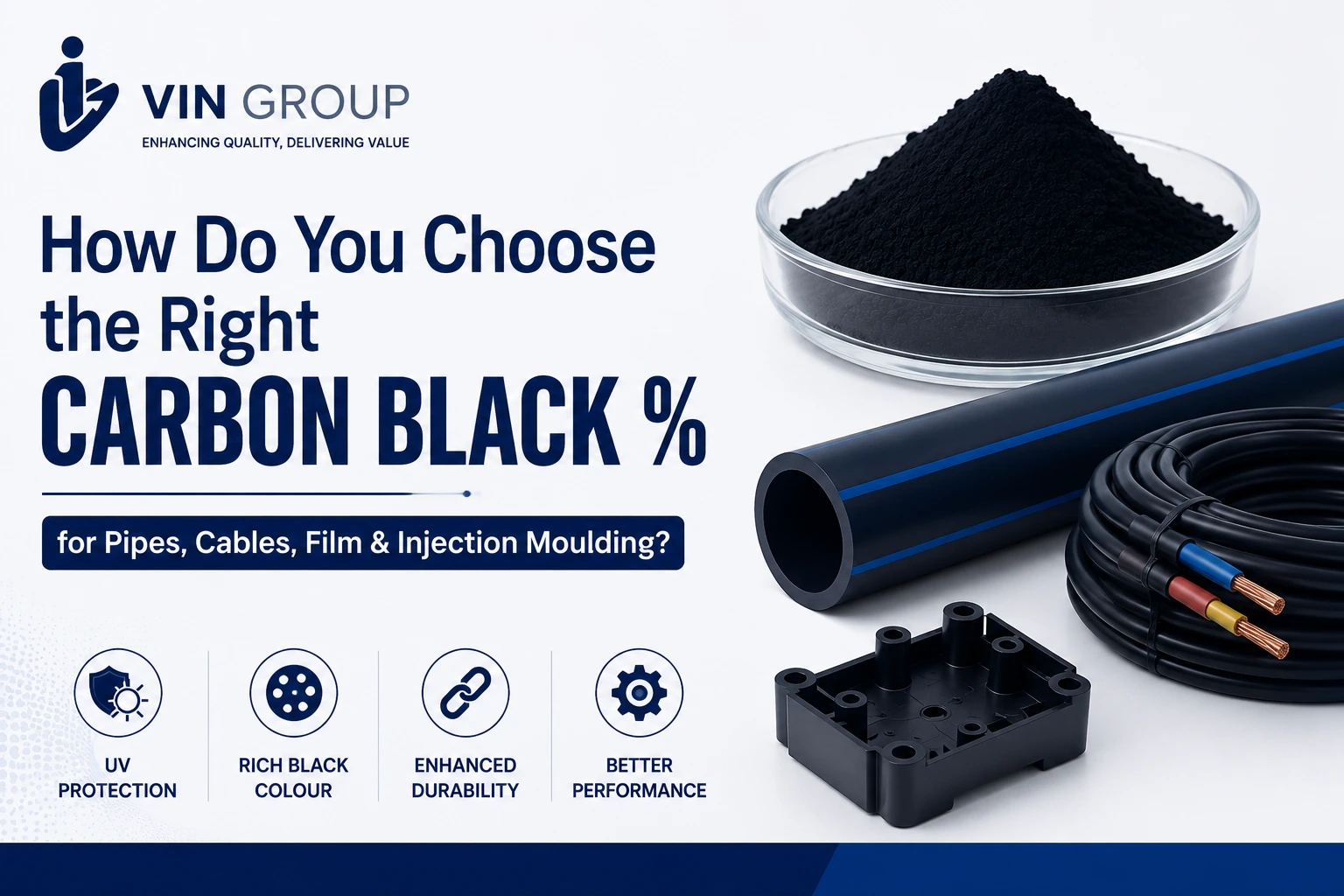
How Do You Choose the Right Carbon Black % for Pipes, Cables, Film & Injection Moulding?
Introduction
Selecting the correct Black Masterbatch is one of the most important decisions in plastic manufacturing. While carbon black is primarily known for providing a deep black appearance, its role extends far beyond coloration. It improves UV protection in plastic products, enhances weather resistance, increases durability, and, in specific formulations, provides electrical conductivity. However, achieving these benefits depends on selecting the right carbon black grade and, more importantly, the correct loading percentage for each application.
There is no universal carbon black percentage that works for every product. The ideal carbon black loading percentage varies depending on whether the material is being used for HDPE pipes, cable insulation, agricultural films, packaging films, or injection moulded components. Using too little carbon black can result in poor UV stability and inconsistent colour, while excessive loading may reduce mechanical properties, affect processability, increase production costs, and create dispersion challenges.
For manufacturers, understanding the relationship between carbon black grade, dosage, polymer compatibility, and processing conditions is essential for producing consistent, high-quality products.
How to Select the Right Carbon Black Percentage for Plastic Applications
Choosing the correct carbon black percentage begins with understanding the purpose it serves in the final product. Manufacturers generally use carbon black for four primary reasons:
- UV protection
- Colour consistency
- Conductivity
- Mechanical performance enhancement
The ideal carbon black dosage in plastics depends on several factors, including polymer type, product thickness, outdoor exposure, processing method, and required performance standards.
Some applications require only a small amount of carbon black for colour, while others demand higher loading levels to provide long-term UV resistance or conductivity. Instead of maximizing carbon black content, manufacturers should focus on achieving the right balance between performance, processing efficiency, and cost.
High-quality Black Masterbatch helps achieve better dispersion, allowing manufacturers to use carbon black more efficiently without compromising product quality.
Carbon Black Loading Percentage for Different Plastic Applications
Every plastic application has unique performance requirements, making application-specific loading percentages essential.
Carbon Black for HDPE Pipes
When manufacturing HDPE pipes used for water supply, gas distribution, or agricultural irrigation, UV stability is critical because these products are often exposed to sunlight for extended periods.
The recommended carbon black loading percentage for carbon black for HDPE pipes generally falls around 2–2.5%, depending on applicable industry standards and the masterbatch concentration used.
Proper dispersion is equally important. Uniformly dispersed carbon black protects the entire pipe surface against ultraviolet degradation, helping improve service life while maintaining mechanical strength.
Carbon Black for Cable Compounds
Cable insulation and sheathing require carbon black for UV resistance and, in some cases, electrical conductivity.
For standard carbon black for cable compounds, loading levels typically depend on whether the application requires:
- UV stabilization
- Semi-conductive properties
- Conductive performance
For conductive cable formulations, specialized grades are often selected because standard pigment carbon blacks may not provide sufficient conductivity.
Selecting the appropriate Black Masterbatch ensures stable processing, excellent dispersion, and reliable long-term cable performance.
Carbon Black for Plastic Films
Agricultural films, mulch films, geomembranes, and packaging films require balanced pigmentation without affecting film flexibility.
For carbon black for plastic films, manufacturers typically use lower loading levels than those used in pipes because excessive carbon black may reduce transparency where required or negatively affect film processing.
Proper particle dispersion helps produce:
- Uniform black colour
- Improved UV protection
- Better weather resistance
- Reduced streaking
- Consistent film thickness
Optimized carbon black dosage in plastics also minimizes processing defects during blown film and cast film production.
Carbon Black for Injection Moulding
Injection moulded products demand excellent surface appearance together with stable mechanical properties.
The ideal carbon black for injection moulding depends on:
- Product wall thickness
- Surface finish requirements
- Indoor or outdoor application
- Resin type
Higher-than-required loading may create flow marks, poor dispersion, and reduced impact strength. Using high-quality Black Masterbatch allows manufacturers to achieve rich black colour with lower pigment loading while maintaining mouldability.
Why Carbon Black Percentage Matters
Simply increasing carbon black content does not automatically improve product performance.
Incorrect loading may lead to:
- Poor dispersion
- Surface defects
- Reduced impact resistance
- Lower elongation
- Processing instability
- Increased production costs
Proper plastic masterbatch formulation considers both pigment concentration and polymer compatibility to deliver consistent product quality.
A well-designed formulation helps manufacturers optimize colour, UV resistance, processing behaviour, and overall performance simultaneously.
What are the different types of carbon black?
Carbon black is available in multiple grades, each designed for different industrial applications based on particle size, structure, tint strength, and reinforcement characteristics.
The major categories include:
Reinforcing Carbon Black
Used primarily in rubber applications where high tensile strength and abrasion resistance are required.
Pigment Carbon Black
Designed mainly for colouring plastics, coatings, inks, and masterbatch production while providing excellent jetness and UV stability.
Conductive Carbon Black
Used in conductive carbon black applications where electrical conductivity or electrostatic discharge protection is required.
Applications include:
- Cable compounds
- Electronic packaging
- Conductive plastics
- Battery materials
Specialty Carbon Black
Developed for demanding applications requiring premium dispersion, gloss, weather resistance, or conductivity.
Selecting the appropriate type depends entirely on the final application’s technical requirements rather than colour alone.
What is the difference between carbon black N220 and N330?
N220 and N330 are among the most commonly used furnace carbon black grades, but they offer different performance characteristics.
| Property | N220 | N330 |
| Particle Size | Smaller | Slightly larger |
| Reinforcement | Higher | Moderate |
| Abrasion Resistance | Excellent | Good |
| Dispersion | Slightly more demanding | Easier |
| Typical Applications | High-performance rubber, specialty compounds | General-purpose rubber and plastics |
Because N220 has finer particles, it generally provides higher reinforcement and better wear resistance.
N330 offers easier processing and balanced mechanical properties, making it suitable for a wide variety of industrial applications.
The final selection depends on processing conditions, desired performance, and formulation requirements rather than grade popularity.
What is carbon black N220 used for?
Carbon black N220 is widely used in applications requiring superior reinforcement and durability.
Common uses include:
- High-performance tyre compounds
- Industrial rubber products
- Conveyor belts
- Automotive rubber components
- Specialty plastic compounds
- Selected masterbatch formulations
Because of its finer particle structure, N220 delivers improved tensile strength and abrasion resistance compared with many general-purpose grades.
However, manufacturers should always evaluate dispersion capability and processing conditions before selecting this grade.
Factors to Consider Before Choosing Black Masterbatch
Selecting the right Black Masterbatch involves more than comparing carbon black grades.
Manufacturers should evaluate:
Polymer Compatibility
The carrier resin should match the base polymer for optimum dispersion.
Processing Method
Extrusion, blow moulding, injection moulding, and film production each require different dispersion characteristics.
UV Exposure
Outdoor products require sufficient carbon black concentration to provide effective UV protection in plastic products.
Mechanical Requirements
Pigment loading should never compromise product strength, flexibility, or dimensional stability.
Dispersion Quality
Well-dispersed carbon black provides better colour consistency while reducing processing defects.
Common Mistakes When Selecting Carbon Black Percentage
Many manufacturers encounter avoidable production issues because of incorrect carbon black selection.
Common mistakes include:
- Using excessive pigment loading
- Selecting the wrong carbon black grade
- Ignoring polymer compatibility
- Poor dispersion during compounding
- Choosing colour over performance
- Not optimizing plastic masterbatch formulation
Avoiding these mistakes improves production efficiency while reducing rejection rates.
Best Practices for Better Carbon Black Performance
Manufacturers can achieve more consistent results by following several best practices:
- Choose carbon black grades based on application requirements.
- Optimize the carbon black loading percentage instead of using excessive pigment.
- Use high-quality Black Masterbatch with excellent dispersion characteristics.
- Match carrier resin with the base polymer.
- Maintain stable processing temperatures.
- Monitor dispersion quality throughout production.
- Conduct routine quality testing for colour consistency and UV performance.
Following these practices helps improve product quality while reducing manufacturing costs.
Conclusion
Choosing the right Black Masterbatch involves much more than selecting a black pigment. The ideal carbon black loading percentage depends on the application, polymer type, processing method, and performance requirements. Whether manufacturing HDPE pipes, cable compounds, plastic films, or injection moulded products, the right formulation ensures excellent colour consistency, UV resistance, durability, and processing efficiency while avoiding unnecessary material costs.
At Vin Group, we combine industry expertise, advanced manufacturing capabilities, and stringent quality control to help customers select the most suitable Black Masterbatch solutions for diverse plastic applications. From optimizing carbon black dosage in plastics and improving plastic masterbatch formulation to delivering reliable solutions for carbon black for HDPE pipes, carbon black for cable compounds, carbon black for plastic films, and carbon black for injection moulding, our team works closely with manufacturers to enhance product performance, processing consistency, and long-term reliability.
FAQs
1. What is Black Masterbatch used for?
Black Masterbatch is used to provide black colour, UV protection, improved weather resistance, and consistent pigmentation in plastic products such as pipes, cables, films, packaging, and injection moulded components.
2. What is the ideal carbon black loading percentage for plastic products?
The ideal carbon black loading percentage depends on the application, resin type, and required performance. Outdoor applications generally require higher loading than products intended only for colour.
3. What is the difference between carbon black N220 and N330?
N220 has finer particles and offers higher reinforcement and abrasion resistance, while N330 provides balanced performance with easier processing for many industrial applications.
4. What is carbon black N220 used for?
Carbon black N220 is commonly used in high-performance rubber products, automotive components, industrial compounds, and selected plastic masterbatch applications requiring higher reinforcement.
5. Why is carbon black important for HDPE pipes?
Carbon black for HDPE pipes provides UV protection, helping prevent degradation caused by prolonged sunlight exposure while extending product service life.
6. How does carbon black improve cable compounds?
Carbon black for cable compounds improves UV resistance, colour stability, and, in conductive formulations, electrical performance for specialized cable applications.
7. Why is dispersion important in Black Masterbatch?
Good dispersion ensures uniform colour, consistent mechanical properties, smoother processing, and improved long-term performance while reducing defects such as streaks and agglomerates.
8. How can Vin Group help with Black Masterbatch selection?
Vin Group provides technically advanced Black Masterbatch solutions with optimized formulations, excellent dispersion, consistent quality, and application-specific support to help manufacturers achieve superior product performance.