
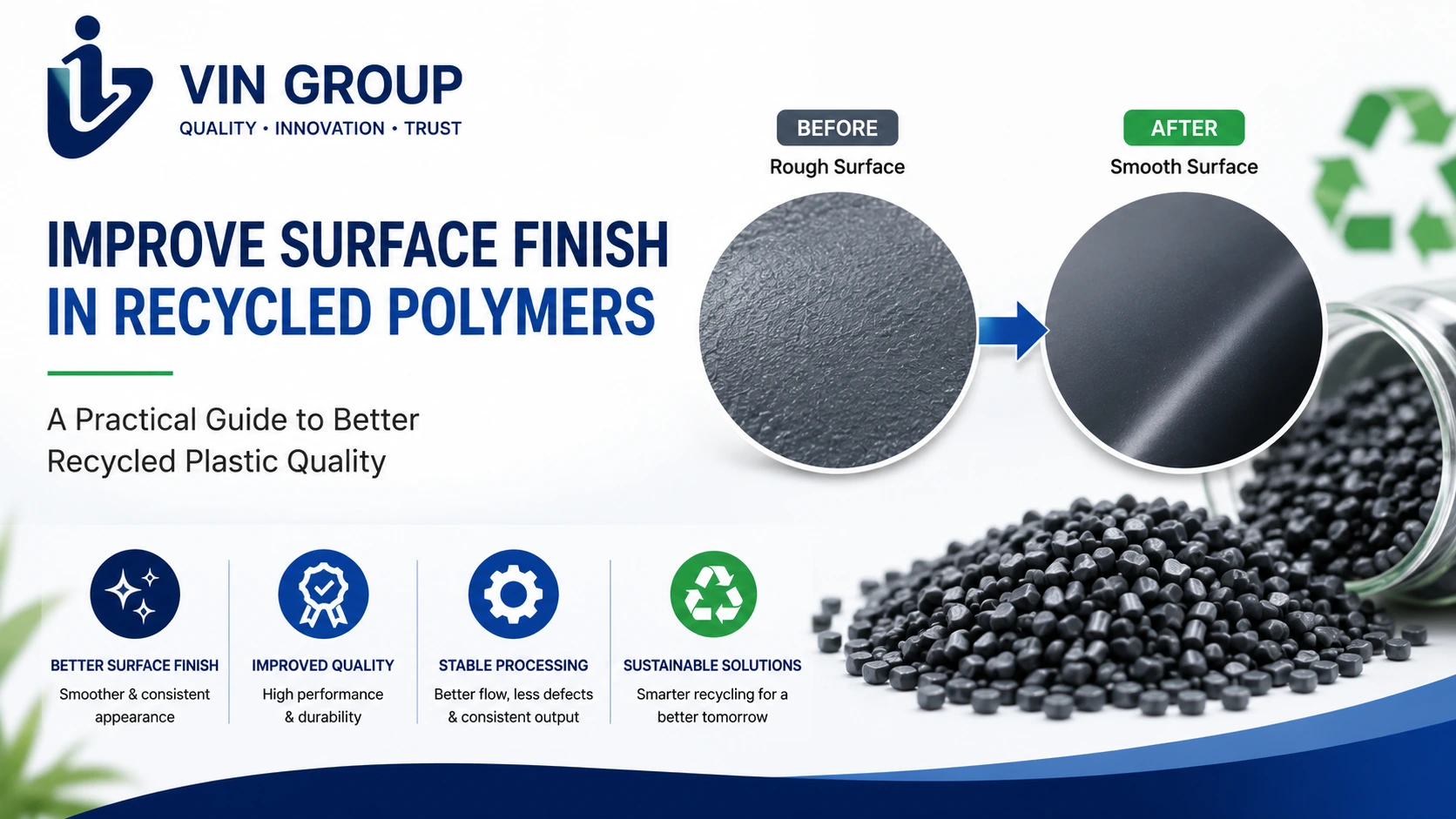
Improve Surface Finish in Recycled Polymers: A Practical Guide to Better Recycled Plastic Quality
As industries move toward sustainability, recycled plastics are becoming increasingly important in manufacturing. From packaging and consumer goods to automotive and industrial applications, manufacturers are actively investing in better processing methods to improve recycled polymer quality. However, one of the biggest challenges remains achieving a smooth, visually appealing surface finish.
Recycled plastics often suffer from rough textures, flow marks, surface inconsistencies, and visible defects caused by contamination, degradation, and unstable processing conditions. These issues can reduce product appeal and affect performance.
This is why manufacturers continuously look for ways to improve surface finish in recycled polymers while maintaining durability, cost efficiency, and sustainability goals.
At Vin Group, quality-driven manufacturing focuses on optimizing recycled polymer performance through advanced processing techniques, material consistency, and smarter formulation strategies.
Improve Surface Finish in Recycled Polymers
Successfully learning how to improve surface finish in recycled polymers requires understanding the key reasons behind rough textures and surface defects.
Several factors influence recycled plastic appearance, including:
- Polymer degradation
- Material contamination
- Poor melt flow
- Equipment settings
- Inconsistent temperature control
- Additive compatibility
Unlike virgin polymers, recycled materials often contain impurities or degraded polymer chains, making smooth surface finishing more challenging.
However, with the right process optimization, manufacturers can significantly improve product appearance and consistency.
Why Do Recycled Polymers Produce a Rough or “Shark-Skin” Surface?
One of the most common processing issues in recycled plastics is a rough texture commonly referred to as the “shark-skin” effect.
This problem usually occurs when polymer melt flow becomes unstable during extrusion or molding.
Common causes include:
Polymer Degradation
Repeated recycling cycles weaken polymer chains, reducing flow consistency.
High Shear Stress
Excessive pressure inside extrusion systems may disrupt smooth material flow.
Poor Melt Stability
Inconsistent melt behavior often creates rough textures.
Contamination
Foreign particles interfere with uniform surface formation.
Manufacturers seeking to improve surface finish in recycled polymers should focus on melt consistency and material cleanliness to reduce shark-skin defects.
How Do Contaminants Affect the Final Surface Aesthetics?
Material contamination is one of the biggest obstacles to smooth recycled plastics.
Even small contaminants can negatively affect product appearance.
Common contamination problems include:
Black Specks or Surface Marks
Residual impurities often create visible defects.
Uneven Texture
Mixed materials disrupt polymer consistency.
Surface Roughness
Foreign particles prevent smooth finishing.
Poor Gloss
Contaminants interfere with surface reflection.
Manufacturers aiming to improve surface finish in recycled polymers should prioritize better sorting, filtration, and cleaning systems.
Cleaner recycled material leads to smoother finished products.
Can Chemical Additives Improve the Surface Finish of Recycled Plastics?
Chemical additives often play an important role in improving recycled polymer quality.
Yes, specialized additives are commonly used to improve appearance and processing performance.
These additives may help:
Improve Melt Flow
Smoother polymer flow reduces rough textures.
Enhance Lubrication
Processing aids reduce friction during extrusion.
Improve Surface Smoothness
Flow modifiers help create cleaner finishes.
Stabilize Polymer Performance
Performance additives reduce degradation effects.
Modern processing additives significantly help manufacturers improve surface finish in recycled polymers while maintaining mechanical properties.
At Vin Group, additive optimization helps improve product aesthetics without compromising durability.
Are There Tooling or Equipment Adjustments That Can Help?
Equipment setup directly affects recycled plastic quality.
Yes, adjusting processing equipment can significantly improve results.
Manufacturers often improve surface quality through:
Optimized Die Design
Better flow channels reduce extrusion instability.
Temperature Adjustments
Balanced heat improves melt consistency.
Reduced Shear Stress
Controlled pressure minimizes shark-skin effects.
Better Filtration Systems
Removes impurities before molding or extrusion.
Screw Configuration Improvements
Optimized extruder design improves material consistency.
These equipment upgrades strongly support efforts to improve surface finish in recycled polymers.
Material Selection and Recycling Quality
Not all recycled materials behave the same way.
Manufacturers should evaluate:
Polymer Type
Different polymers respond differently to recycling.
Number of Reprocessing Cycles
Repeated processing may weaken properties.
Contamination Levels
Cleaner feedstock improves appearance.
Additive Compatibility
Correct formulation improves surface consistency.
Understanding these variables helps manufacturers consistently improve surface finish in recycled polymers while maintaining production efficiency.
Best Practices for Better Surface Finish in Recycled Polymers
Manufacturers looking to improve recycled polymer quality should follow several proven practices.
Improve Material Sorting
Cleaner input materials reduce defects.
Optimize Processing Temperature
Balanced thermal settings improve melt behavior.
Use Processing Additives
Flow modifiers improve surface smoothness.
Upgrade Equipment
Modern extrusion systems improve consistency.
Improve Filtration Systems
Removing impurities improves appearance.
Monitor Melt Flow Stability
Stable flow reduces surface irregularities.
These improvements help manufacturers improve surface finish in recycled polymers without sacrificing sustainability goals.
Sustainability and the Future of Recycled Plastics
As sustainability regulations increase, businesses continue investing in smarter recycling methods.
Innovations in plastic waste management innovative solutions are helping industries:
- Improve recycled polymer performance
- Reduce landfill waste
- Increase production efficiency
- Improve material aesthetics
Advanced recycling methods also support stronger commercial adoption of recyclable polymers across industries.
This growing emphasis on sustainable materials continues to drive innovation in polymer engineering.
Final Thoughts
Improving the surface finish of recycled polymers requires a combination of clean raw materials, optimized processing conditions, advanced additive technologies, and well-maintained manufacturing equipment. By minimizing contamination, enhancing melt flow, and maintaining stable production parameters, manufacturers can produce recycled plastic products with smoother surfaces, improved aesthetics, and consistent performance while supporting sustainable manufacturing practices.
At Vin Group, we help manufacturers maximize the potential of recycled polymers through precision compounding, innovative processing solutions, and quality-driven manufacturing practices. Our expertise in material optimization and recycled polymer processing enables businesses to achieve superior surface finish, enhanced product consistency, and high-performance recycled plastic solutions that support both commercial success and environmental sustainability.