
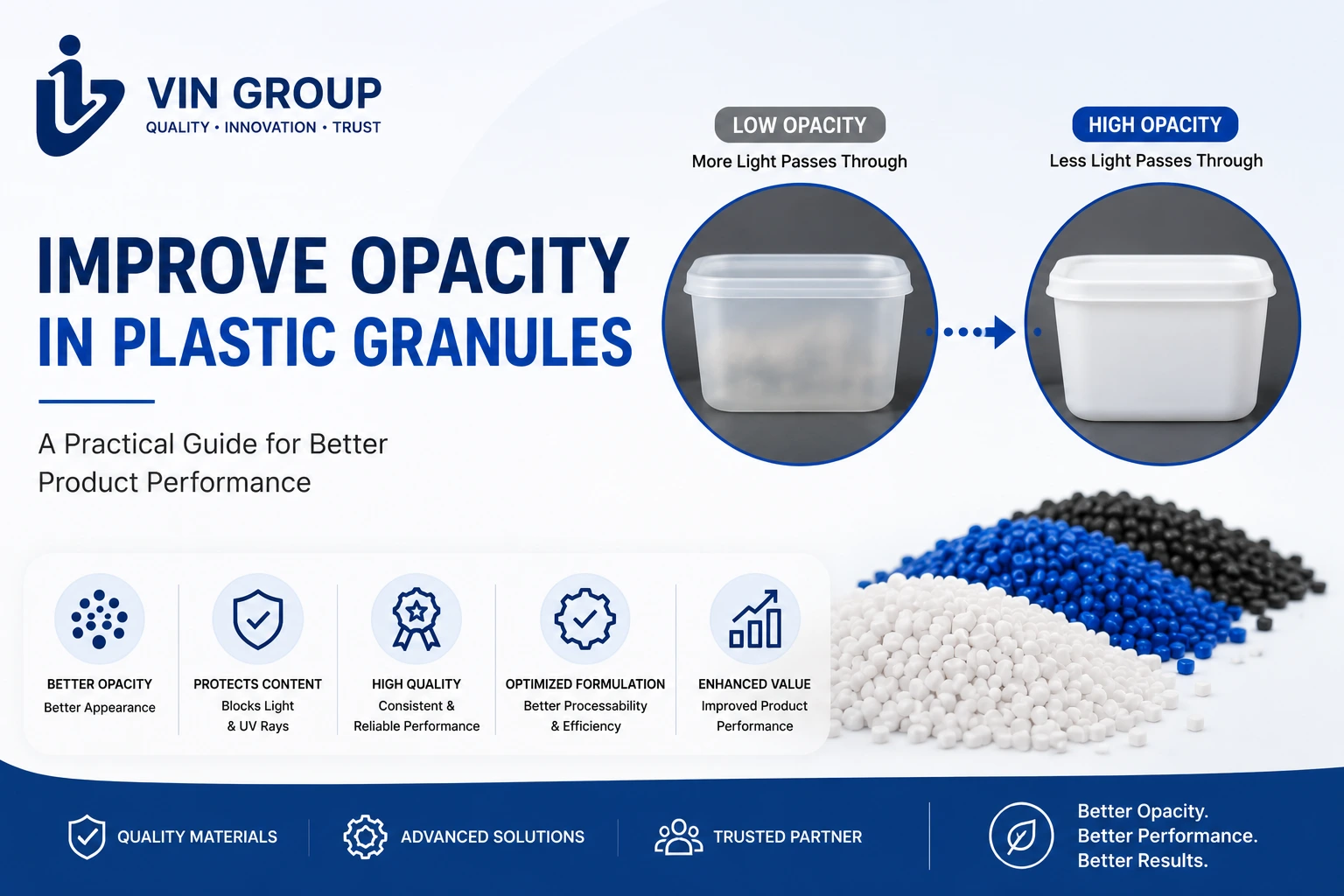
How to Improve Opacity in Plastic Granules: A Practical Guide for Better Product Performance
In plastic manufacturing, visual appearance plays a major role in product quality and market acceptance. While some applications demand transparency, others require stronger opacity for better appearance, UV resistance, product protection, and surface consistency. Industries manufacturing packaging materials, containers, molded components, household products, and consumer goods often seek ways to improve opacity in plastic granules without negatively affecting durability or processing performance.
Poor opacity can make plastic products appear inconsistent, weak, or visually unattractive. Uneven pigmentation, incorrect polymer selection, poor additive compatibility, and low-quality fillers are among the most common causes of insufficient opacity.
At Vin Group, quality-focused plastic manufacturing emphasizes optimized formulations, material compatibility, and controlled processing to create plastic granules with reliable opacity and improved visual performance.
How to Improve Opacity in Plastic
Successfully learning how to improve opacity in plastic granules requires understanding how polymers, fillers, pigments, and additives interact during production.
Opacity refers to the ability of plastic material to block or scatter light. Products with higher opacity prevent visibility through the material, creating a denser and more uniform appearance.
Several factors influence opacity performance, including:
- Base polymer selection
- Pigment concentration
- Filler compatibility
- Light scattering properties
- Masterbatch formulation
- Processing consistency
By controlling these factors, manufacturers can significantly improve product quality and reduce appearance-related defects.
Why Opacity Matters in Plastic Manufacturing
Opacity is not only about aesthetics. It also influences performance and product functionality.
Higher opacity helps:
Improve Product Appearance
Uniform opacity creates a premium and consistent finish.
Protect Sensitive Contents
Opaque packaging helps reduce light exposure.
Enhance Brand Value
Products with stronger visual consistency often improve customer perception.
Support Packaging Performance
In food and pharmaceutical packaging, opacity may improve protection against environmental exposure.
This is particularly important in discussions about the transparency of polymeric food packaging materials, where product visibility and protection must be balanced carefully.
How Does the Type of Base Polymer Affect Opacity?
One of the most important but overlooked factors is polymer selection.
The base polymer directly affects light transmission and surface appearance.
Some polymers are naturally more transparent, while others offer stronger opacity.
For example:
Polypropylene (PP)
Often semi-transparent but can be modified for better opacity.
Polyethylene (PE)
May appear translucent depending on thickness and additives.
Polystyrene (PS)
Offers good clarity but can be adjusted using opacity modifiers.
ABS and Filled Plastics
Naturally provide stronger opacity.
A common question manufacturers ask is: is plastic transparent or opaque by default?
The answer depends on polymer structure and additive formulation. Some materials are naturally transparent, while others are translucent or opaque depending on processing conditions.
This is why selecting the right resin becomes essential when trying to improve opacity in plastic granules.
Can I Use Fillers to Improve Opacity?
Fillers are among the most widely used methods for increasing opacity.
Yes, fillers are commonly used to scatter light and reduce transparency.
Popular filler options include:
Calcium Carbonate
Improves whiteness and opacity while supporting cost efficiency.
Talc
Enhances dimensional stability and light scattering.
Titanium Dioxide (TiO₂)
Widely recognized as one of the most effective opacity-enhancing materials.
Mineral Fillers
Help reduce transparency and improve visual consistency.
However, manufacturers must balance filler loading carefully because excessive filler use may negatively impact mechanical performance.
At Vin Group, material optimization focuses on maintaining both durability and appearance when adjusting formulations.
What Are the Best Additives to Increase Opacity in Plastic Granules?
Specialized additives often help manufacturers achieve better results.
Several additives are commonly used to improve opacity performance.
Titanium Dioxide (TiO₂)
One of the most effective solutions for improving whiteness and opacity.
Opacity-Enhancing Masterbatch
These additives improve light scattering and reduce transparency.
Pigment Concentrates
High-quality pigment for plastic applications improves visual consistency and appearance.
Specialty Additives
Custom additives may improve opacity while maintaining flexibility and durability.
Manufacturers often work closely with plastic pigment manufacturers to develop customized formulations based on specific industrial requirements.
Are There Specialized Opacity-Enhancing Masterbatches?
Masterbatch technology plays a major role in plastic coloration and opacity.
Yes, manufacturers increasingly use specialized masterbatches designed to improve opacity.
These formulations typically contain:
- Titanium dioxide
- White pigments
- Light-scattering additives
- Compatible carrier resins
Opacity-enhancing masterbatches offer several advantages:
Better Consistency
Improves visual uniformity.
Stable Processing
Supports smooth extrusion and molding.
Improved Surface Finish
Creates stronger visual appearance.
Better Light Blocking
Reduces transparency in finished products.
Using advanced masterbatch systems is one of the most effective ways to improve opacity in plastic granules while maintaining process stability.
Understanding Transparency, Translucency, and Opacity in Plastics
Manufacturers and consumers often ask whether a material should be transparent or opaque.
For example, plastic bottle is transparent or translucent or opaque depends entirely on formulation and intended use.
Transparent Plastics
Allow clear visibility through the material.
Translucent Plastics
Permit partial light transmission while blurring visibility.
Opaque Plastics
Block light effectively and prevent visibility.
Examples of clear plastics include acrylic and polycarbonate, which are commonly used when visibility is important.
However, packaging and industrial sectors often prefer opaque materials for durability, privacy, and product protection.
This raises another common question: is plastic opaque by default?
The answer is no—opacity depends on polymer type, additives, fillers, and pigmentation.
Role of Pigments in Opacity Improvement
Pigments strongly influence final appearance.
Manufacturers often use plastic pigment powder to improve color consistency and reduce transparency.
The right pigment for plastic helps:
- Improve visual density
- Enhance product brightness
- Reduce translucency
- Maintain consistent surface appearance
Working with experienced plastic pigment manufacturers often helps businesses achieve more predictable performance.
Common Reasons for Poor Opacity in Plastic Granules
Several production issues may reduce opacity performance.
Low Pigment Concentration
Insufficient pigment reduces light blocking ability.
Incorrect Polymer Selection
Some polymers naturally remain transparent.
Poor Additive Compatibility
Incompatible materials weaken opacity performance.
Uneven Mixing
Poor dispersion creates inconsistent appearance.
Excessive Processing Heat
Thermal degradation may affect visual quality.
Recognizing these problems early helps manufacturers reduce waste and improve product consistency.
Best Practices to Improve Opacity in Plastic Granules
Manufacturers aiming to consistently improve opacity in plastic granules should follow these practical strategies:
- Select suitable base polymers
- Use high-quality opacity-enhancing masterbatch
- Optimize filler loading carefully
- Improve pigment dispersion quality
- Work with reliable plastic pigment manufacturers
- Maintain stable processing temperatures
- Improve material compatibility during formulation
These improvements support stronger visual consistency and higher-quality finished products.
Final Thoughts
Improving the opacity of plastic granules requires the right balance of polymer selection, pigment quality, filler compatibility, masterbatch formulation, and controlled processing conditions. By optimizing these factors, manufacturers can achieve superior light-blocking properties, enhanced surface consistency, improved product aesthetics, and reliable performance while minimizing production defects and material waste.
At Vin Group, we support manufacturers with advanced compounding expertise, high-performance additive solutions, and precision-driven processing techniques to enhance the opacity and overall quality of plastic granules. Our commitment to innovation, material optimization, and consistent manufacturing helps businesses produce durable, visually appealing, and high-performance plastic products that meet the evolving demands of modern industries.