
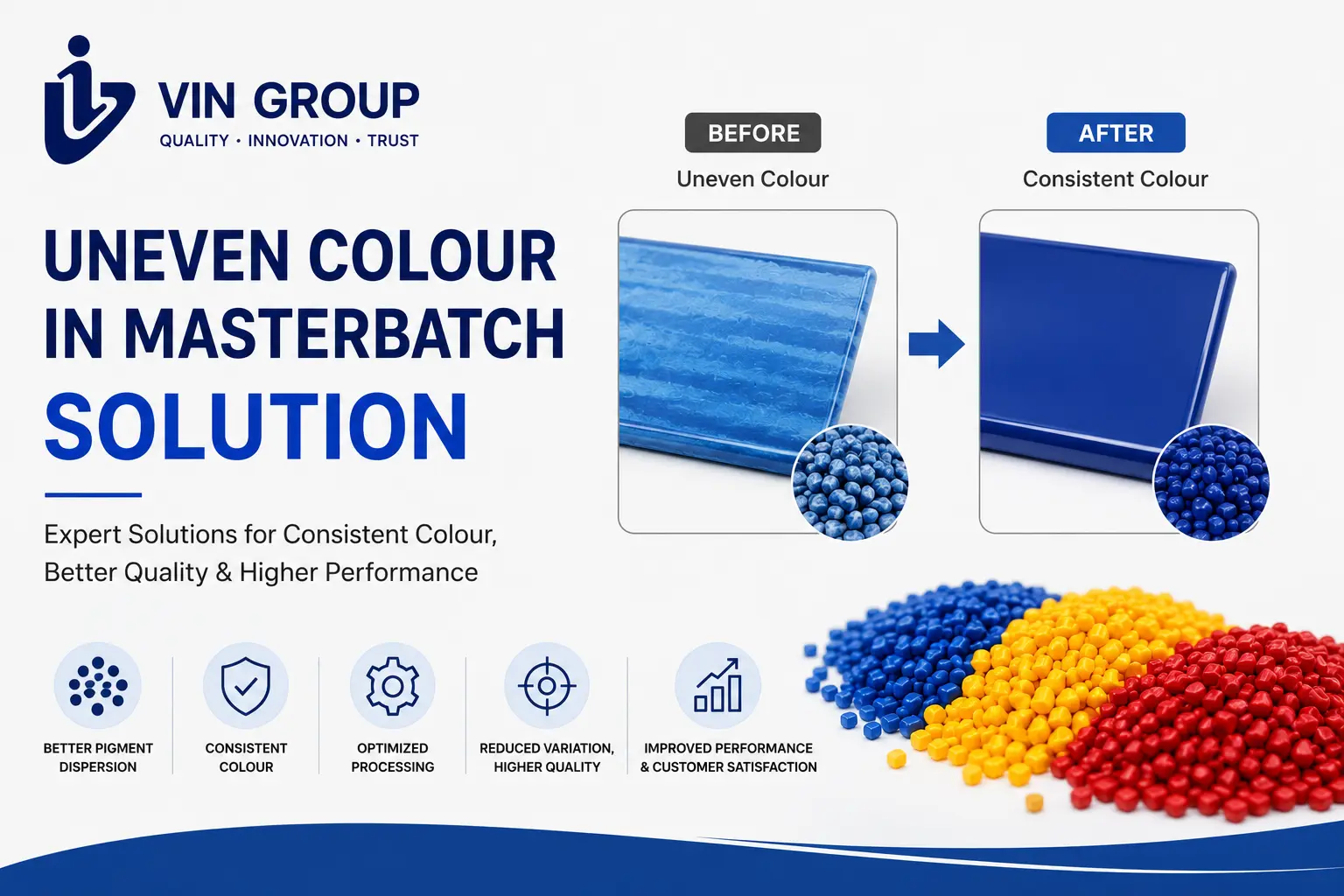
How To Deal With Uneven Coloring Of Color Masterbatch: A Complete Guide to Solving Color Inconsistency
Color consistency is one of the most important quality indicators in plastic and polymer manufacturing. Whether masterbatch is used for packaging materials, molded products, automotive components, consumer goods, or industrial applications, uneven coloration can lead to product rejection, customer dissatisfaction, and increased production costs.
Manufacturers frequently struggle with issues such as streaks, swirls, patchy shades, inconsistent pigmentation, and poor batch-to-batch performance. These problems often stem from poor pigment dispersion, carrier resin incompatibility, incorrect equipment settings, or unstable processing conditions.
This is why industries constantly look for a reliable uneven colour in masterbatch solution to achieve uniform color, stable production, and better product aesthetics.
At Vin Group, quality-focused manufacturing emphasizes process optimization, dispersion control, and equipment precision to improve masterbatch consistency and reduce production defects.
How To Deal With Uneven Coloring Of Color Masterbatch
Successfully resolving color inconsistency requires understanding the root causes behind uneven masterbatch dispersion.
A practical uneven colour in masterbatch solution focuses on:
- Pigment dispersion quality
- Carrier resin compatibility
- Equipment configuration
- Temperature control
- Processing consistency
- Batch formulation stability
Without proper control, manufacturers may experience visible defects and repeated masterbatch colour variation problem issues.
Below are practical methods to improve consistency and reduce production defects.
What Causes Uneven Colour in Plastic Masterbatch?
Understanding the causes of uneven colour in plastic masterbatch is the first step toward improving manufacturing quality.
Some common causes include:
Poor Pigment Dispersion
Uneven pigment blending often causes visible color inconsistency.
Incompatible Carrier Resins
Poor resin compatibility weakens color stability and dispersion quality.
Incorrect Processing Temperature
Improper heat settings affect pigment flow and distribution.
Equipment Misalignment
Poor machine calibration creates unstable material feeding and inconsistent mixing.
Moisture Contamination
Moisture often interferes with pigment performance.
Manufacturers seeking an effective masterbatch colour inconsistency solution should identify these root causes before adjusting production settings.
How Does Equipment Setup Affect Color Uniformity?
One of the most overlooked factors in color consistency is machine setup.
Equipment settings strongly influence material flow, mixing efficiency, and pigment distribution.
Incorrect setup may cause:
- Uneven feeding rates
- Poor dispersion quality
- Temperature instability
- Material stagnation
To how to improve masterbatch colour uniformity, manufacturers should focus on:
Screw Configuration
Proper screw design improves pigment distribution during extrusion.
Feeding Consistency
Stable material feeding prevents color variation.
Temperature Control
Balanced thermal conditions improve pigment integration.
Mixing Efficiency
Improved shear force helps reduce masterbatch pigment dispersion issues.
Regular machine maintenance also minimizes the risk of inconsistent color production.
What Role Do Carrier Resins Play in Color Consistency?
Carrier resin compatibility is essential for stable masterbatch performance.
Carrier resins help disperse pigments uniformly across the polymer matrix.
When compatibility is poor, manufacturers may experience:
- Uneven shading
- Weak color intensity
- Surface defects
- Poor processing performance
Compatible carriers help:
Improve Pigment Distribution
Better bonding improves consistency.
Reduce Color Variation
Stable resin interaction minimizes defects.
Improve Product Appearance
Smoother pigment flow creates more uniform color.
Choosing compatible materials is one of the best ways to improve colour dispersion in masterbatch.
Why Is My Finished Product Showing Streaks, Swirls, or Color Patches?
Visible surface defects are one of the clearest signs of poor masterbatch performance.
These issues usually happen because pigments are not distributed evenly throughout the polymer system.
Common causes include:
Incomplete Pigment Mixing
Poor blending creates visible colour streaks in masterbatch solution.
Improper Temperature
Incorrect processing heat may disrupt pigment flow.
Equipment Problems
Inconsistent screw speed affects color distribution.
Moisture Contamination
Water content interferes with material consistency.
Manufacturers experiencing repeated masterbatch pigment dispersion issues should carefully monitor processing conditions.
Fixing these issues helps create smoother and more visually consistent products.
How Can I Fix Inconsistent Color Batch-to-Batch?
Many manufacturers struggle with production instability.
Batch variation often occurs because of inconsistent formulation, unstable processing settings, or poor material control.
Manufacturers can reduce inconsistency through:
Standardized Raw Materials
Use consistent pigment and resin grades.
Better Formula Control
Stable recipes reduce color deviation.
Controlled Equipment Settings
Maintain identical processing conditions between batches.
Improved Pigment Dispersion
Consistent mixing improves color stability.
Following these methods offers a practical masterbatch colour inconsistency solution for long-term production reliability.
How to Fix Uneven Colour in Masterbatch
Manufacturers often ask how to fix uneven colour in masterbatch without increasing production waste.
Several proven methods can help.
Improve Pigment Mixing
Uniform dispersion remains the most important factor.
Optimize Extrusion Conditions
Stable screw speed and temperature improve consistency.
Use Compatible Carrier Resins
Better compatibility improves pigment distribution.
Reduce Moisture Exposure
Dry materials before processing.
Improve Equipment Calibration
Balanced settings support stable production.
These improvements significantly help how to fix uneven colour in masterbatch while reducing defects.
Improve Colour Dispersion in Masterbatch for Better Results
To improve colour dispersion in masterbatch, manufacturers should focus on advanced processing techniques.
Best practices include:
High-Shear Mixing
Improves particle separation and uniformity.
Better Pigment Wetting
Enhances compatibility between pigment and resin.
Stable Processing Temperatures
Protects pigment integrity during production.
Uniform Feeding Systems
Improves consistency throughout the extrusion process.
Consistent dispersion helps reduce the masterbatch colour variation problem and improves overall product appearance.
Common Signs of Masterbatch Pigment Dispersion Issues
Manufacturers should identify early warning signs of poor dispersion.
Some common symptoms include:
- Uneven color patches
- Streak marks
- Swirls in finished products
- Reduced gloss
- Shade inconsistency
- Batch-to-batch variation
Recognizing these problems early helps manufacturers improve production efficiency and product quality.
Best Practices to Improve Masterbatch Colour Uniformity
Businesses aiming to how to improve masterbatch colour uniformity should follow these best practices:
- Select compatible carrier resins
- Improve pigment dispersion quality
- Standardize production formulas
- Maintain stable equipment settings
- Optimize extrusion temperatures
- Dry materials properly before processing
- Improve mixing consistency
These improvements help manufacturers achieve stronger color consistency and reduce product rejection rates.
Benefits of Solving Uneven Colour in Masterbatch
Implementing a reliable uneven colour in masterbatch solution offers several manufacturing advantages.
Better Product Appearance
Uniform color improves product aesthetics.
Lower Production Waste
Fewer rejected products reduce material loss.
Stronger Brand Consistency
Stable shades improve product reliability.
Better Customer Satisfaction
Consistent quality improves market trust.
Improving color consistency also supports long-term production efficiency.
Final Thoughts
Achieving uniform and vibrant color in masterbatch requires more than selecting the right pigments, it depends on precise dispersion, compatible carrier resins, optimized processing conditions, and consistent equipment performance. By addressing the root causes of color variation, manufacturers can eliminate streaks, patchy shades, and batch-to-batch inconsistencies while improving product aesthetics, reducing production waste, and ensuring reliable manufacturing quality.
At Vin Group, we help manufacturers overcome masterbatch color challenges through advanced compounding expertise, optimized processing techniques, and high-performance additive solutions. Our commitment to precision, consistency, and quality-driven manufacturing enables businesses to achieve superior color uniformity, enhanced pigment dispersion, and dependable product performance across a wide range of plastic and polymer applications.