
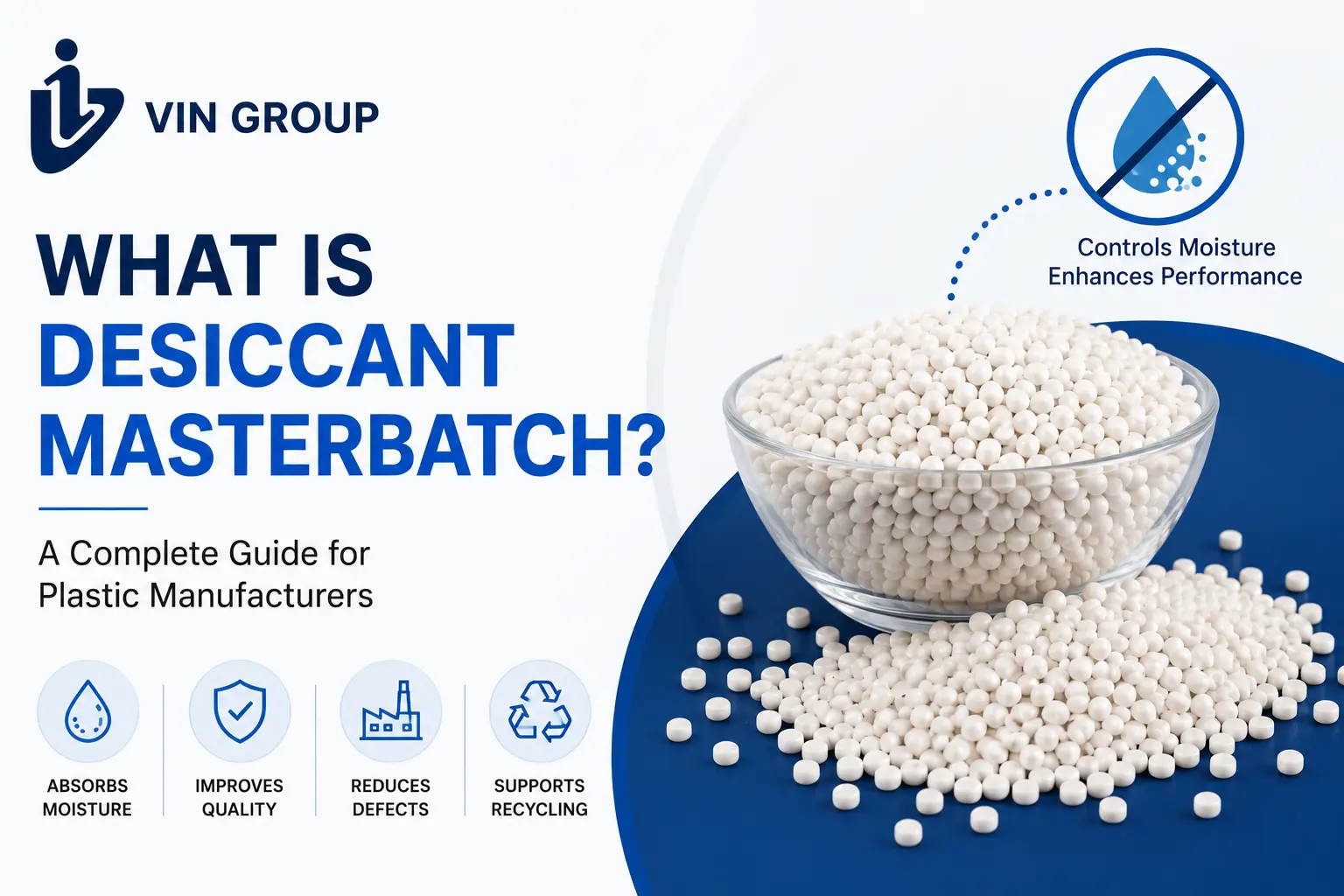
What is Desiccant Masterbatch? A Complete Guide
Moisture is one of the biggest challenges in plastic manufacturing. Excess moisture in plastic raw materials can lead to defects such as bubbles, weak product strength, poor finishing, and reduced durability. This is where desiccant masterbatch plays an important role in plastic production.
Understanding What is Desiccant Masterbatch? A Complete Guide helps manufacturers improve production quality while reducing waste and operational issues. At Vin Group, maintaining high-performance plastic processing standards remains a priority, and moisture control solutions such as desiccant masterbatch contribute significantly to achieving better outcomes.
In this guide, we will explore the meaning, composition, purpose, working mechanism, and benefits of desiccant masterbatch in the plastic industry.
What is Desiccant Masterbatch?
Desiccant masterbatch is a moisture-absorbing additive used in plastic manufacturing to eliminate excess water content from recycled or moisture-sensitive plastic materials. It is commonly added during plastic processing to prevent defects caused by moisture contamination.
This masterbatch contains moisture-absorbing agents that help improve the final quality of plastic products by reducing bubbles, surface imperfections, and inconsistencies.
In industries where moisture control is essential, desiccant masterbatch provides an efficient and cost-effective solution for maintaining production quality.
At Vin Group, moisture management plays an essential roDesiccant materials are usually composed of highly absorbent compounds that attract and retain moisture. In plastic processing, desiccant masterbatch often contains:
Calcium Oxide (Quicklime)
Calcium oxide is one of the most widely used moisture absorble in ensuring consistency across plastic processing applications.
What is Meant by Desiccant?
The term “desiccant” refers to a material designed to absorb moisture from surrounding environments. Desiccants are widely used across industries to control humidity and protect products from water-related damage.
In plastic manufacturing, desiccants help remove trapped moisture from polymer materials before or during production.
If you are wondering what is desiccant powder, it is generally a moisture-absorbing substance used to prevent humidity damage in industrial and commercial applications.
Desiccants are commonly used in packaging, electronics, pharmaceuticals, and plastic processing to maintain product stability and performance.
What is Desiccant Made Of?
One of the most common questions in the manufacturing industry is what is desiccant made of.
ers in desiccant masterbatch. It reacts with moisture and effectively removes water content from plastic materials.
Silica-Based Materials
Silica compounds are commonly used due to their strong moisture absorption capacity.
Mineral Fillers and Polymer Carriers
Desiccant masterbatch includes carrier resins and fillers that ensure smooth mixing during production.
The exact composition may vary depending on industrial requirements and application types.
How Does Desiccant Work?
Understanding how does desiccant work is important for manufacturers dealing with moisture-sensitive plastic production.
Desiccants work by attracting and absorbing moisture molecules from materials or surrounding air. In plastic manufacturing, desiccant masterbatch absorbs water present in recycled plastic or raw polymer materials during processing.
The absorbed moisture is neutralized, reducing defects such as:
- Air bubbles
- Surface cracking
- Weak structural integrity
- Uneven product finishing
- Reduced durability
This process allows manufacturers to improve production efficiency without requiring extensive drying procedures.
For businesses handling moisture-sensitive polymers, desiccant masterbatch offers an effective moisture control solution.
Why is Desiccant Masterbatch Important in Plastic Production?
Moisture contamination can create significant production issues in plastics. Desiccant masterbatch is used to overcome these challenges while maintaining quality.
Improves Product Quality
By reducing moisture content, manufacturers can create smoother and more durable plastic products.
Reduces Manufacturing Defects
Moisture often causes bubbling and uneven textures during molding or extrusion. Desiccant masterbatch minimizes these issues.
Cost-Effective Solution
Instead of investing heavily in drying systems, manufacturers can use desiccant masterbatch to simplify moisture control.
Supports Recycled Plastic Processing
Recycled plastics often contain higher moisture levels. Desiccant masterbatch helps make recycled materials easier to process.
At Vin Group, maintaining production quality involves selecting reliable solutions that support efficient and defect-free manufacturing.
What is the Purpose of a Desiccant?
The primary purpose of a desiccant is to absorb excess moisture and maintain dryness in materials or environments.
In industrial applications, desiccants help:
Prevent Moisture Damage
Water exposure can weaken products and affect performance.
Improve Storage Conditions
Desiccants help preserve materials during transportation and storage.
Maintain Product Stability
Industries use desiccants to maintain consistent quality and prevent spoilage.
Support Plastic Manufacturing
In polymer processing, desiccants reduce moisture-related production defects and improve final product quality.
For manufacturers, understanding what is the purpose of a desiccant helps improve efficiency and reduce waste.
What is the Best Example of Desiccant?
Several materials function as desiccants, but some are more commonly used due to their effectiveness.
Here are some of the best examples:
Silica Gel
Silica gel is among the most widely recognized desiccants. It is commonly used in packaging to absorb humidity.
Calcium Oxide
Calcium oxide is a powerful moisture absorber frequently used in industrial desiccant masterbatch.
Activated Clay
Activated clay helps absorb moisture in packaging and transportation applications.
Molecular Sieves
These advanced desiccants offer high absorption capacity and are used in industrial settings.
If you are curious about what are desiccant packs made of, they are often filled with silica gel, activated clay, or molecular sieve materials designed to absorb moisture efficiently.
What Are Desiccant Packs Made Of?
Many people often ask what are desiccant packs made of because these small packets are commonly found inside packaging.
Desiccant packs typically contain:
- Silica gel beads
- Activated charcoal
- Calcium chloride
- Molecular sieve compounds
- Clay desiccants
These materials are enclosed inside breathable packaging that allows moisture absorption while preventing leakage.
Their main purpose is to protect products from humidity during shipping and storage.
How Much is 1 Unit of Desiccant?
The term “1 unit of desiccant” generally refers to a standard measurement used to describe moisture absorption capacity.
The exact quantity may vary depending on industrial standards and application types. In packaging industries, one desiccant unit is typically designed to absorb a defined amount of moisture under controlled environmental conditions.
In plastic processing, dosage requirements depend on:
- Plastic type
- Moisture level
- Processing method
- Production volume
Manufacturers determine the required quantity based on material specifications and operational requirements.
Benefits of Using Desiccant Masterbatch
Using desiccant masterbatch offers several advantages for manufacturers.
Better Surface Finish
Products appear smoother and more visually appealing.
Improved Mechanical Strength
Reduced moisture contributes to stronger and more durable products.
Increased Production Efficiency
Manufacturers experience fewer defects and interruptions.
Lower Material Waste
Fewer rejected products mean reduced costs.
Enhanced Processing of Recycled Plastics
Desiccant masterbatch improves the usability of moisture-prone recycled materials.
These benefits make desiccant masterbatch an essential solution in modern plastic manufacturing.
Factors to Consider When Using Desiccant Masterbatch
To maximize performance, manufacturers should consider:
Moisture Levels
Higher moisture content may require additional dosage.
Type of Plastic Material
Different polymers absorb moisture differently.
Processing Temperature
Correct processing temperatures improve effectiveness.
Product Requirements
The end-use application determines the amount of desiccant needed.
At Vin Group, proper material handling and moisture control remain essential for delivering reliable plastic processing performance.
Conclusion
Choosing the right desiccant masterbatch is key to minimizing moisture-related issues and ensuring smooth, cost-effective plastic manufacturing. With improved product quality, reduced defects, and enhanced processing performance, it has become an essential solution for modern plastic production.
Vin Group offers high-quality desiccant masterbatch designed to meet the evolving needs of plastic manufacturers. Our commitment to quality, consistency, and customer satisfaction enables businesses to optimize production processes while achieving durable, high-performance plastic products.