
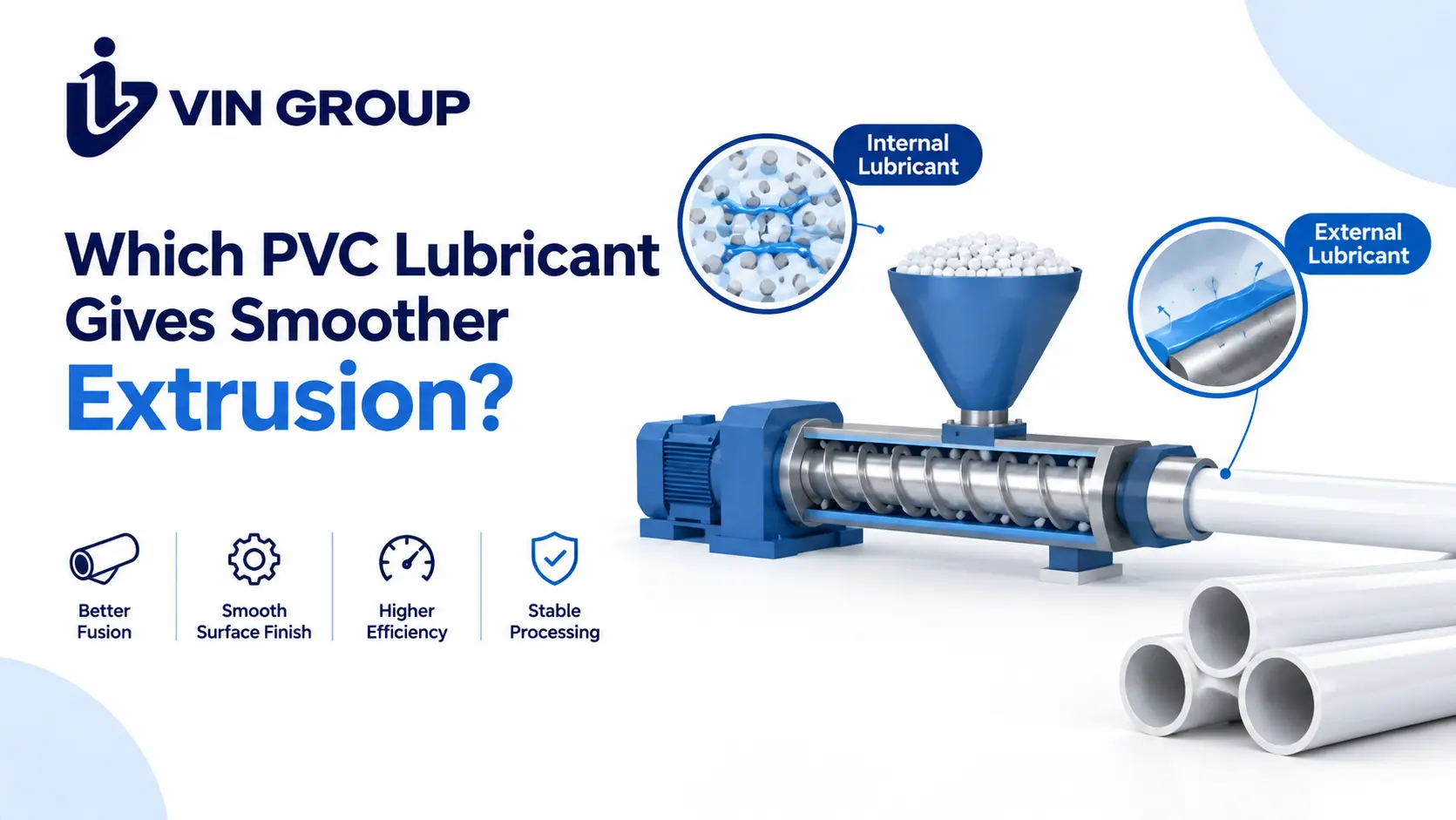
Internal vs External Lubricants: Which PVC Pipe Lubricant Additive Gives Smoother Extrusion?
PVC pipe manufacturing demands precision at every stage of the extrusion process. While PVC resin, stabilizers, fillers, and processing aids play essential roles, one often-overlooked component significantly influences processing efficiency and product quality—the PVC pipe lubricant additive. Lubricants help reduce friction during processing, improve melt flow, prevent sticking to machinery, and contribute to a smooth surface finish.
Choosing the right lubricant system is not simply about reducing friction. Manufacturers must carefully balance Internal and external lubricant for PVC formulations to achieve consistent fusion, stable extrusion, high production speeds, and excellent pipe quality. An imbalance can lead to poor surface finish, excessive die build-up, delayed fusion, or reduced mechanical properties.
This guide explains how internal and external lubricants work, their differences, how they influence PVC extrusion, and how manufacturers can select the most suitable PVC pipe lubricant additive for their production requirements.
Why Lubricants Are Essential in PVC Pipe Manufacturing
Rigid PVC compounds generate considerable friction during mixing and extrusion. Without proper lubrication, excessive heat builds up, causing processing instability and poor product quality.
A well-designed lubricant package helps manufacturers achieve:
- Smooth material flow
- Stable extrusion
- Faster production cycles
- Reduced equipment wear
- Better dimensional accuracy
- Improved surface finish
- Consistent product quality
- Lower reject rates
Selecting the correct PVC lubricant is therefore essential for maintaining efficient manufacturing operations.
What Is a PVC Pipe Lubricant Additive?
A PVC pipe lubricant additive is a processing additive designed to control friction during PVC processing.
Its primary functions include:
- Reducing friction inside the PVC melt
- Reducing friction between the PVC compound and metal surfaces
- Improving melt flow
- Preventing sticking inside processing equipment
- Supporting uniform fusion
- Producing smoother pipe surfaces
Lubricants do not strengthen PVC directly. Instead, they help create the processing conditions necessary for manufacturing high-quality products consistently.
Understanding Internal and External Lubricants
PVC processing typically requires two different lubrication mechanisms.
These are:
- Internal lubrication
- External lubrication
Each performs a different function during extrusion.
What Is an Internal Lubricant for PVC?
An Internal lubricant for PVC works inside the polymer matrix.
Its primary role is to reduce internal friction between PVC particles as they melt and fuse together.
Benefits include:
- Improved melt flow
- Better fusion
- Reduced melt viscosity
- Easier processing
- Higher production efficiency
- Improved dispersion of additives
Internal lubricants become compatible with the PVC melt and help the material move more efficiently through the extrusion process.
What Is an External Lubricant?
External lubricants behave differently.
Rather than mixing completely with the PVC melt, they migrate toward the metal surfaces of the processing equipment.
Their primary functions include:
- Reducing friction between PVC and machinery
- Preventing sticking
- Improving die release
- Lowering equipment wear
- Reducing die build-up
- Improving surface appearance
External lubrication becomes especially important during high-speed pipe extrusion where material continuously contacts screws, barrels, calibrators, and dies.
Internal vs External Lubricant for PVC
Understanding the difference between both lubricant types is essential when designing a PVC formulation.
| Property | Internal Lubricant | External Lubricant |
| Primary Function | Reduces internal melt friction | Reduces metal-to-polymer friction |
| Fusion | Promotes fusion | Controls fusion rate |
| Melt Flow | Improves | Minimal direct effect |
| Equipment Protection | Limited | Excellent |
| Surface Finish | Indirect improvement | Significant improvement |
| Processing Stability | High | High |
Neither lubricant replaces the other.
Instead, successful formulations require the correct balance of Internal and external lubricant for PVC to achieve optimal extrusion performance.
Why Lubricant Balance Matters
One of the most common formulation mistakes is assuming that adding more lubricant automatically improves processing.
In reality, excessive lubrication can create processing problems.
Similarly, insufficient lubrication may lead to:
- High melt temperature
- Poor extrusion stability
- Rough surfaces
- Increased torque
- Equipment wear
- Inconsistent pipe dimensions
The correct PVC lubricant package depends on the complete formulation rather than a single additive.
How Lubricants Improve PVC Processing
A properly balanced PVC pipe lubricant additive contributes to several important manufacturing improvements.
Better Fusion Control
Internal lubricants help PVC particles fuse uniformly during processing.
Consistent fusion improves:
- Mechanical properties
- Pipe strength
- Dimensional stability
- Product consistency
Improved Extrusion Stability
External lubricants reduce friction between molten PVC and processing equipment.
Benefits include:
- Stable output
- Reduced pressure fluctuations
- Lower equipment wear
- Consistent pipe dimensions
Faster Production
Well-balanced lubrication allows manufacturers to operate at higher extrusion speeds while maintaining excellent product quality.
Higher productivity helps reduce manufacturing costs without sacrificing performance.
Better Surface Finish
Smooth pipe surfaces improve both product appearance and downstream performance.
Proper lubrication reduces:
- Surface drag marks
- Die lines
- Scratches
- Material sticking
This results in pipes with a cleaner, more professional finish.
Choosing the Right PVC Lubricant
Several factors influence lubricant selection.
Manufacturers should evaluate:
PVC Resin Grade
Different PVC resin grades require different lubrication levels depending on molecular weight and processing characteristics.
Processing Equipment
Extruder design, screw configuration, die geometry, and production speed all affect lubrication requirements.
Product Type
Different products require different lubricant packages.
Examples include:
- Pressure pipes
- Plumbing pipes
- Agricultural pipes
- Electrical conduits
- PVC fittings
Each application places unique demands on the extrusion process.
Production Speed
Higher production speeds generally require more carefully optimized lubrication systems to maintain stable processing.
Common Types of PVC Lubricants
Several lubricant technologies are commonly used in PVC formulations.
These include:
- Paraffin waxes
- Polyethylene waxes
- Oxidized polyethylene waxes
- Fatty acid esters
- Metallic stearates
- Calcium stearate
- Stearic acid
- Complex lubricant blends
Each offers different processing characteristics depending on whether internal or external lubrication is required.
PVC Solvent vs PVC Lubricant
Manufacturers sometimes confuse PVC Solvent with processing lubricants, but they serve entirely different purposes.
A PVC Solvent is primarily used for joining PVC pipes and fittings by softening the material to create a strong bonded connection.
A PVC pipe lubricant additive, on the other hand, is incorporated into the PVC formulation during manufacturing to improve extrusion performance, melt flow, and surface quality.
Understanding this distinction helps avoid confusion during material selection and production planning.
Signs That Your Lubrication System Needs Optimization
Manufacturers should review their formulation if they observe:
- Rough pipe surfaces
- High extrusion torque
- Die build-up
- Poor fusion
- Inconsistent pipe dimensions
- Excessive equipment wear
- Material sticking
- Reduced production efficiency
These issues often indicate that the balance between internal and external lubrication needs adjustment.
Can a Single Additive Perform Both Roles?
One of the most common questions among PVC pipe manufacturers is whether a single additive can replace both internal and external lubricants.
The answer is partially yes, but with important limitations.
Some modern lubricant systems are designed as multifunctional additives that provide both internal and external lubrication. These products simplify formulations and improve processing consistency by balancing melt flow and equipment lubrication. However, in high-output PVC pipe manufacturing, relying on a single additive alone is not always sufficient.
Most rigid PVC formulations still perform best when the ratio of Internal and external lubricant for PVC is carefully optimized. This allows manufacturers to fine-tune:
- Fusion time
- Melt flow
- Extrusion stability
- Surface finish
- Pipe dimensions
- Production speed
Rather than replacing one lubricant with another, successful formulations focus on achieving the right balance for the specific resin grade, processing equipment, and end application.
What Happens If You Use Too Much Lubricant?
Lubricants improve processing only when used in the correct quantity. Excessive lubrication can negatively affect both manufacturing performance and finished product quality.
Common issues caused by excessive lubricant addition include:
Delayed Fusion
Too much lubricant may reduce the interaction between PVC particles, delaying proper fusion during extrusion.
This can result in:
- Poor mechanical strength
- Reduced impact resistance
- Lower product durability
Surface Defects
Excess lubricant may migrate to the pipe surface, causing:
- Uneven finish
- Gloss variation
- Surface streaks
- Flow marks
These defects reduce the visual quality of finished pipes.
Reduced Productivity
Improper lubrication can create unstable processing conditions, leading to:
- Frequent machine adjustments
- Increased rejects
- Higher downtime
- Lower production efficiency
Dimensional Inconsistency
Excessive lubrication can affect material flow, making it more difficult to maintain consistent wall thickness and pipe dimensions.
For these reasons, manufacturers should optimize the dosage of every PVC lubricant rather than assuming that more lubricant automatically improves processing.
Which Additive Yields the Smoothest Surface Finish?
Surface quality is one of the most important indicators of a well-balanced PVC formulation.
Although no single additive guarantees the best finish in every application, external lubricants generally have the greatest influence on surface appearance because they reduce friction between the molten PVC and metal processing equipment.
A smooth pipe surface is achieved when:
- Internal lubrication promotes uniform fusion.
- External lubrication prevents sticking and die build-up.
- Processing parameters are properly controlled.
- The lubricant package is compatible with the complete formulation.
In practice, the smoothest extrusion is achieved through the correct combination of Internal lubricant for PVC and external lubricants rather than relying on a single processing additive.
Best Practices for Selecting a PVC Pipe Lubricant Additive
Choosing the right PVC pipe lubricant additive requires evaluating the complete manufacturing process rather than selecting products based only on cost.
Manufacturers should consider:
Product Requirements
Different products require different lubrication systems.
Examples include:
- Pressure pipes
- Plumbing pipes
- Agricultural pipes
- Electrical conduits
- PVC fittings
Extrusion Conditions
Factors such as screw design, barrel temperature, die geometry, and production speed directly influence lubricant performance.
Resin Compatibility
Lubricants should be compatible with the selected PVC resin, stabilizer package, processing aids, fillers, and other additives to ensure stable processing.
Production Efficiency
A well-balanced lubrication system contributes to:
- Stable extrusion
- Lower reject rates
- Higher throughput
- Better dimensional consistency
- Reduced equipment maintenance
Achieving Smoother Extrusion in PVC Pipe Manufacturing
Smooth extrusion depends on much more than selecting a single lubricant.
Manufacturers should optimize:
- PVC resin quality
- Stabilizer system
- Processing aids
- Lubricant package
- Filler loading
- Processing temperatures
- Screw configuration
- Extrusion speed
When all these factors work together, manufacturers achieve consistent production, excellent surface finish, and high-quality PVC pipes.
Future Trends in PVC Lubrication Technology
As PVC processing technology continues to evolve, lubricant systems are becoming more advanced and application-specific.
Current trends include:
- Multifunctional lubricant packages
- Improved processing efficiency
- Better compatibility with high-speed extrusion
- Reduced equipment wear
- Enhanced surface finish
- Optimized formulations for energy-efficient processing
- Greater consistency in large-scale manufacturing
These developments help manufacturers improve productivity while maintaining excellent product quality.
Conclusion
Selecting the right PVC pipe lubricant additive is essential for achieving smooth extrusion, stable processing, and consistent product quality. While Internal lubricant for PVC improves melt flow and fusion, external lubricants minimize friction between the PVC compound and processing equipment, resulting in better surface finish and improved manufacturing efficiency. The best results are achieved by carefully balancing both types of lubrication rather than relying on a single additive or excessive dosage.
At Vin Group, we provide high-performance PVC additive solutions that help manufacturers optimize processing, improve extrusion stability, enhance surface finish, and increase overall production efficiency. Our technical expertise enables customers to select the most suitable additive combinations for their formulations, ensuring reliable processing, superior product quality, and long-term manufacturing success.
Frequently Asked Questions
1. What is a PVC pipe lubricant additive?
A PVC pipe lubricant additive is a processing additive that reduces friction during PVC extrusion, improves melt flow, enhances surface finish, and supports stable manufacturing.
2. What is the difference between internal and external lubricant for PVC?
Internal and external lubricant for PVC perform different functions. Internal lubricants reduce friction within the PVC melt to improve fusion, while external lubricants reduce friction between the PVC compound and processing equipment.
3. Why is an internal lubricant for PVC important?
An Internal lubricant for PVC promotes better melt flow, faster fusion, improved additive dispersion, and more consistent extrusion, resulting in higher-quality finished products.
4. Can one lubricant replace both internal and external lubricants?
Some multifunctional lubricant systems provide both internal and external lubrication. However, for most PVC pipe formulations, the best processing performance is achieved through a balanced combination of both lubricant types.
5. Does excessive PVC lubricant affect pipe quality?
Yes. Excessive PVC lubricant may delay fusion, create surface defects, reduce mechanical strength, and lower overall production efficiency.
6. Is PVC solvent the same as a PVC lubricant?
No. PVC Solvent is used for joining PVC pipes and fittings, whereas a PVC pipe lubricant additive is incorporated into the formulation during manufacturing to improve extrusion and processing.
7. Which lubricant provides the smoothest PVC pipe surface?
A combination of properly balanced internal and external lubricants generally produces the smoothest surface finish by improving fusion while minimizing friction with processing equipment.
8. How can Vin Group help PVC pipe manufacturers?
Vin Group offers advanced PVC additive solutions and technical support to help manufacturers optimize formulations, improve extrusion performance, achieve smoother surface finishes, reduce processing issues, and produce high-quality PVC pipes consistently.