
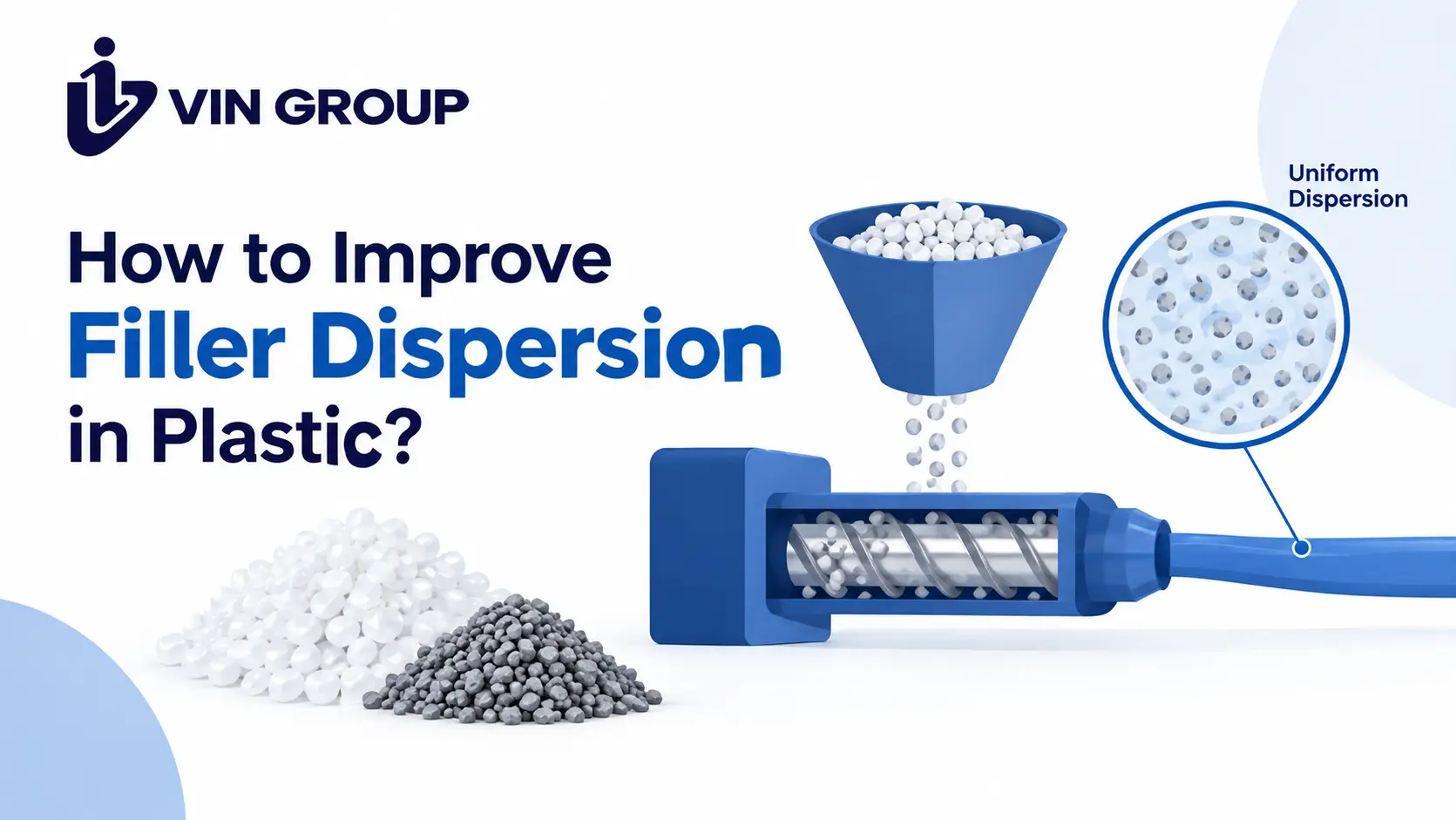
How to Improve Filler Dispersion in Plastic?
Plastic manufacturing often relies on fillers to improve material performance, reduce production costs, and enhance product functionality. However, poor filler distribution can negatively affect strength, durability, appearance, and consistency. Uneven filler dispersion may lead to weak mechanical properties, poor surface finish, material defects, and processing inefficiencies.
Understanding how to improve filler dispersion in plastic is essential for manufacturers seeking stronger, more reliable, and high-performance polymer products. Whether working with mineral fillers, reinforcing agents, or specialty additives, achieving uniform dispersion significantly improves final product quality.
At Vin Group, maintaining advanced polymer processing standards includes improving filler compatibility and ensuring consistent material performance.
In this guide, we will discuss filler dispersion, common challenges, filler types, and proven techniques for improving polymer performance.
What Is Filler in Plastic?
One of the most commonly searched questions is, what is filler in plastic?
A filler in plastic refers to materials added to polymer systems to improve specific properties or reduce production costs. Fillers help enhance performance characteristics such as stiffness, strength, dimensional stability, heat resistance, and durability.
Common purposes of fillers include:
- Improving strength
- Enhancing rigidity
- Increasing durability
- Reducing material cost
- Improving thermal performance
- Controlling shrinkage
Fillers are widely used in plastics, rubber, composites, and industrial polymer products.
At Vin Group, selecting suitable filler materials helps improve consistency and product performance.
What Is the Dispersion of Fillers?
A key technical question is, what is the dispersion of fillers?
Filler dispersion refers to how evenly filler particles are distributed throughout a polymer matrix.
Good filler dispersion ensures:
- Uniform strength
- Better surface finish
- Consistent mechanical properties
- Improved thermal performance
- Enhanced durability
Poor dispersion often causes:
- Particle agglomeration
- Weak structural zones
- Surface imperfections
- Reduced product quality
Proper filler dispersion in polymer composites significantly improves performance and reliability.
What Are the Fillers Used in Plastics?
Many manufacturers ask, what are the fillers used in plastics?
Several fillers are commonly added to plastic materials depending on performance requirements.
Calcium Carbonate
Widely used to improve stiffness and reduce cost.
Talc
Improves dimensional stability and rigidity.
Glass Fiber
Enhances strength and structural performance.
Silica
Improves wear resistance and thermal stability.
Carbon Black
Improves UV resistance and conductivity.
Clay Fillers
Enhance durability and mechanical performance.
Each filler type offers different benefits depending on the polymer system.
Why Is Filler Dispersion Important?
Uniform filler distribution significantly impacts material quality.
Improves Mechanical Strength
Well-dispersed fillers strengthen polymer structure.
Improves Surface Finish
Even distribution reduces roughness and defects.
Enhances Thermal Stability
Uniform fillers improve heat resistance.
Improves Product Reliability
Consistent material behavior increases durability.
Supports Better Processing
Properly dispersed fillers improve manufacturing consistency.
Understanding how to improve dispersion becomes essential for long-term product performance.
How to Improve Filler Dispersion in Plastic?
Manufacturers frequently ask, how to improve filler dispersion in plastic effectively.
Several proven techniques help improve filler distribution.
Use High-Shear Mixing
High-shear processing helps break filler agglomerates and distribute particles more evenly.
This improves:
- Uniformity
- Strength
- Surface consistency
Select Compatible Fillers
Compatibility between filler and polymer significantly improves distribution.
Poor compatibility often causes clumping.
Use Coupling Agents
Coupling agents improve bonding between fillers and polymers.
Benefits include:
- Better adhesion
- Improved dispersion
- Stronger material performance
Optimize Processing Temperature
Proper heat improves polymer flow and particle movement.
Incorrect temperatures may reduce dispersion quality.
Improve Filler Particle Size
Smaller particles often distribute more uniformly.
Use Dispersion Aids
Special additives improve separation and filler distribution.
These methods significantly improve filler dispersion in polymer composites.
Filler Dispersion in Polymer Composites
Proper filler dispersion in polymer composites directly affects material performance.
Well-dispersed fillers improve:
Strength
Composite materials become stronger.
Stiffness
Materials resist deformation more effectively.
Surface Quality
Uniform appearance improves aesthetics.
Processing Consistency
Stable manufacturing reduces defects.
Poor dispersion, however, often weakens performance and increases production waste.
At Vin Group, maintaining optimized material processing supports better composite reliability.
How to Improve Dispersion in Polymers
A frequently searched topic is how to improve dispersion across polymer systems.
Here are practical approaches:
Improve Material Compatibility
Compatible fillers distribute more effectively.
Increase Shear During Mixing
Strong mixing reduces particle clusters.
Use Surface-Treated Fillers
Surface treatment improves interaction between fillers and polymers.
Optimize Equipment Settings
Temperature and pressure affect particle movement.
Improve Material Preparation
Pre-processing improves consistency.
These strategies improve both filler performance and overall product quality.
What Happens When Too Much Filler Is Added to Dental Resins?
A technical question often asked is, what happens when too much filler is added to dental resins?
Although dental materials differ from industrial plastics, filler principles remain similar.
Excess filler may cause:
Reduced Flexibility
The material becomes brittle.
Poor Workability
Processing becomes more difficult.
Weak Bonding
Poor dispersion reduces structural consistency.
Surface Irregularities
Excess particles affect smoothness.
The same concept applies in plastics—too much filler without proper dispersion can reduce material quality.
What Type of Filler Can I Use on Plastic?
Another commonly searched question is, what type of filler can I use on plastic?
The answer depends on the application.
For Structural Strength
Glass fiber and talc work well.
For Cost Reduction
Calcium carbonate is commonly used.
For Surface Improvement
Silica fillers improve finish quality.
For UV Resistance
Carbon black improves weather resistance.
Choosing the right filler depends on product requirements and intended performance.
What Is the Best Filler for Plastic?
A frequently asked question is, what is the best filler for plastic?
There is no universal answer because the best filler depends on the application.
Calcium Carbonate
Good for cost reduction and stiffness.
Glass Fiber
Best for strength improvement.
Talc
Ideal for dimensional stability.
Silica
Useful for wear resistance.
The right filler selection improves durability and overall product quality.
How to Fill Gaps in Plastic
Some users also search how to fill gaps in plastic.
For repairs and finishing:
Plastic-Compatible Fillers
Specialized compounds fill cracks and gaps.
Plastic Welding
Heat-based repairs improve strength.
Surface Sanding and Finishing
Improves appearance after repairs.
While different from industrial fillers, repair fillers also rely on compatibility and strong bonding.
Factors Affecting Filler Dispersion
Several variables influence filler performance.
Particle Size
Smaller particles disperse more evenly.
Polymer Viscosity
High viscosity limits particle movement.
Mixing Quality
Poor mixing reduces consistency.
Material Compatibility
Incompatible materials create agglomeration.
Processing Conditions
Stable temperatures improve results.
Understanding these factors helps manufacturers reduce defects and improve product reliability.
Best Practices for Better Filler Dispersion
Manufacturers can improve filler performance by:
Using High-Quality Fillers
Premium materials improve consistency.
Optimizing Processing Conditions
Stable temperatures improve distribution.
Improving Mixing Systems
Advanced equipment improves uniformity.
Conducting Material Testing
Routine analysis improves reliability.
Using Dispersion Aids
Special additives improve particle separation.
At Vin Group, maintaining superior material standards supports stronger, more durable, and reliable polymer products.
Conclusion
As plastic applications become increasingly demanding, achieving uniform filler dispersion has become a key factor in developing stronger and more reliable composite materials. Every improvement in particle distribution contributes to better structural integrity, enhanced processing stability, and longer product life.
Vin Group delivers polymer solutions that help manufacturers optimize filler performance while maintaining efficient production. By combining high-quality materials with technical expertise, we support the development of plastic products that perform consistently in even the most challenging applications.