
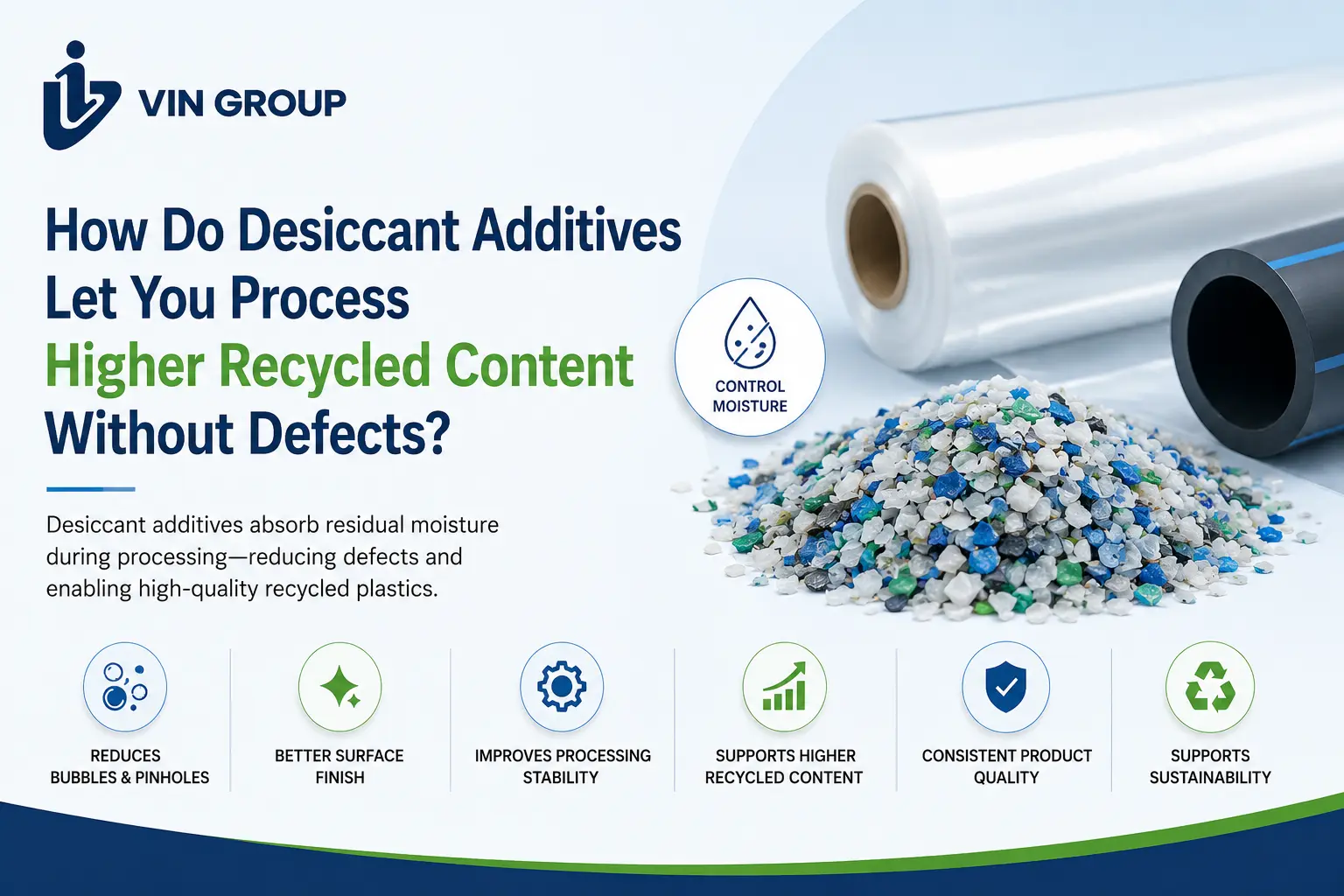
How Do Desiccant Additives Let You Process Higher Recycled Content Without Defects?
Sustainability has become a major focus in the plastics industry, leading manufacturers to increase the use of recycled polymers in packaging, films, pipes, molded products, and industrial components. While using higher recycled content helps reduce plastic waste and lowers raw material costs, it also introduces several processing challenges. One of the most common issues is moisture contamination, which can lead to bubbles, pinholes, fish-eyes, poor surface finish, and unstable extrusion.
To overcome these problems, manufacturers increasingly rely on a desiccant for reclaimed polymer. These specialized additives absorb residual moisture during processing, allowing higher percentages of recycled material to be incorporated without compromising product quality or production efficiency.
This guide explains how desiccant additives work, why recycled plastics are more susceptible to moisture-related defects, and how they help manufacturers achieve Defect-free recycled plastic production while increasing recycled content.
Why Higher Recycled Content Creates Processing Challenges
Recycled plastics undergo multiple stages before being reprocessed, including collection, washing, shredding, drying, storage, and transportation.
Throughout this process, polymers can absorb moisture from the surrounding environment.
When moisture-containing recycled plastics are processed at high temperatures, the trapped water rapidly converts into steam, causing defects such as:
- Bubbles
- Pinholes
- Fish-eyes
- Surface imperfections
- Inconsistent melt flow
- Poor mechanical properties
- Increased scrap
- Reduced productivity
As manufacturers continue using High recycled content plastics, effective moisture management becomes increasingly important.
What Is a Desiccant for Reclaimed Polymer?
A desiccant for reclaimed polymer is a functional additive that chemically absorbs or neutralizes residual moisture during plastic processing.
Instead of allowing moisture to become steam inside the extruder, the desiccant reacts with water molecules and converts them into stable compounds that remain safely dispersed within the polymer.
This process helps manufacturers produce:
- Stable extrusion
- Better surface finish
- Reduced defects
- Improved melt flow
- Higher productivity
- Consistent product quality
These additives are widely used for PE, PP, recycled polyolefins, and mixed recycled plastic streams.
Understanding Desiccant Additives for Plastics
Desiccant additives for plastics are specifically formulated to control moisture that remains even after conventional drying.
Unlike drying equipment that removes free moisture before processing, desiccant additives continue working during extrusion by absorbing residual water that may still be trapped inside recycled polymers.
Their primary advantages include:
- Improved moisture control
- Reduced extrusion defects
- Better processing stability
- Higher production efficiency
- Lower rejection rates
- Improved finished product appearance
What Is Desiccant Masterbatch?
Desiccant masterbatch is one of the most commonly used moisture-control additives in recycled plastic processing.
It consists of moisture-absorbing compounds dispersed within a compatible polymer carrier, allowing easy mixing with recycled plastic during extrusion.
Its primary functions include:
- Moisture absorption
- Improved melt stability
- Bubble reduction
- Fish-eye prevention
- Surface quality improvement
- Consistent extrusion
Because of its ease of use and effectiveness, desiccant masterbatch has become a preferred solution for manufacturers processing recycled plastics.
How Desiccants Improve Recycled Plastic Processing
One of the biggest advantages of using a desiccant for reclaimed polymer is improved Recycled plastic processing.
By controlling residual moisture, desiccants help:
- Stabilize melt flow
- Reduce pressure fluctuations
- Improve extrusion consistency
- Minimize machine downtime
- Produce higher-quality finished products
Stable processing allows manufacturers to increase recycled content while maintaining production efficiency.
Moisture Control in Plastic Extrusion
Effective Moisture control in plastic extrusion is essential for producing high-quality recycled plastic products.
Residual moisture can cause:
- Surface defects
- Internal voids
- Weak mechanical properties
- Film imperfections
- Processing instability
Desiccant additives significantly reduce these problems by chemically binding moisture before it creates defects during processing.
Moisture Absorber for Plastics
A Moisture absorber for plastics provides several important processing benefits.
These include:
- Reduced moisture-related defects
- Improved product appearance
- Better dimensional stability
- Consistent extrusion
- Lower scrap rates
- Higher productivity
These advantages become even more valuable when manufacturing products containing high percentages of recycled material.
Plastic Processing Additives That Support Higher Recycled Content
Several Plastic processing additives work together to improve recycled plastic manufacturing.
Common additives include:
- Desiccant masterbatch
- Stabilizers
- Processing aids
- Compatibilizers
- Slip additives
- Anti-block additives
Among these, desiccants play a critical role by eliminating one of the most common causes of processing defects—residual moisture.
Recycled Plastic Quality Improvement
Achieving Recycled plastic quality improvement requires optimizing both material selection and processing conditions.
Manufacturers should focus on:
- Moisture management
- Proper additive selection
- Controlled extrusion temperatures
- Consistent raw material quality
- Appropriate processing parameters
Using a high-quality desiccant additive helps maintain stable processing while improving the appearance and performance of finished products.
Anti-Moisture Additive for Recycled Plastics
An effective Anti-moisture additive for recycled plastics offers several production advantages.
These include:
- Reduced bubbles
- Fewer fish-eyes
- Improved surface finish
- Better melt stability
- Lower rejection rates
- Improved production efficiency
- Better recycled product consistency
As recycled content continues to increase, these additives become increasingly valuable for maintaining manufacturing quality.
What Can Consumers Do to Make Sure That More Materials Are Recycled?
Although manufacturers play a major role in recycling, consumers also contribute significantly to improving recycling rates and supporting the circular economy.
Consumers can help by:
- Separating recyclable waste correctly.
- Cleaning plastic packaging before disposal.
- Following local recycling guidelines.
- Reducing contamination in recyclable materials.
- Choosing products made with recycled plastics.
- Supporting brands committed to sustainable packaging.
- Reusing plastic products whenever possible.
Better recycling practices increase the availability of high-quality reclaimed polymers, making it easier for manufacturers to produce products with High recycled content plastics while reducing environmental impact.
What Is the Purpose of a Desiccant in a Product Packaging?
The term “desiccant” is used in different industries, including plastic processing and product packaging.
In product packaging, a desiccant is used to absorb moisture inside sealed packages. This helps protect moisture-sensitive products from humidity during storage and transportation.
Common benefits include:
- Preventing moisture damage
- Reducing mold and mildew
- Protecting product quality
- Extending shelf life
- Preventing corrosion in sensitive products
Although packaging desiccants and Desiccant masterbatch both manage moisture, they serve different purposes. Packaging desiccants protect finished products after manufacturing, while desiccant masterbatch removes residual moisture during plastic processing.
Which Polymer Can Be Remelted and Therefore Recycled?
Thermoplastics are polymers that soften when heated and solidify when cooled. Because of this property, they can generally be remelted and reprocessed multiple times, making them suitable for recycling.
Common recyclable thermoplastics include:
- Polyethylene (PE)
- Polypropylene (PP)
- Polyvinyl Chloride (PVC)
- Polystyrene (PS)
- Polyethylene Terephthalate (PET)
These materials are widely used in packaging, films, containers, pipes, automotive components, and consumer products.
As recycled content increases in these polymers, effective moisture management using a desiccant for reclaimed polymer becomes increasingly important to maintain processing stability and product quality.
Best Practices for Defect-Free Recycled Plastic Processing
Producing Defect-free recycled plastic requires more than adding a desiccant. Manufacturers should optimize the complete production process.
Store Materials Correctly
Recycled pellets and flakes should be stored in dry, clean environments to minimize moisture absorption before processing.
Inspect Raw Materials
Moisture levels can vary between recycled material batches. Regular inspection allows manufacturers to adjust processing conditions accordingly.
Optimize Extrusion Conditions
Maintaining appropriate extrusion temperatures, screw speed, and residence time helps maximize the effectiveness of desiccant additives.
Select Compatible Additives
A desiccant for reclaimed polymer should work efficiently alongside stabilizers, processing aids, lubricants, and compatibilizers to achieve consistent results.
Monitor Product Quality
Routine quality checks help identify processing issues early and maintain stable production with high recycled content.
Future Trends in Recycled Plastic Processing
The demand for sustainable plastics continues to drive innovation in moisture management technologies.
Some important developments include:
- Higher-performance desiccant masterbatches
- Improved moisture absorption efficiency
- Better compatibility with recycled polymers
- Increased use of recycled content
- Reduced processing defects
- More energy-efficient manufacturing
- Greater production consistency
These advancements enable manufacturers to incorporate higher levels of recycled material while maintaining product performance and processing reliability.
Conclusion
Using a high-quality desiccant for reclaimed polymer is one of the most effective ways to process higher recycled content without compromising product quality. By improving Moisture control in plastic extrusion, desiccant additives reduce bubbles, fish-eyes, surface imperfections, and other moisture-related defects that commonly affect recycled materials. They also enhance processing stability, improve Recycled plastic quality improvement, and help manufacturers achieve consistent, Defect-free recycled plastic production while supporting sustainability goals.
At Vin Group, we provide advanced Desiccant additives for plastics that help manufacturers maximize the use of recycled polymers while maintaining reliable processing and superior product quality. Our innovative additive solutions improve extrusion stability, reduce production losses, optimize moisture management, and support efficient, cost-effective manufacturing. Backed by technical expertise and a commitment to customer success, Vin Group helps businesses confidently increase recycled content without sacrificing performance.
Frequently Asked Questions
1. What is a desiccant for reclaimed polymer?
A desiccant for reclaimed polymer is a moisture-absorbing additive that chemically binds residual water during processing, reducing extrusion defects and improving recycled plastic quality.
2. What is desiccant masterbatch used for?
Desiccant masterbatch is used to absorb residual moisture during plastic processing, helping eliminate bubbles, fish-eyes, pinholes, and other moisture-related defects.
3. How do desiccant additives for plastics improve processing?
Desiccant additives for plastics improve melt stability, reduce moisture-related defects, enhance surface finish, increase production efficiency, and support higher recycled content.
4. Why is moisture control important in plastic extrusion?
Proper Moisture control in plastic extrusion prevents steam formation during processing, reducing bubbles, surface defects, poor mechanical properties, and unstable melt flow.
5. Can desiccants improve recycled plastic quality?
Yes. Desiccants contribute to Recycled plastic quality improvement by minimizing moisture-related defects, improving extrusion consistency, and producing smoother, higher-quality finished products.
6. Which industries commonly use anti-moisture additives for recycled plastics?
An Anti-moisture additive for recycled plastics is widely used in plastic film production, packaging, injection molding, blow molding, pipe extrusion, and compound manufacturing.
7. Can manufacturers process higher recycled content without defects?
Yes. By combining proper material handling, optimized processing conditions, and an effective desiccant for reclaimed polymer, manufacturers can successfully process High recycled content plastics with fewer defects.
8. How does Vin Group help manufacturers process recycled plastics?
Vin Group offers advanced moisture management solutions and technical support that help manufacturers improve Recycled plastic processing, enhance product quality, reduce production defects, and increase manufacturing efficiency.