
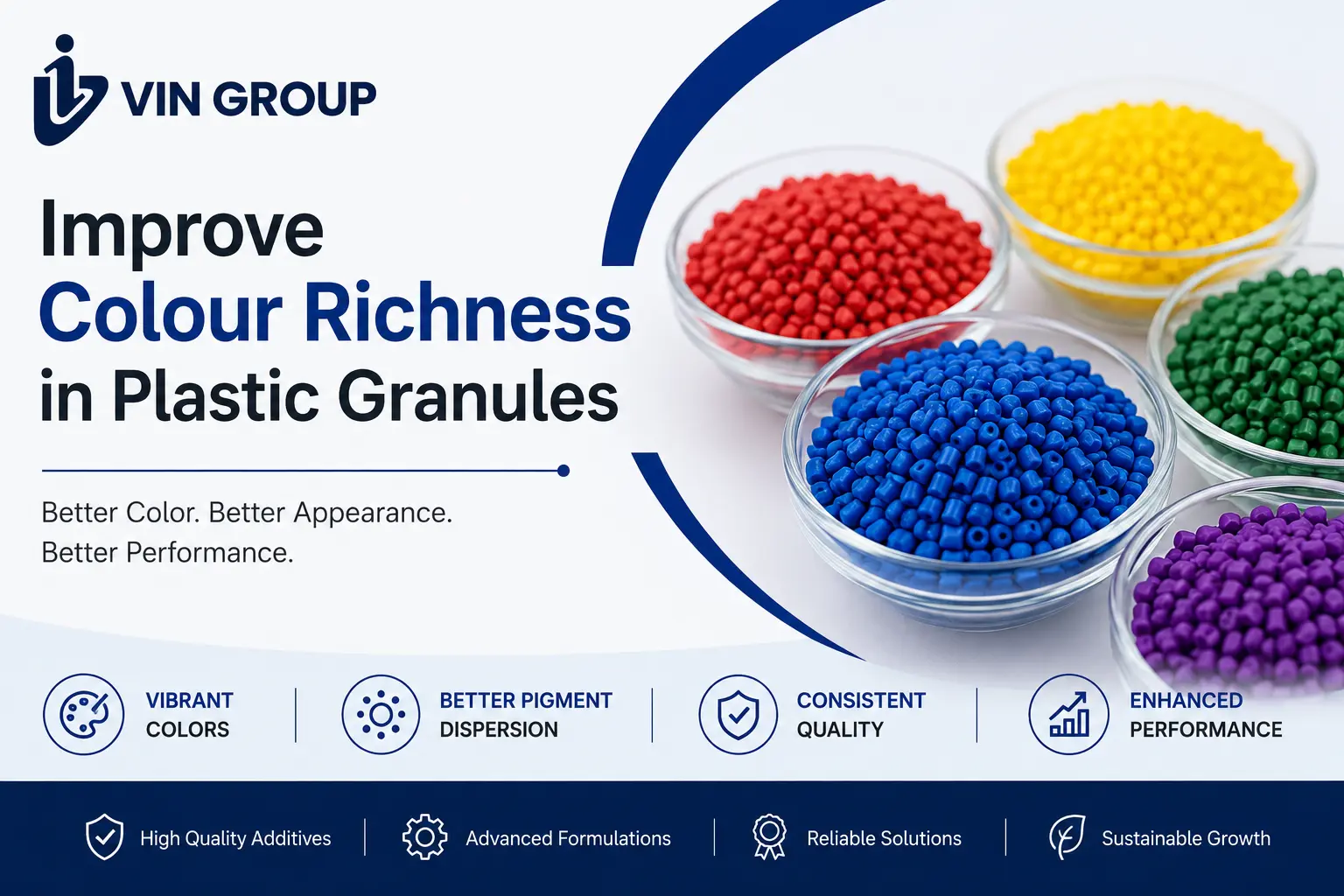
Guide to Overcoming Color Challenges in Plastic: How to Improve Colour Richness in Plastic Granules
Color consistency is one of the most important quality factors in plastic manufacturing. Whether plastic granules are used for packaging, automotive components, household products, industrial applications, or consumer goods, rich and vibrant color significantly improves product appeal and market value.
However, manufacturers often face challenges such as dull shades, faded tones, uneven pigmentation, inconsistent dispersion, and poor compatibility between pigments and polymers. These problems directly affect product appearance and customer satisfaction.
This is why industries continuously seek ways to improve colour richness in plastic granules through better pigment selection, optimized processing methods, and improved resin compatibility.
At Vin Group, quality-focused plastic manufacturing emphasizes consistency, vibrant coloration, and optimized formulation techniques to deliver superior product performance.
Guide to Overcoming Color Challenges in Plastic
Achieving rich and vibrant colors in plastic granules requires balancing pigment quality, processing temperature, carrier resin compatibility, and dispersion methods.
To successfully improve colour richness in plastic granules, manufacturers must focus on:
- Pigment particle size
- Resin compatibility
- Processing stability
- Dispersion quality
- Moisture management
- Color concentrate performance
Poorly controlled processing often results in faded or inconsistent plastic products, increasing rejection rates and production costs.
Below are some practical methods manufacturers use to achieve stronger and longer-lasting color performance.
Why Is Color Richness Important in Plastic Granules?
Color quality directly affects how consumers perceive plastic products.
Rich colors improve:
Product Appearance
Bright and uniform colors create premium-looking products.
Brand Consistency
Manufacturers rely on stable shades for consistent product identity.
Product Value
Strong color richness often increases visual appeal and market competitiveness.
Production Reliability
Stable pigmentation reduces quality issues during molding and extrusion.
When manufacturers improve colour richness in plastic granules, they also improve overall product consistency.
How to Colour Plastic Granules Effectively
One of the most common manufacturing questions is: how to colour plastic granules properly for long-lasting and vibrant results?
Plastic coloring generally involves adding pigments, dyes, or color concentrates during material preparation.
Common coloring methods include:
Masterbatch Coloring
Pigments are pre-dispersed into carrier resin and blended into raw plastic material.
Pre-Colored Resin
Plastic manufacturers use ready-colored polymers for consistent shades.
Dry Pigment Mixing
Powder pigments are mixed directly with polymer granules.
Liquid Coloring
Special liquid pigments are added during processing.
Among these options, plastic coloring granules using masterbatch systems often deliver better consistency and color control.
Can Pigment Particle Size Impact Color Intensity?
Yes, particle size strongly affects color richness.
Smaller pigment particles generally provide:
- Better dispersion
- Stronger color intensity
- Improved gloss
- More uniform appearance
Larger particles may create uneven shading or dull-looking products.
Manufacturers trying to improve colour richness in plastic granules often optimize pigment size to achieve deeper and more vibrant colors.
Better particle distribution also supports long-term color consistency.
How Do I Achieve Deep, Vibrant Colors in Recycled Plastics?
Manufacturers can improve recycled plastic color performance through:
Using High-Quality Color Concentrates
Premium masterbatches help mask inconsistencies in recycled materials.
Improving Pigment Loading
Balanced pigment concentration improves visual depth.
Better Material Sorting
Cleaner recycled material improves color consistency.
Compatible Carrier Resin Selection
Matching resins improve pigment stability.
These strategies significantly help manufacturers improve colour richness in plastic granules even in recycled polymer systems.
Why Do My Colored Plastics Look Dull or Faded After Processing?
This issue generally occurs because of:
Excessive Processing Heat
High temperatures may degrade pigments.
Poor Dispersion
Uneven mixing weakens color consistency.
Resin Incompatibility
Mismatched materials affect color stability.
Moisture Contamination
Water vapor may impact surface quality and pigment performance.
Manufacturers focusing on improvement colour performance should monitor temperature stability carefully.
Controlled processing conditions help preserve brightness and reduce fading.
How Does Carrier Resin Compatibility Affect Color Richness?
Carrier resins hold pigments and help distribute them evenly throughout the polymer system.
Poor compatibility may result in:
- Weak pigment distribution
- Color streaking
- Dull appearance
- Surface defects
Compatible carrier systems improve:
Dispersion Quality
Pigments spread more uniformly.
Stronger Color Intensity
Better bonding improves richness.
Improved Surface Appearance
Consistent resin flow creates smoother finishes.
Manufacturers seeking to improve colour richness in plastic granules should carefully evaluate resin compatibility before production.
Common Causes of Poor Color Richness in Plastic Granules
Several production issues can negatively affect plastic color quality.
Uneven Pigment Mixing
Poor mixing often causes inconsistent shades.
Excessive Heat Exposure
Thermal degradation reduces pigment strength.
Low-Quality Color Concentrates
Inferior additives may weaken vibrancy.
Moisture Problems
Moisture contamination affects surface quality.
Incorrect Pigment Dosage
Improper loading reduces color depth.
Understanding these challenges helps manufacturers improve production efficiency while supporting better improvement colour strategies.
Benefits of High-Quality Plastic Coloring Granules
Using premium plastic coloring granules offers several manufacturing advantages.
Better Color Consistency
Ensures uniform appearance across products.
Reduced Production Defects
Improves process stability.
Enhanced Product Aesthetics
Creates richer and more appealing colors.
Improved Durability
Better pigments resist fading and wear.
This is especially important in industries requiring premium visual performance.
Best Practices to Improve Colour Richness in Plastic Granules
Manufacturers aiming to consistently improve colour richness in plastic granules should follow these best practices:
- Select high-quality pigments and concentrates
- Maintain proper processing temperature
- Optimize pigment particle size
- Improve dispersion during mixing
- Use compatible carrier resins
- Control moisture contamination
- Monitor pigment loading levels carefully
These improvements help create brighter, richer, and longer-lasting plastic products.
Role of Processing Conditions in Color Quality
Processing consistency strongly affects plastic appearance.
Manufacturers should carefully manage:
Temperature Control
Balanced heat protects pigment integrity.
Mixing Quality
Uniform blending improves consistency.
Cooling Systems
Proper cooling preserves surface finish.
Material Handling
Clean storage reduces contamination risks.
Small processing improvements often result in major gains in color quality and production efficiency.
Final Thoughts
Producing plastic granules with rich, vibrant, and consistent color requires more than simply adding pigments. It depends on the right combination of high-quality color concentrates, effective dispersion, compatible carrier resins, controlled processing conditions, and precise formulation. By optimizing these factors, manufacturers can minimize color inconsistencies, improve product aesthetics, reduce production defects, and enhance the overall value of their plastic products.
At Vin Group, we help manufacturers overcome color-related challenges through advanced compounding expertise, optimized processing techniques, and high-performance additive solutions. Our focus on precision, consistency, and innovation enables businesses to achieve superior color richness, excellent dispersion, and reliable product quality, delivering plastic granules that meet the highest standards for appearance, performance, and long-term durability.