
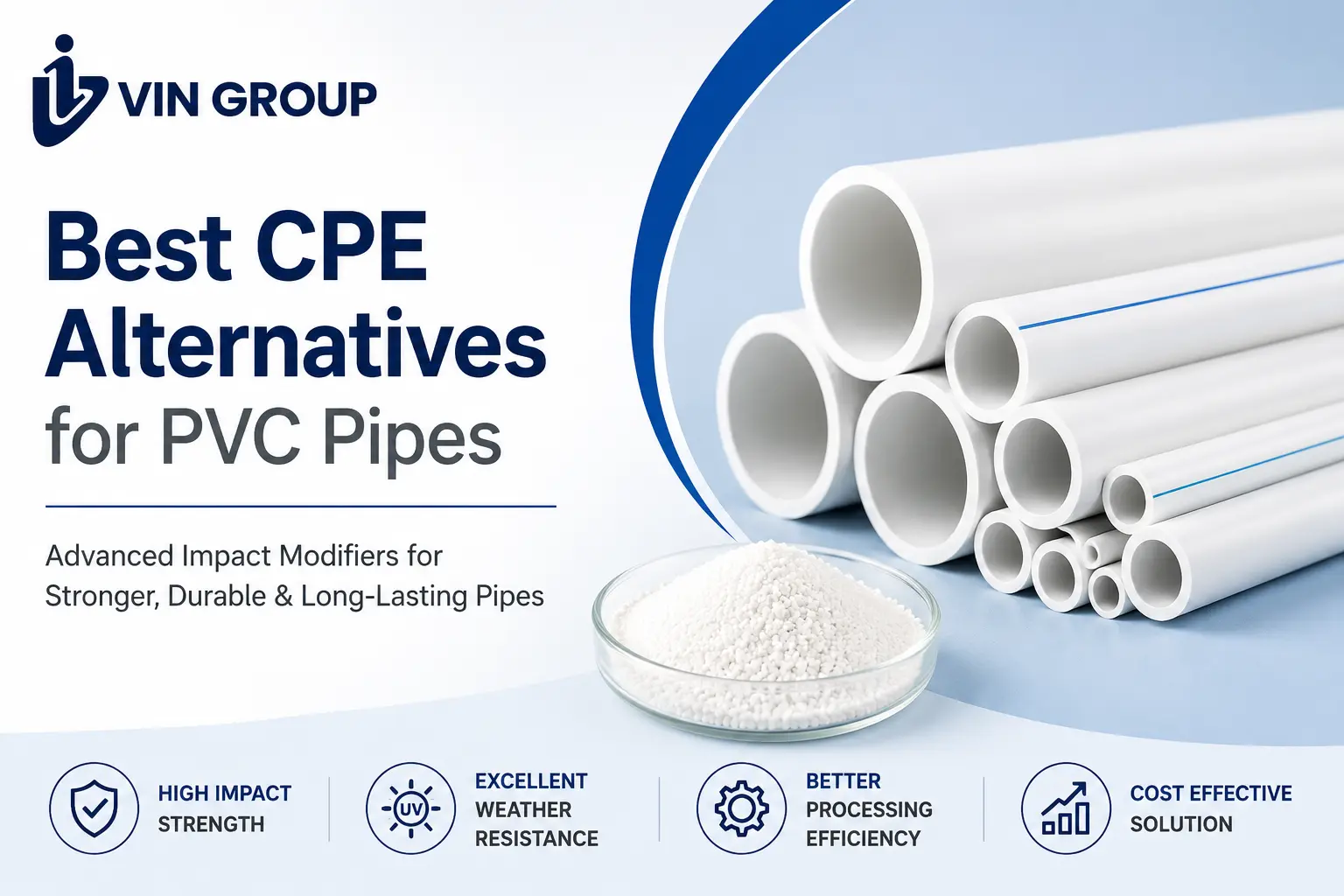
Best CPE Alternatives for PVC Pipes Without Sacrificing Performance
PVC pipes have become one of the most widely used piping solutions across plumbing, irrigation, construction, industrial processing, and municipal infrastructure. Their lightweight nature, corrosion resistance, affordability, and ease of installation make them an excellent choice for numerous applications. However, the performance of PVC pipes depends on much more than the base resin itself. Manufacturers rely on impact modifiers such as Chlorinated Polyethylene (CPE) to improve toughness, impact resistance, and long-term durability.
Today, manufacturers are increasingly exploring a CPE alternative for PVC pipes that delivers comparable or even better mechanical properties while reducing processing challenges, improving weatherability, or lowering formulation costs. Modern acrylic impact modifiers, MBS modifiers, ABS-based modifiers, and advanced polymer technologies are helping manufacturers achieve these goals without compromising product quality.
This guide explains the best alternatives to CPE, compares common pipe materials, discusses selection criteria, and helps manufacturers understand when switching from conventional CPE becomes beneficial.
Why CPE Is Used in PVC Pipes
Before discussing alternatives, it is important to understand why CPE has been widely adopted.
Chlorinated Polyethylene functions primarily as an impact modifier. It improves:
- Low-temperature impact strength
- Pipe toughness
- Crack resistance
- Weather resistance
- Processing stability
- Mechanical durability
These characteristics make CPE especially valuable in pressure pipes, agricultural pipes, conduit pipes, and outdoor applications exposed to varying weather conditions.
However, modern processing requirements often demand additives that provide similar or superior performance with improved gloss, easier processing, higher productivity, and better long-term stability. This is where selecting the right CPE alternative for PVC pipes becomes important.
Why Manufacturers Look for a CPE Alternative for PVC Pipes
Manufacturers evaluate alternatives for several reasons:
Better Processing Efficiency
Certain modern acrylic modifiers disperse more uniformly inside PVC compounds, reducing processing variations and improving consistency during extrusion.
Improved Weather Resistance
Outdoor pipes require excellent UV stability and long-term durability. Some advanced modifiers outperform conventional CPE under prolonged environmental exposure.
Higher Surface Finish
Premium pressure pipes often demand smoother surfaces with better gloss and appearance.
Better Mechanical Balance
Instead of maximizing only impact resistance, manufacturers seek balanced performance including:
- Tensile strength
- Flexural strength
- Dimensional stability
- Heat resistance
- Long service life
Optimized Production Costs
Although raw material prices vary, improving production efficiency and reducing scrap often lowers overall manufacturing costs.
Best CPE Alternatives for PVC Pipes
Several technologies now compete with traditional CPE depending on application requirements.
1. Acrylic Impact Modifiers (AIM)
Acrylic impact modifiers are considered one of the strongest replacements for CPE.
Advantages include:
- Excellent weather resistance
- Outstanding UV stability
- High impact strength
- Better gloss
- Consistent processing
- Superior outdoor performance
These modifiers are commonly used in:
- Pressure pipes
- Window profiles
- Exterior building products
- Premium PVC applications
Because they maintain excellent long-term performance, acrylic modifiers are frequently selected as a high-performance CPE alternative for PVC pipes.
2. MBS Impact Modifiers
MBS (Methacrylate-Butadiene-Styrene) modifiers are widely used where transparency is required.
Key benefits include:
- High impact resistance
- Excellent clarity
- Smooth processing
- Improved toughness
However, MBS generally offers lower weather resistance than acrylic modifiers, making it better suited for indoor products than outdoor pipe systems.
3. Advanced Polymer Impact Modifiers
New-generation polymer modifiers combine multiple performance benefits:
- Excellent dispersion
- Better fusion
- Improved processing window
- Lower formulation variation
- Enhanced impact strength
Many manufacturers are evaluating these systems when designing next-generation PVC formulations.
What Should You Consider Before Replacing CPE?
Every formulation behaves differently.
Instead of replacing CPE purely based on cost, manufacturers evaluate several performance factors.
Pipe Application
Different pipes require different formulations.
Examples include:
- Drinking water
- Sewerage
- Agriculture
- Electrical conduit
- Industrial chemicals
- Pressure pipelines
Each application places different demands on the modifier.
Processing Equipment
Extrusion conditions influence additive selection.
Machine design, screw configuration, temperature profile, and throughput all affect how an impact modifier performs during production.
Required Mechanical Properties
Manufacturers usually compare:
- Impact strength
- Tensile strength
- Elongation
- Flexural modulus
- Vicat softening temperature
- Long-term hydrostatic strength
Only after evaluating these properties should a new modifier replace conventional CPE.
Comparing Common PVC Pipe Materials
Many buyers search online for the PVC UPVC & CPVC difference before choosing pipe materials.
Although these materials belong to the PVC family, their applications differ considerably.
PVC
Standard PVC is economical and widely used for drainage, electrical conduits, and irrigation where moderate temperature performance is acceptable.
uPVC
uPVC contains no plasticizers, making it stronger and more rigid than standard PVC.
Applications include:
- Drinking water
- Pressure pipelines
- Plumbing
- Agriculture
Lead-free uPVC systems are widely used for potable water because of their strength, corrosion resistance, and suitability for cold-water distribution.
CPVC
CPVC undergoes additional chlorination, allowing it to handle significantly higher temperatures than PVC. Many CPVC systems are rated for hot-water service up to about 93°C, making them suitable for residential and commercial plumbing.
Understanding the PVC UPVC & CPVC difference helps manufacturers choose both the correct base resin and the appropriate impact modifier.
What Is the Use of CPE in PVC Pipe?
CPE plays a vital role in improving the mechanical performance of rigid PVC compounds.
Its primary functions include:
- Increasing impact strength
- Improving crack resistance
- Enhancing durability
- Maintaining flexibility under stress
- Improving low-temperature performance
- Increasing weather resistance
Without an effective impact modifier, rigid PVC pipes become more susceptible to brittle failure, particularly in colder climates or under mechanical loading.
However, many manufacturers now evaluate acrylic impact modifiers and advanced polymer technologies as a CPE alternative for PVC pipes because they can provide improved processing consistency, enhanced weatherability, and excellent long-term performance.
Choosing the Right CPE Alternative for PVC Pipes
When selecting a CPE alternative for PVC pipes, manufacturers should evaluate:
- Required impact strength
- Processing performance
- Outdoor weather resistance
- UV stability
- Long-term durability
- Production efficiency
- Formulation compatibility
- Cost-performance balance
Acrylic impact modifiers are often chosen for premium outdoor applications due to their excellent weatherability, while advanced polymer modifiers can offer improved processing and balanced mechanical properties. The ideal choice depends on the specific pipe formulation, end-use environment, and performance objectives.
Conclusion
Choosing the right CPE alternative for PVC pipes is about achieving the ideal balance between durability, processability, cost, and long-term performance. Whether you are manufacturing pressure pipes, plumbing systems, agricultural pipes, or industrial products, the correct impact modifier can significantly improve product quality while enhancing production efficiency.
At Vin Group, we specialize in high-performance polymer additives and plastic processing solutions designed to help manufacturers produce reliable, durable, and cost-effective PVC products. Our team works closely with customers to recommend suitable additive solutions that improve impact resistance, processing stability, weatherability, and overall product performance. With a focus on quality, technical expertise, and customer support, Vin Group helps businesses develop formulations that meet evolving industry requirements and deliver consistent manufacturing results.
Frequently Asked Questions
1. What is the best CPE alternative for PVC pipes?
Acrylic impact modifiers are among the most widely recommended CPE alternative for PVC pipes because they provide excellent weather resistance, impact strength, and processing stability.
2. What is the use of CPE in PVC pipe?
CPE improves impact resistance, toughness, crack resistance, low-temperature performance, and overall durability of rigid PVC pipes.
3. What is the difference between PVC, uPVC and CPVC?
The PVC UPVC & CPVC difference lies mainly in composition and temperature capability. PVC is suitable for general applications, uPVC is rigid and commonly used for potable water systems, while CPVC offers higher heat resistance for hot-water plumbing.
4. PVC vs UPVC vs CPVC which is better?
The answer depends on the application. PVC is suitable for drainage, uPVC is ideal for cold-water pressure systems, and CPVC is preferred for hot-water applications.
5. UPVC or CPVC which is better for drinking water?
Both are suitable. uPVC is generally preferred for cold-water distribution, while CPVC is better where hot water is involved.
6. Does replacing CPE affect pipe performance?
Yes. A properly selected CPE alternative for PVC pipes can maintain or even improve impact resistance, weatherability, processing consistency, and long-term durability when matched to the application.
7. Why is mould formulation important when selecting additives?
The formulation determines how well additives interact with the PVC resin, influencing processing behavior, mechanical properties, surface quality, and product lifespan.
8. How can Vin Group help PVC pipe manufacturers?
Vin Group provides high-quality polymer additives and technical support to help manufacturers optimize formulations, improve processing efficiency, enhance pipe performance, and produce durable PVC products tailored to diverse industrial applications.