
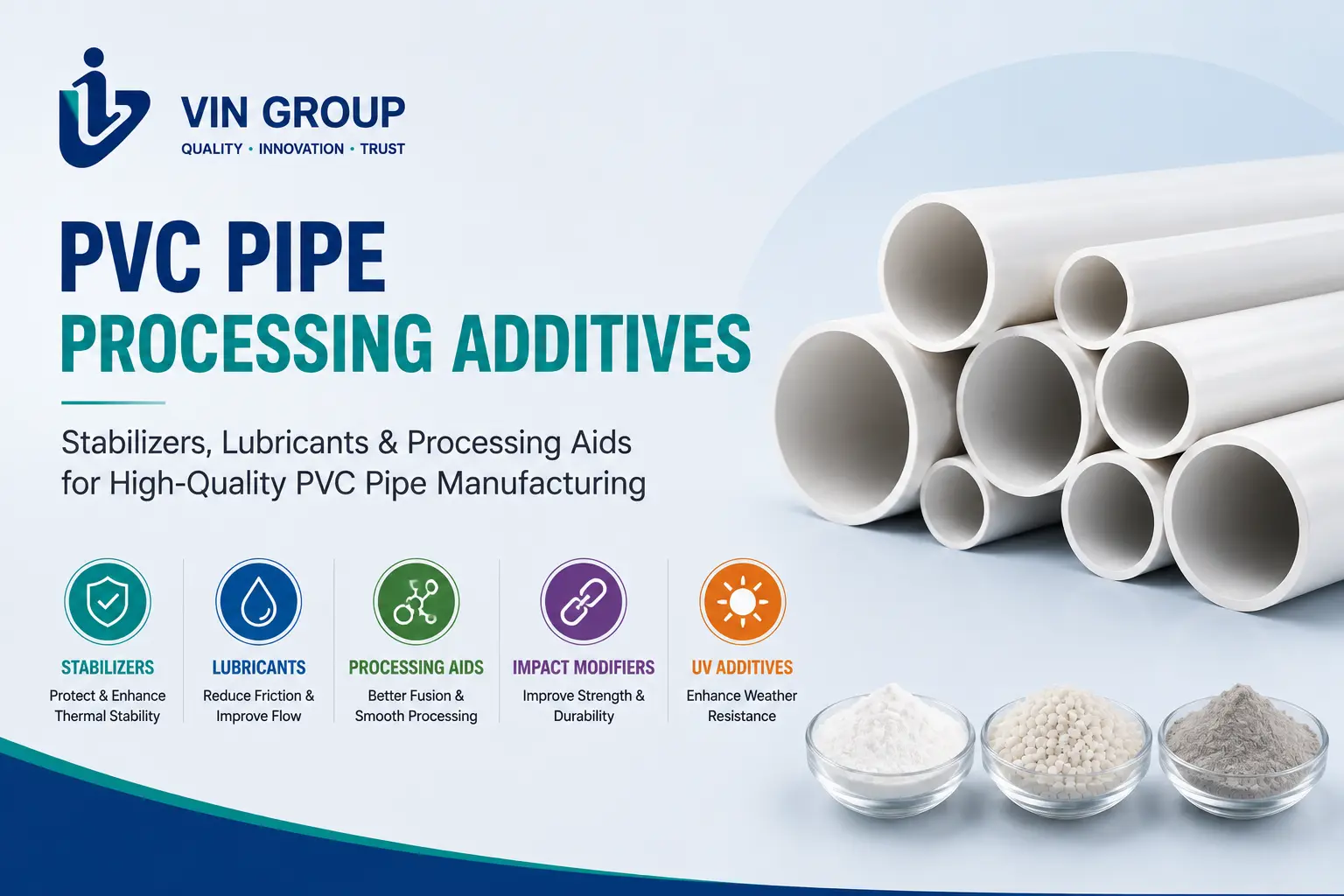
Which Stabilizers, Lubricants & Processing Aids Work Best for PVC Pipe Manufacturing?
PVC pipes have become the preferred choice for water supply, drainage, irrigation, electrical conduits, and industrial piping because of their durability, corrosion resistance, and cost-effectiveness. While PVC resin is the primary ingredient, the performance of the finished pipe largely depends on selecting the right PVC Pipe Processing Additives. These additives improve processing efficiency, enhance mechanical properties, increase thermal stability, and ensure the final product meets industry quality standards.
From stabilizers that protect PVC during high-temperature processing to lubricants that improve melt flow and processing aids that enhance fusion, every additive has a specific role in the manufacturing process. Choosing the correct formulation not only improves production efficiency but also extends the service life of PVC pipes.
This guide explains the different stabilizers, lubricants, and processing aids used in PVC pipe manufacturing, their functions, and how manufacturers can select the right additive package for consistent, high-quality production.
Why Are PVC Pipe Processing Additives Important?
PVC is a thermoplastic material that requires several additives before it can be converted into durable pipes. During processing, PVC resin is exposed to high temperatures and mechanical stress, making it susceptible to degradation if processed without suitable additives.
The right PVC Pipe Processing Additives help manufacturers:
- Improve thermal stability during extrusion
- Enhance melt strength and fusion
- Reduce friction during processing
- Improve impact strength
- Increase weather resistance
- Ensure smooth surface finish
- Improve dimensional stability
- Extend product lifespan
A well-balanced additive package also helps reduce production defects, lower machine wear, and improve manufacturing efficiency.
What Is the Raw Material of PVC?
Many manufacturers ask, what is the raw material of PVC before understanding the role of additives.
Polyvinyl Chloride (PVC) resin is produced through the polymerization of vinyl chloride monomer (VCM). However, PVC resin alone is not suitable for manufacturing pipes because it has limited thermal stability and processing characteristics.
To produce high-performance PVC pipes, manufacturers combine PVC resin with carefully selected additives, including stabilizers, lubricants, processing aids, fillers, pigments, and impact modifiers. The final formulation depends on the pipe’s intended application, performance requirements, and processing conditions.
How Is PVC Pipe Manufactured?
Understanding how is PVC pipe manufactured helps explain why additives are essential throughout production.
The typical PVC pipe production process includes the following steps:
- Mixing PVC resin with additives.
- Dry blending until a homogeneous compound is achieved.
- Feeding the compound into an extruder.
- Heating and melting the material.
- Extruding the molten PVC through a pipe die.
- Vacuum sizing to achieve precise dimensions.
- Water cooling.
- Haul-off and cutting.
- Inspection and quality testing.
At every stage of the PVC pipe production process, additives improve material flow, thermal stability, fusion, and dimensional accuracy.
Types of PVC Pipe Processing Additives
1. PVC Stabilizers
Stabilizers are among the most important PVC Pipe Processing Additives because PVC begins degrading when exposed to high processing temperatures.
Their primary functions include:
- Preventing thermal degradation
- Maintaining polymer strength
- Improving colour stability
- Increasing product life
- Enhancing weather resistance
Modern pipe manufacturers commonly use calcium-zinc stabilizers and organotin stabilizers depending on the application and regulatory requirements.
2. Processing Aids
Processing aids improve fusion between PVC particles and help produce smooth, defect-free pipes.
Some common PVC processing aid uses include:
- Faster fusion
- Better melt strength
- Improved surface finish
- Higher extrusion output
- Reduced die lines
- Better dimensional consistency
Choosing the correct PVC processing aid type depends on extrusion speed, pipe size, formulation, and desired mechanical properties.
3. Lubricants
Lubricants reduce friction during extrusion and help the molten PVC move efficiently through the processing equipment.
They are generally divided into:
Internal lubricants
These reduce friction between PVC molecules and improve melt flow.
External lubricants
These reduce friction between the molten compound and machine surfaces, helping prevent sticking inside the extruder and die.
A balanced lubricant system is essential because excessive lubrication may reduce fusion, while insufficient lubrication can increase machine wear and processing defects.
4. Impact Modifiers
PVC pipes used in demanding environments require higher impact resistance.
Impact modifiers improve:
- Toughness
- Crack resistance
- Low-temperature performance
- Pipe durability
They are particularly important for pressure pipes, underground piping systems, and applications exposed to mechanical stress.
5. Fillers
Fillers improve stiffness, dimensional stability, and cost efficiency.
Common fillers include calcium carbonate, which enhances rigidity while maintaining good processing characteristics when used in appropriate proportions.
6. Pigments and UV Additives
PVC pipes used outdoors require protection against sunlight and weathering.
Pigments provide consistent colour, while UV stabilizers help prevent fading, brittleness, and surface degradation caused by prolonged ultraviolet exposure.
Together, these additives improve both the appearance and long-term durability of PVC piping systems.
How to Select the Right PVC Pipe Processing Additives
Choosing the right PVC Pipe Processing Additives requires balancing product performance, processing efficiency, and long-term durability. Rather than relying on a standard formulation, manufacturers should evaluate several factors before finalising an additive package.
Consider the Pipe Application
Different pipe applications require different formulations. Pressure pipes, plumbing systems, electrical conduits, irrigation pipes, and drainage pipes all operate under different conditions. The additive package should match the required strength, thermal stability, weather resistance, and service life.
Evaluate Processing Conditions
Extrusion temperature, screw design, production speed, cooling system, and equipment configuration all influence additive performance. Selecting additives that are compatible with existing processing conditions helps improve productivity and reduce manufacturing defects.
Focus on Regulatory Compliance
For potable water, food-contact, or industrial applications, additives should comply with relevant national and international standards. Using certified raw materials helps manufacturers meet quality and safety requirements.
Balance Cost and Performance
Higher additive loading does not always improve product quality. The objective is to develop a formulation that delivers consistent performance while maintaining cost-effective production. Optimising stabilizers, lubricants, and processing aids together often provides better results than increasing the dosage of a single additive.
Benefits of Using the Right PVC Pipe Processing Additives
A properly formulated additive package provides advantages throughout the manufacturing process as well as during the product’s service life.
Some of the key benefits include:
- Improved thermal stability during extrusion
- Better fusion of PVC resin
- Higher production efficiency
- Reduced machine wear
- Improved dimensional accuracy
- Enhanced impact resistance
- Better weather and UV resistance
- Smooth surface finish
- Longer service life
- Consistent product quality
These benefits help manufacturers reduce rejection rates, improve operational efficiency, and produce reliable PVC pipes that meet customer expectations.
What Additives Are Used in PVC?
PVC compounds contain a combination of additives that enhance both processing and product performance.
Common PVC pipe additives include:
- Heat stabilizers
- Processing aids
- Internal lubricants
- External lubricants
- Impact modifiers
- Fillers
- Pigments
- UV stabilizers
- Antioxidants
The exact combination depends on the pipe’s application, extrusion process, and required performance characteristics.
What Chemicals Are Used in PVC Pipe?
Many people ask, What chemicals are used in PVC pipe?
A typical PVC pipe formulation consists of PVC resin along with carefully selected additives used to improve processing and long-term performance. These commonly include calcium-zinc or organotin stabilizers, acrylic processing aids, wax-based lubricants, calcium carbonate fillers, titanium dioxide for colour stability, impact modifiers, pigments, and UV stabilizers where outdoor exposure is expected.
The specific formulation varies according to pipe type, manufacturing process, and industry standards.
What Additive Is Used to Make PVC Flexible?
Standard PVC pipes are manufactured using rigid PVC (uPVC), which does not require plasticizers. However, when flexibility is needed for products such as hoses, cables, or flexible tubing, manufacturers add plasticizers.
Plasticizers increase flexibility by reducing the intermolecular forces within the PVC structure, making the material softer and easier to bend. Since rigid PVC pipes require high strength and dimensional stability, plasticizers are generally not used in conventional pressure or plumbing pipe manufacturing.
Conclusion
Selecting the right PVC Pipe Processing Additives is essential for manufacturing durable, high-performance PVC pipes with consistent quality. Stabilizers protect PVC during processing, lubricants improve material flow, and processing aids enhance fusion and extrusion efficiency. Together with impact modifiers, fillers, pigments, and UV stabilizers, these additives ensure that PVC pipes deliver excellent mechanical strength, dimensional stability, and long-term reliability.
Choosing the appropriate additive formulation requires careful consideration of the application, processing conditions, regulatory requirements, and performance expectations. By using high-quality additive systems and optimised formulations, manufacturers can improve production efficiency, reduce defects, and produce PVC pipes that meet demanding industry standards.
At Vin Group, we specialise in delivering advanced additive solutions that help PVC pipe manufacturers achieve reliable processing, consistent product quality, and improved operational efficiency. Our portfolio includes stabilizers, lubricants, processing aids, and customised formulations designed to meet diverse manufacturing requirements. Backed by technical expertise and a commitment to quality, Vin Group works closely with customers to optimise formulations, improve productivity, and support the production of high-performance PVC piping solutions.
FAQs
1. What are PVC Pipe Processing Additives?
PVC Pipe Processing Additives are materials added to PVC resin to improve processing, thermal stability, lubrication, fusion, durability, and the overall performance of PVC pipes.
2. What is the raw material of PVC?
If you’re wondering what is the raw material of PVC, it is primarily Polyvinyl Chloride resin produced from vinyl chloride monomer (VCM). The resin is then blended with additives before pipe manufacturing.
3. How is PVC pipe manufactured?
To understand how is PVC pipe manufactured, PVC resin is mixed with additives, extruded through a pipe die, vacuum sized, cooled, cut, and tested before dispatch.
4. What are the most common additives used in PVC pipe manufacturing?
The most common additives used in PVC pipe manufacturing include heat stabilizers, lubricants, processing aids, impact modifiers, fillers, pigments, and UV stabilizers.
5. What are the main PVC processing aid uses?
Common PVC processing aid uses include improving fusion, increasing melt strength, enhancing surface finish, reducing extrusion defects, and improving production efficiency.
6. Which PVC processing aid type is best for pipe extrusion?
The best PVC processing aid type depends on the formulation, extrusion speed, and pipe application. Acrylic processing aids are among the most widely used for rigid PVC pipe manufacturing.
7. Why are lubricants important in PVC pipe production?
Lubricants reduce friction during extrusion, improve material flow, prevent sticking inside the machinery, and help achieve smoother pipe surfaces with consistent dimensions.
8. How do PVC pipe additives improve product quality?
Appropriate PVC pipe additives improve thermal stability, weather resistance, impact strength, dimensional accuracy, processing efficiency, and the overall service life of PVC pipes.