
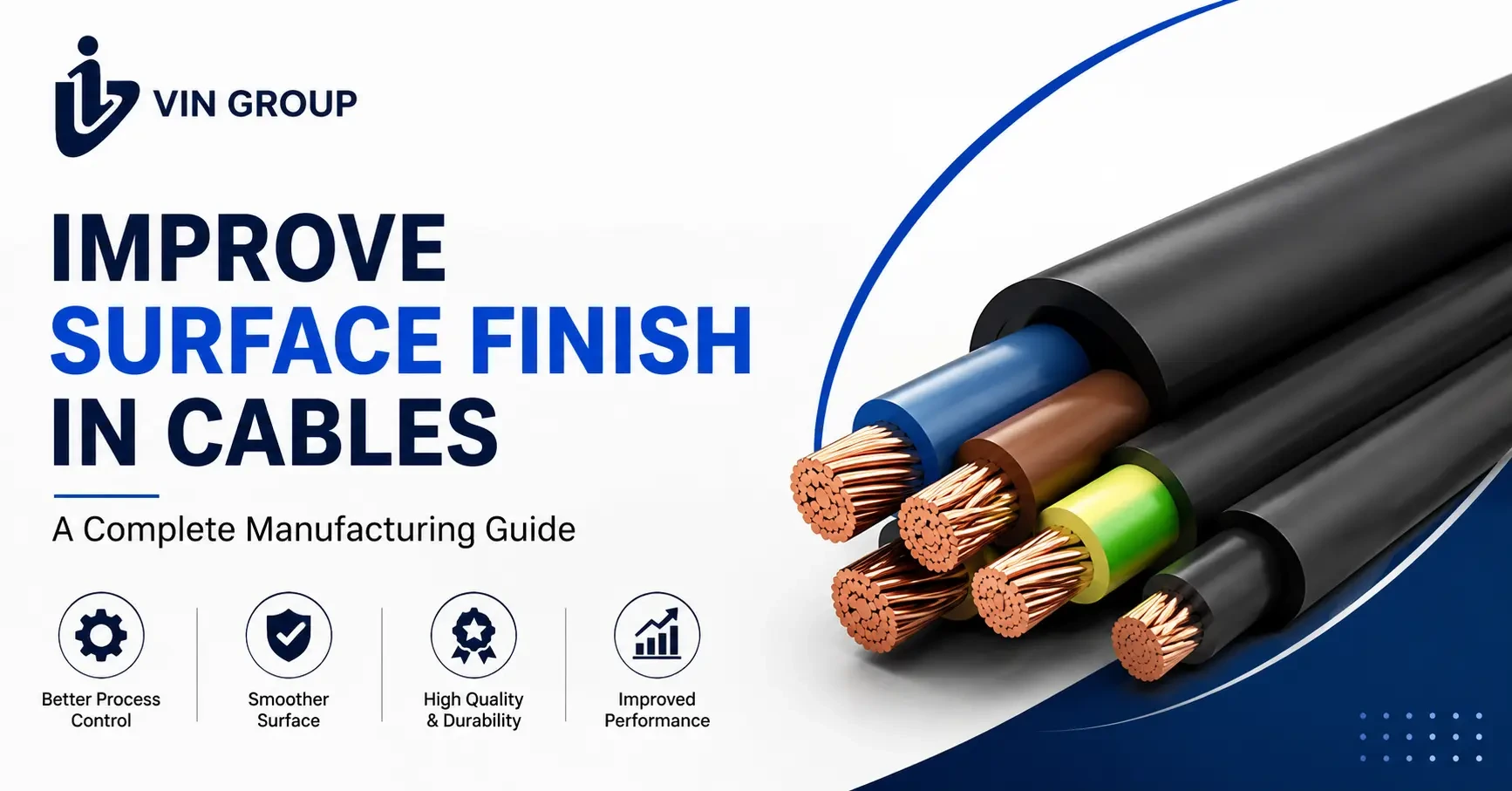
Improve Surface Finish in Cables: A Complete Manufacturing Guide
Introduction
In cable manufacturing, product appearance and quality play a critical role in performance, durability, and customer satisfaction. One of the most important factors that manufacturers focus on is surface finish. Poor surface quality in cables may lead to rough textures, visible marks, uneven coating, reduced durability, and lower market acceptance.
Understanding how to improve surface finish in cables is essential for manufacturers aiming to maintain product consistency and high-quality standards. Surface defects can result from poor material quality, improper extrusion settings, temperature imbalance, contamination, tooling issues, or cooling inconsistencies.
At Vin Group, maintaining quality-driven manufacturing practices means focusing on process optimization and defect prevention to ensure consistent cable performance. This guide explains practical strategies to improve cable surface quality while reducing manufacturing defects.
Why Surface Finish Matters in Cable Manufacturing
Surface finish directly affects cable appearance, durability, insulation quality, and operational performance.
Poor cable surface finish may result in:
- Rough outer surfaces
- Inconsistent coating thickness
- Surface scratches or marks
- Poor insulation appearance
- Reduced flexibility
- Lower customer confidence
Manufacturers constantly explore surface finish methods to improve cable quality and reduce production defects.
Smooth cable surfaces not only improve aesthetics but also help improve resistance to environmental wear and handling damage.
Common Causes of Poor Surface Finish in Cables
Before learning how to improve cable quality, manufacturers must understand the root causes of defects.
Improper Extrusion Temperature
Excessively high or low temperatures affect polymer flow consistency.
Incorrect temperature settings may produce rough or uneven cable surfaces.
Poor Material Quality
Contaminated or low-quality raw materials can affect coating smoothness.
Inconsistent Cooling
Uneven cooling may create texture variations and surface marks.
Die and Tooling Problems
Damaged or poorly maintained dies negatively affect cable appearance.
Moisture Contamination
Moisture in polymers can cause bubbles, streaks, and rough finishes.
Understanding these challenges helps manufacturers implement better surface finish methods.
How Do You Improve Surface Finish?
A frequently asked question is: How do you improve surface finish?
Improving cable surface quality requires process optimization and material consistency.
Optimize Extrusion Temperature
Maintaining balanced extrusion temperatures improves polymer flow and coating consistency.
Stable processing conditions significantly improve surface finish.
Use High-Quality Raw Materials
Good-quality polymers reduce contamination and improve product appearance.
Improve Cooling Systems
Uniform cooling improves dimensional stability and surface smoothness.
Maintain Dies and Equipment
Regular maintenance prevents scratches and uneven extrusion.
Control Moisture Levels
Drying raw materials before processing reduces surface defects.
At Vin Group, maintaining production consistency through proper process monitoring helps manufacturers achieve better cable quality.
How to Improve Surface Finish in Machining Concepts Applied to Cable Manufacturing
Although cable manufacturing differs from machining, several quality principles overlap.
Manufacturers researching how to improve surface finish in machining often focus on consistency, tool quality, temperature control, and process optimization.
In cable production, similar principles include:
- Stable processing temperatures
- Equipment maintenance
- Material consistency
- Surface defect prevention
- Controlled cooling
Applying these principles can help manufacturers reduce imperfections and improve cable quality.
Surface Finish Methods Used in Cable Manufacturing
Manufacturers use multiple surface finish methods to improve cable appearance and functionality.
Extrusion Process Optimization
Balanced extrusion speed improves coating smoothness.
Material Filtration
Filtering materials removes impurities and improves surface consistency.
Precision Die Design
High-quality dies help maintain uniform cable coating.
Controlled Cooling Systems
Consistent cooling improves surface texture.
Regular Equipment Calibration
Machine calibration improves production stability.
These surface finish methods help manufacturers achieve smoother and defect-free cable surfaces.
What Does 0.8 Surface Finish Mean?
A common technical question is: What does 0.8 surface finish mean?
A 0.8 surface finish refers to surface roughness measurement, generally expressed in micrometers (µm).
A lower number indicates a smoother surface.
In manufacturing applications:
- 0.8 µm finish indicates relatively smooth surfaces.
- It is commonly used where precision and aesthetics matter.
In cable manufacturing, smoother surfaces often indicate better process control and higher-quality finishing.
What Does 3.2 Surface Finish Mean?
Another frequently searched question is: What does 3.2 surface finish mean?
A 3.2 surface finish represents a rougher texture compared to 0.8.
This finish level may be acceptable in industrial applications where ultra-smooth surfaces are not necessary.
However, in premium cable production, manufacturers often aim for smoother finishes to improve quality and market appeal.
Understanding finish measurements helps improve production standards.
What Is the Process of Improving the Surface?
Manufacturers often ask: What is the process of improving the surface?
The process generally includes:
Material Preparation
Clean, high-quality material improves consistency.
Temperature Optimization
Balanced heating improves coating smoothness.
Extrusion Control
Maintaining proper line speed improves surface finish.
Cooling Stabilization
Controlled cooling reduces defects.
Inspection and Quality Checks
Surface testing ensures consistency.
The process of improving cable surfaces requires continuous monitoring and quality optimization.
How to Get Better Surface Finish in Machining Lessons for Cable Manufacturing
Many industrial principles from how to get better surface finish in machining can apply to cable production.
Key lessons include:
Precision Control
Small parameter changes affect final quality.
Equipment Maintenance
Well-maintained tools improve surface consistency.
Stable Processing Conditions
Balanced temperature and pressure improve results.
Contamination Prevention
Clean production environments reduce defects.
These principles support better manufacturing outcomes across industries.
How to Get a Good Surface Finish on Lathe and Similar Process Control
Manufacturers searching how to get a good surface finish on lathe focus on feed rate, tool sharpness, and process stability.
Similarly, cable manufacturing requires:
- Controlled extrusion speed
- Proper die condition
- Stable temperatures
- Consistent cooling
Applying controlled manufacturing practices improves cable surface quality.
How to Improve Surface Finish in Turning and Cable Extrusion
The same precision principles behind how to improve surface finish in turning apply to cable manufacturing.
Factors affecting quality include:
Stable Process Parameters
Consistency reduces defects.
Material Compatibility
Correct material selection improves performance.
Tooling Maintenance
Proper equipment improves smoothness.
Process consistency remains one of the most important quality factors.
How to Improve Surface Finish in Grinding and Sand Casting Comparisons
Manufacturers often search for how to improve surface finish in grinding and how to improve surface finish of sand casting to understand defect reduction.
Although processes differ, common quality principles include:
- Better process control
- Reduced contamination
- Equipment maintenance
- Consistent operating conditions
These lessons can help manufacturers improve surface finish in cable production environments.
Best Practices to Improve Surface Finish in Cables
Manufacturers can improve cable quality by following these practices:
Use Moisture-Free Materials
Dry materials improve consistency.
Optimize Processing Speed
Avoid excessive extrusion speed.
Monitor Temperature Closely
Balanced temperatures improve smoothness.
Inspect Dies Regularly
Clean dies reduce scratches.
Maintain Production Equipment
Routine maintenance improves product quality.
At Vin Group, maintaining quality-focused production practices helps reduce defects and improve cable performance.
Conclusion
Achieving a high-quality surface finish in cables requires a combination of premium raw materials, precise process control, optimized extrusion parameters, effective cooling systems, and regular equipment maintenance. By identifying the root causes of surface defects and implementing preventive manufacturing practices, cable manufacturers can improve product appearance, insulation quality, durability, and overall production efficiency. Consistent quality control throughout the manufacturing process also helps reduce material waste, minimize product rejection, and ensure reliable long-term performance.
At Vin Group, we are committed to supporting cable manufacturers with advanced material solutions, process optimization, and quality-focused manufacturing practices. Our expertise helps deliver smooth, durable, and high-performance cable products that meet the evolving requirements of modern industries while maintaining consistent production standards.